
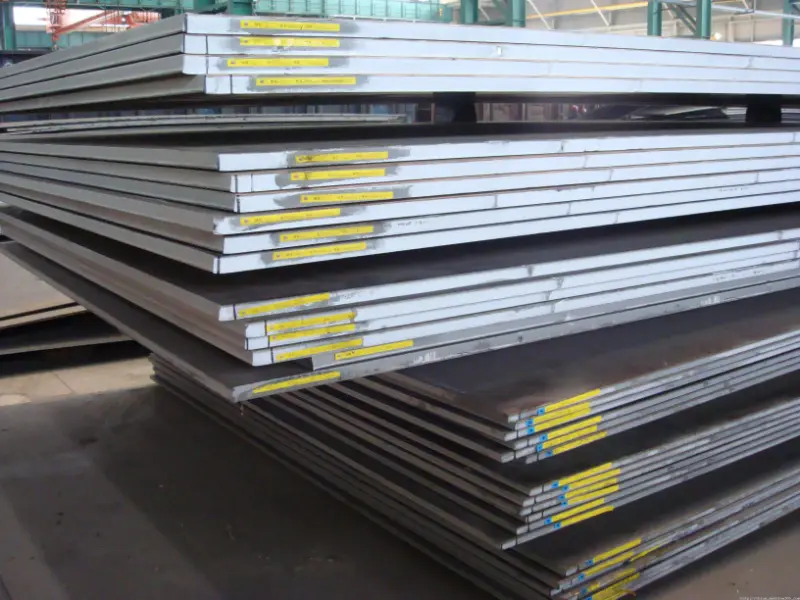
GL Grade A420 Shipbuilding Steel Plate
GL Grade A420 Shipbuilding Steel Plate - High Strength Structural Steel for Marine Applications
In-depth data sheet for GL Grade A420 shipbuilding steel plate: chemical composition, mechanical & physical properties, full international cross‑references, and application guidance.
Hot rolling, normalising, thermomechanical controlled processing (TMCP), possible quenched & tempered upon agreement
- Phone : +8618037372205
- Email : [email protected]
- WhatsApp: Contact via Whtsapp
- WeChat: +8618037372205
GL Grade A420 Shipbuilding Steel Plate Introduction
GL Grade A420 is a normalised or thermomechanically rolled high‑strength shipbuilding steel plate with a guaranteed minimum yield strength of 420 MPa. It is classified under the rules of Germanischer Lloyd (now part of DNV GL) for the construction of seagoing vessels and offshore structures. The steel offers an excellent combination of
- high strength for weight reduction
- good weldability
- reliable notch toughness at –20 °C
making it suitable for critical hull members such as deck plating, bottom shells, and longitudinal stiffeners. Grade A420 corresponds to the IACS DH420 category and is commonly supplied in thicknesses up to 100 mm in either normalised (N) or thermomechanical‑controlled‑processed (TMCP) condition. It meets all requirements for impact‑tested structural steel in marine environments.
GL Grade A420 Shipbuilding Steel Plate Chemical Composition – Second Pour Analysis
Typical ladle analysis limits for GL A420 in accordance with IACS UR W11 (Rev.12) and GL Rules. The steel is micro‑alloyed with niobium and vanadium to achieve the minimum 420 MPa yield strength while maintaining good weldability. Total aluminium is controlled for fine grain practice.
- Nb, V, Ti singly or in combination provide grain refinement and precipitation hardening.
- Residual elements are kept low to guarantee toughness at −20 °C.
| Element | Standard Value (max, unless range) | Remarks |
|---|---|---|
| Carbon (C) | ≤ 0.21 | Ladle analysis |
| Silicon (Si) | 0.10 – 0.50 | Typical range |
| Manganese (Mn) | 0.60 – 1.70 | Depending on thickness and deoxidation practice |
| Phosphorus (P) | ≤ 0.035 | |
| Sulphur (S) | ≤ 0.035 | Low S for improved toughness |
| Chromium (Cr) | ≤ 0.20 | Residual element |
| Nickel (Ni) | ≤ 0.40 | |
| Molybdenum (Mo) | ≤ 0.08 | |
| Copper (Cu) | ≤ 0.35 | |
| Aluminium (Als) | ≥ 0.015 | Total aluminium, for fine grain |
| Niobium (Nb) | 0.02 – 0.05 | Micro‑alloying – grain refiner |
| Vanadium (V) | 0.05 – 0.10 | Micro‑alloying – strengthening |
| Titanium (Ti) | ≤ 0.02 | Optional addition |
| Nitrogen (N) | ≤ 0.012 | Unless sufficient amount of nitride formers present |
GL Grade A420 Shipbuilding Steel Plate Physical Properties – Typical Reference Data
Typical physical properties for low‑alloy structural steel at room temperature (20 °C). These values are not part of the classification certificate but are useful for design and heat transfer calculations.
- Thermal conductivity and specific heat capacity are based on typical structural steel data and may vary slightly with exact composition and temperature.
| Property | Typical Value | Unit | Condition / Reference |
|---|---|---|---|
| Density (ρ) | 7.85 | g/cm³ | Ambient temperature |
| Modulus of Elasticity (E) | 210 | GPa | Room temperature |
| Shear Modulus (G) | 81 | GPa | Room temperature |
| Poisson's Ratio (ν) | 0.3 | – | Room temperature |
| Thermal Expansion Coeff. (α) | 12.0 × 10⁻⁶ | 1/K | Average 20–100 °C |
| Thermal Conductivity (λ) | 46 | W/(m·K) | At 20 °C |
| Specific Heat Capacity (cp) | 460 | J/(kg·K) | At 20 °C |
| Electrical Resistivity (ρe) | 0.15 × 10⁻⁶ | Ω·m | At 20 °C |
GL Grade A420 Shipbuilding Steel Plate Mechanical Properties – Typical Values
Minimum guaranteed values for plates up to 50 mm thickness. For thicknesses 50 mm to 70 mm, slight reductions in elongation are applied. All tests are carried out on normalised or TMCP material in transverse direction unless otherwise specified.
- Yield strength (ReH) is the upper yield or 0.2% proof strength.
- Charpy V‑notch impact test at –20 °C in longitudinal direction: average of three specimens ≥ 27 J, single min 20 J.
- Bend test: 180° bend over a mandrel of diameter 3 a (where a = specimen thickness).
| Property | Minimum / Typical Value | Unit | Test Conditions |
|---|---|---|---|
| Yield Strength (ReH) | ≥ 420 | MPa | t ≤ 50 mm, transverse |
| Tensile Strength (Rm) | 530 – 680 | MPa | t ≤ 50 mm |
| Elongation (A%) | ≥ 18 | % | Gauge length 5.65√So, t ≤ 50 mm |
| Charpy Impact Energy (KV) | ≥ 27 (average) / ≥ 20 (single) | J | Longitudinal, –20 °C |
| Bend Test | No cracks or defects | – | 180° bend, mandrel Ø = 3a |
GL Grade A420 Shipbuilding Steel Plate Fully Equivalent International Standards & Replaceable Grades
| Country / Region | Standard / Rules | Corresponding Grade | Remarks |
|---|---|---|---|
| International (IACS) | IACS UR W11 | DH420 | Exact chemical and mechanical match |
| USA | ABS Rules | ABS DH420 | Same –20 °C impact, 420 MPa YS |
| Norway / Global | DNV Rules | DNV DH420 | Fully compatible |
| United Kingdom | Lloyd's Register | LR DH420 | Identical requirements |
| France | Bureau Veritas | BV DH420 | Identical requirements |
| China | CCS Rules | CCS DH420 | Equivalent to GL A420 |
| Japan | ClassNK Rules | NK KE420 | KE designation for DH series |
| South Korea | KR Rules | KR DH420 | Equivalent to GL A420 |
| Italy | RINA Rules | RINA DH420 | Equivalent to GL A420 |
GL Grade A420 Shipbuilding Steel Plate Application Introduction
GL A420 is engineered for strength‑critical structural components in ships and offshore installations. Its reliable low‑temperature toughness and good weldability make it ideal for harsh marine environments. Typical fields and products include:
Product Applications: Hull shell plates (bottom, side, deck), Longitudinal stiffeners and frames, Transverse webs and girders, Bulkhead plates, Deck stringer plates, Offshore structural modules
Processed into products: Ship bottom shell plating, Main deck plating and strakes, Web frames and floor plates, Hatch coamings and sheer strakes, Bilge keels and bracket plates, Offshore platform braces and node connections
Application industries: Shipbuilding (tankers, bulk carriers, container vessels, navy ships), Offshore oil & gas (platforms, FPSO topsides, jackets), Marine engineering (docks, caissons, floating cranes)
GL Grade A420 Shipbuilding Steel Plate Similar / Alternative Materials – Close Performance Steels
| Country / Region | Standard / Rules | Grade | Remarks |
|---|---|---|---|
| International (IACS) | IACS UR W11 | AH420 | Same yield strength but higher impact temperature (0 °C) – less demanding |
| International (IACS) | IACS UR W11 | EH420 | Same yield strength with –40 °C impact – more demanding |
| International (IACS) | IACS UR W11 | FH420 | Same yield strength with –60 °C impact – extremely demanding |
| International (IACS) | IACS UR W11 | DH460 | Higher strength, –20 °C impact (min YS 460 MPa) |
| International (IACS) | IACS UR W11 | EH460 | Higher strength, –40 °C impact |
Notes:
- Weldability: low carbon equivalent (CE < 0.43 typically) allows cold cracking‑resistant joints with standard procedures; preheat may be required for thick sections.
- Post‑weld heat treatment may be applied if required by design codes.
- Ultrasonic testing according to GL rules is mandatory for thicknesses above 25 mm.
- Thickness range: normally 6 mm to 100 mm; wider availability from mills.
- Marking: each plate is stamped with grade, heat number, and classification society approval.
- Share



