
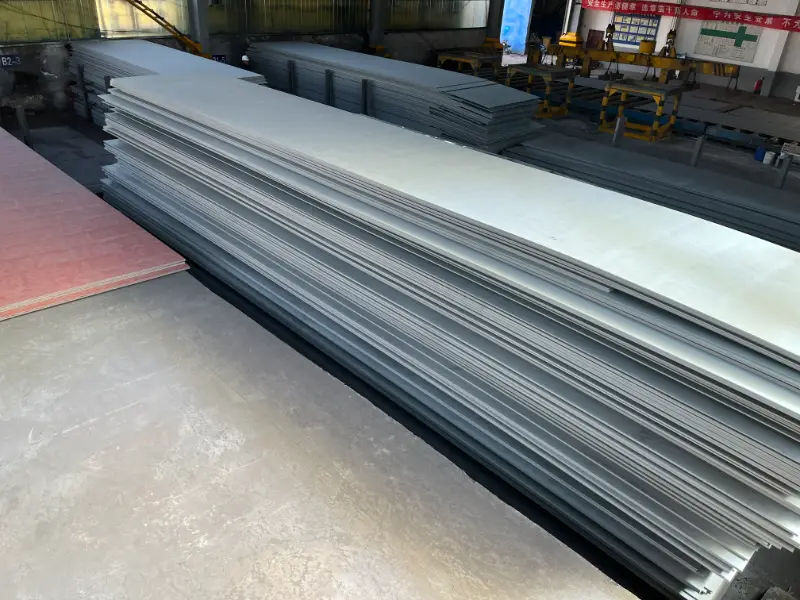
GL Grade F32 Shipbuilding Steel Plate
GL Grade F32 Shipbuilding Steel Plate - FH32 High-Strength Marine Steel
Complete technical profile of GL Grade F32 (FH32) shipbuilding steel plate under Germanischer Lloyd rules, including chemical composition, mechanical properties, thermal and electrical characteristics, international equivalents, and application guidance.
Hot rolling, normalizing, thermomechanical controlled rolling (TMCP), welding, cutting, forming
- Phone : +8618037372205
- Email : [email protected]
- WhatsApp: Contact via Whtsapp
- WeChat: +8618037372205
GL Grade F32 Shipbuilding Steel Plate Introduction
GL Grade F32 (FH32) is a high-strength hull structural steel plate classified under the rules of Germanischer Lloyd (now DNV GL). It belongs to the FH32 grade category, designed for critical low-temperature applications with excellent weldability and notch toughness. The minimum yield strength is 315 MPa, and it is typically supplied in normalized or thermomechanically rolled condition. FH32 steel is widely used in ship hulls, offshore platforms, and marine engineering structures where high strength and impact resistance at subzero temperatures are required. Its fine-grain microstructure and controlled rolling/processing ensure reliable performance in demanding marine environments. The steel complies with IACS UR W11 and is recognized by all major classification societies under equivalent designations.
GL Grade F32 Shipbuilding Steel Plate Chemical Composition
The chemical composition of FH32 shipbuilding steel is strictly controlled to ensure weldability and toughness. Carbon equivalent (CEV) is limited to 0.38% max. Grain-refining elements such as Al, Nb, V, and Ti may be added individually or in combination. The analysis below conforms to IACS UR W11 and GL rules for plates of thickness ≤50 mm; for thicker plates, slight adjustments apply but remain within the same upper limits.
| Element | Standard Value (max, unless range given) | Remarks |
|---|---|---|
| Carbon (C) | 0.18 % | Max. Not mandatory but typical; actual aim lower for TMCP |
| Manganese (Mn) | 0.90 - 1.60 % | Range depends on plate thickness and product analysis |
| Silicon (Si) | 0.50 % | Max. Usually 0.15 - 0.50 % |
| Phosphorus (P) | 0.025 % | Max. Strict limit for low-temperature toughness |
| Sulfur (S) | 0.025 % | Max. Low sulfur essential for through-thickness properties |
| Aluminum (Al, acid soluble) | 0.015 % min | Minimum required as grain refiner, typically 0.020 - 0.060 % |
| Niobium (Nb) | 0.02 - 0.05 % | Optional; used singly or in combination with V, Ti |
| Vanadium (V) | 0.05 - 0.10 % | Optional |
| Titanium (Ti) | 0.02 % max | Optional; residual from deoxidation, or intentional up to 0.02 % |
| Chromium (Cr) | 0.20 % | Residual, max allowed |
| Nickel (Ni) | 0.40 % | Residual, max allowed |
| Molybdenum (Mo) | 0.08 % | Residual, max allowed |
| Copper (Cu) | 0.35 % | Residual, max allowed |
| Nitrogen (N) | 0.009 % (typical) | Not specified but limited by practice; 0.012 % max if any element like V, Nb added |
| Carbon Equivalent (CEV) | 0.38 % max (ladle) | CEV = C + Mn/6 + (Cr+Mo+V)/5 + (Ni+Cu)/15 |
GL Grade F32 Shipbuilding Steel Plate Thermal & Electrical Physical Properties
The following physical property values are typical for FH32 carbon-manganese structural steel at ambient temperature (20°C) unless otherwise noted. These are not direct classification requirements but are provided for design calculations. Slight variations may exist depending on the exact chemical composition and heat treatment. All values are approximate.
| Property | Standard Requirement Value | Unit | Test Condition / Remarks |
|---|---|---|---|
| Density (ρ) | 7850 | kg/m³ | Room temperature, typical for structural steel |
| Modulus of Elasticity (E) | 210 | GPa | At 20°C, longitudinal |
| Shear Modulus (G) | 81 | GPa | Calculated from E and Poisson's ratio |
| Poisson's Ratio (ν) | 0.3 | – | At 20°C, within elastic range |
| Thermal Expansion Coefficient (α) | 12.0 × 10⁻⁶ | /K | Linear expansion, 20–200°C |
| Thermal Conductivity (λ) | 50 | W/(m·K) | At 20°C, typical for C-Mn steel |
| Specific Heat Capacity (cp) | 460 | J/(kg·K) | At 20°C |
| Electrical Resistivity (ρe) | 0.22 × 10⁻⁶ | Ω·m | At 20°C, typical for low-alloy steel |
GL Grade F32 Shipbuilding Steel Plate Mechanical Properties
Mechanical properties are determined on test specimens taken from normalized or TMCP plates. The values below comply with GL rules and IACS UR W11 for FH32 steel. For thicknesses above 50 mm, tensile properties may be adjusted as shown. Impact tests are conducted at -60°C with minimum absorbed energy requirements for longitudinal and transverse specimens. Bending tests are mandatory for verification of formability.
| Property | Standard Requirement Value | Unit | Test Condition / Remarks |
|---|---|---|---|
| Yield Strength (ReH) | ≥ 315 | MPa | Thickness ≤ 50 mm, longitudinal/transverse |
| Yield Strength (ReH) | ≥ 305 | MPa | Thickness > 50 mm ≤ 70 mm |
| Yield Strength (ReH) | ≥ 295 | MPa | Thickness > 70 mm ≤ 100 mm |
| Tensile Strength (Rm) | 440 - 590 | MPa | Thickness ≤ 100 mm, all positions |
| Elongation (A) | ≥ 22 | % | Gauge length 5.65√So (proportional specimen), thickness ≤ 50 mm |
| Elongation (A) | ≥ 21 | % | Thickness > 50 mm ≤ 70 mm |
| Elongation (A) | ≥ 20 | % | Thickness > 70 mm ≤ 100 mm |
| Impact Test (KV2) | ≥ 34 (longitudinal) / ≥ 24 (transverse) | J | At -60°C, standard Charpy V-notch, average of 3 tests |
| Bend Test | No cracks or ruptures | – | Bend angle 180°, mandrel diameter 3t (t ≤ 30 mm), 4t (t > 30 mm) |
GL Grade F32 Shipbuilding Steel Plate Complete Equivalents – Identical Classification Society Grades for FH32
| Country / Region | Standard / Classification Society | Grade | Remarks |
|---|---|---|---|
| USA | ABS (American Bureau of Shipping) | FH32 | Identical chemical and mechanical requirements per IACS |
| France | BV (Bureau Veritas) | FH32 | Equivalent under BV Rules |
| China | CCS (China Classification Society) | FH32 | Direct adoption of IACS UR W11 |
| Germany / Norway | DNV (Det Norske Veritas) | FH32 | Former GL requirements now integrated |
| South Korea | KR (Korean Register) | FH32 | Same specification |
| United Kingdom | LR (Lloyd's Register) | FH32 | Identical grade |
| Japan | NK (Nippon Kaiji Kyokai) | FH32 | Equivalent to ClassNK FH32 |
| Italy | RINA (Registro Italiano Navale) | FH32 | Same standard |
| Russia | RS (Russian Maritime Register) | FH32 | Corresponds to RS FH32 |
| International | IACS UR W11 | FH32 | Unified requirement, basis for all above |
GL Grade F32 Shipbuilding Steel Plate Application Introduction
FH32 shipbuilding steel is specifically engineered for welded structures in ships and marine installations where low-temperature toughness is essential. It is suitable for service down to -60°C and offers good weldability with low CEV. The material is typically used in heavier sections of hulls, decks, and stiffening members. Proper welding procedures and consumables must be selected to maintain impact properties. It can be processed by hot rolling, cold forming (limited), and flame/plasma cutting.
Product Applications: Hull shells (bottom, side, and deck plating), Longitudinal stiffeners and frames, Transverse bulkheads and web frames, Deck girders and hatch coamings, Foundations for heavy machinery, Ice-strengthened structures (ice belt area), Transition pieces for offshore wind turbines (with class approval)
Processed into products: Ship hull plate (main body and reinforcement), Stiffeners (angle, bulb profiles, and tee sections), Brackets and gussets, Keel plates, Rudder and propeller supports, Offshore module structural beams and columns, Caissons and riser protection structures
Application industries: Shipbuilding and ship repair, Offshore oil and gas platforms, Marine engineering and coastal infrastructure, Heavy civil construction (where class-approved plate is specified), Pressure vessel and storage tank fabrication (subject to class rules)
GL Grade F32 Shipbuilding Steel Plate Similar / Alternative Materials with Comparable Properties
| Country / Region | Standard / Specification | Grade | Remarks |
|---|---|---|---|
| Europe | EN 10025-3 / EN 10025-4 | S355N / S355ML | Structural steel with 355 MPa yield, similar toughness; weldable fine-grain steel, not class-approved |
| USA | ASTM A131 / A131M | FH32 | ASTM grade equivalent for shipbuilding, identical mechanical properties |
| China | GB 712 | FH32 | Chinese national standard for hull structural steel, same strength level |
| Japan | JIS G 3106 | SM490B / SM490YA | Welded structural steel, yield ≥325 MPa; broader applications but similar chemistry |
| Russia | GOST 5521 | F32 | Corresponding Russian grade for shipbuilding |
| Global | API 2H / 2W | - | Offshore structural steels with similar strength but different certification requirements |
Notes:
Certification: Material must be supplied with GL type approval certificate, including ladle analysis and mechanical test reports. Supplementary testing (e.g., Z-direction through-thickness, CTOD) may be required for critical applications. Welding: Pre-heating and interpass temperature control may be necessary depending on thickness and CEV; use low-hydrogen processes. Thickness tolerance and flatness: Conform to EN 10029 or classification society standards. Surface condition: Delivered as-rolled, descaled, or blasted to SA 2.5. Marking: Each plate shall be stamped with grade, heat number, and classification society brand. This datasheet does not substitute the official GL rules; always refer to the latest edition of the relevant standard.
- Share



