
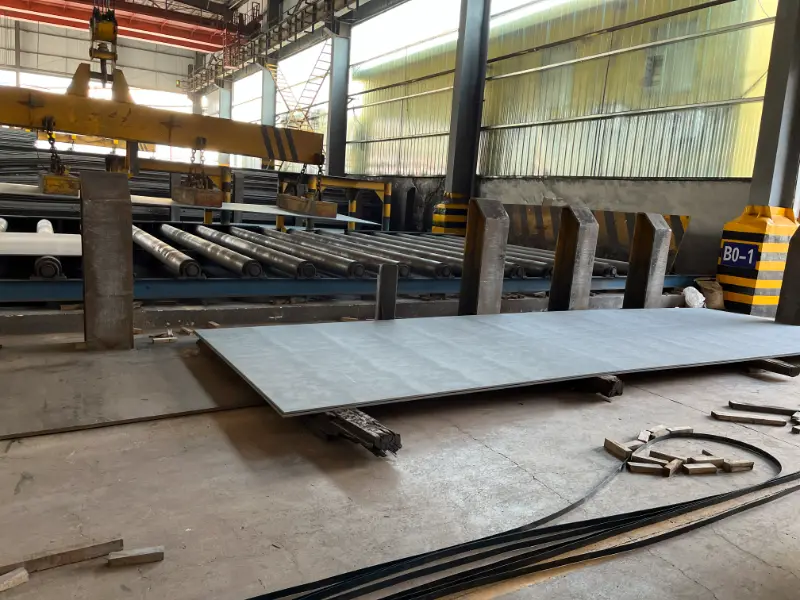
GL Grade A36 Shipbuilding Steel Plate
GL Grade A36 Shipbuilding Steel Plate - Properties, Equivalents & Applications
Comprehensive material data for GL Grade A36 shipbuilding steel: chemical composition, mechanical and physical properties, international equivalents, and application guide.
Hot rolling, normalizing rolling, thermo-mechanical controlled rolling (TMCP), welding (all standard methods), gas/plasma/laser cutting, cold forming, machining
- Phone : +8618037372205
- Email : [email protected]
- WhatsApp: Contact via Whtsapp
- WeChat: +8618037372205
GL Grade A36 Shipbuilding Steel Plate Introduction
GL Grade A36 (often designated GL-A36) is a normal strength hull structural steel certified by Germanischer Lloyd (now integrated into DNV). It is primarily used in the construction of seagoing vessels, offshore structures, and marine equipment. The steel exhibits a minimum yield strength of 235 MPa, good weldability, and reliable notch toughness at ambient temperatures. Key characteristics:
- Balanced strength and ductility for standard shipbuilding applications
- Excellent formability and weldability with conventional techniques
- Widely recognized by all major classification societies through cross-certification
- Available in normalized or thermo-mechanically rolled condition to refine grain structure and improve toughness
GL Grade A36 Shipbuilding Steel Plate Chemical Composition according to GL Rules
The following chemical composition limits apply to ladle analysis for GL Grade A36 steel plates with thickness ≤ 100 mm. Elements not listed are not intentionally added except for deoxidation or grain refinement purposes. Note: Carbon equivalent (CEV) is typically controlled to ensure good weldability.
| Element | Specified Value (max unless stated) | Remarks |
|---|---|---|
| Carbon (C) | ≤ 0.21% | Typical aim 0.12–0.17% |
| Silicon (Si) | ≤ 0.50% | Deoxidizer; typically 0.15–0.30% |
| Manganese (Mn) | ≥ 2.5×C to max 1.60% | Common range 0.60–1.00% for t ≤ 40 mm |
| Phosphorus (P) | ≤ 0.035% | Residual element |
| Sulfur (S) | ≤ 0.035% | Residual element |
| Chromium (Cr) | ≤ 0.20% | Residual |
| Nickel (Ni) | ≤ 0.40% | Residual |
| Molybdenum (Mo) | ≤ 0.08% | Residual |
| Copper (Cu) | ≤ 0.35% | Residual |
| Aluminum (Al) total | ≥ 0.015% (if fully killed) | Fine grain practice; not mandatory for all grades |
| Niobium (Nb) | ≤ 0.03% (if added) | Microalloying optional |
| Vanadium (V) | ≤ 0.05% (if added) | Microalloying optional |
| Titanium (Ti) | ≤ 0.02% (if added) | Microalloying optional |
GL Grade A36 Shipbuilding Steel Plate Thermal and Electrical Physical Properties
The data below represent typical values for carbon-manganese structural steel similar to GL A36. Because shipbuilding steel is essentially standard C-Mn steel, these physical constants are widely used for design calculations. They are provided for reference and may vary slightly with actual composition and processing.
| Property | Typical Value | Unit | Test Conditions |
|---|---|---|---|
| Density (ρ) | ~7850 | kg/m³ | At 20 °C |
| Young's Modulus (E) | ~210 | GPa | At 20 °C, static |
| Shear Modulus (G) | ~81 | GPa | Calculated from E and ν |
| Poisson's Ratio (ν) | ~0.30 | – | Elastic range |
| Thermal Expansion Coefficient (α) | ~11.5 × 10⁻⁶ | /K | Between 20 °C and 100 °C |
| Thermal Conductivity (λ) | ~52 | W/(m·K) | At 100 °C |
| Specific Heat Capacity (cₚ) | ~460 | J/(kg·K) | At 20 °C |
| Electrical Resistivity (ρₑ) | ~0.16 | μΩ·m | At 20 °C |
GL Grade A36 Shipbuilding Steel Plate Mechanical Properties – Tensile and Impact Testing
Mechanical properties are determined on test pieces taken in the transverse (or longitudinal) direction as per the applicable standard. Values apply to plates of all thicknesses up to 100 mm. Impact test: Charpy V-notch average of three specimens ≥ 27 J at +20 °C, with a single value not less than 20 J. For thicker plates or specific conditions, other temperatures may be agreed.
| Property | Required Value | Unit | Test Conditions / Remarks |
|---|---|---|---|
| Yield Strength (ReH) | ≥ 235 | MPa | Upper yield; for all thicknesses |
| Tensile Strength (Rm) | 400 – 520 | MPa | For all thicknesses |
| Elongation (A5) | ≥ 22 | % | t ≤ 50 mm, longitudinal, gauge length 5.65√S₀ |
| Elongation (A5) | ≥ 21 | % | 50 < t ≤ 70 mm |
| Elongation (A5) | ≥ 20 | % | 70 < t ≤ 100 mm |
| Impact Energy (KV₂) | ≥ 27 (average) | J | +20 °C, longitudinal, 10×10 mm specimen |
| Impact Energy (KV₂) – lateral expansion | ≥ 0.50 | mm | Often specified as an alternative or supplement |
| Bend Test (180°) | d = 3a | – | t ≤ 25 mm; no cracks or defects |
| Bend Test (180°) | d = 4a | – | 25 < t ≤ 40 mm |
| Bend Test (180°) | d = 5a | – | t > 40 mm |
GL Grade A36 Shipbuilding Steel Plate Fully Equivalent Material Standards and Replaceable Grades
| Country/Region | Standard/Class Society | Grade | Remarks |
|---|---|---|---|
| International | DNV (former GL) | NV A / DNV A / GL-A36 | Direct successor; identical rules |
| USA | ABS | ABS Grade A | Common normal strength hull steel |
| France | Bureau Veritas (BV) | BV Grade A | Recognized through cross-certification |
| China | China Classification Society (CCS) | CCS A | Same strength level, often used for local shipyards |
| UK | Lloyd's Register (LR) | LR Grade A | Equivalent normal strength ship plate |
| Japan | ClassNK (NK) | NK Grade A (K A) | Japanese classification equivalent |
| South Korea | Korean Register (KR) | KR Grade A | Widely used in Asian shipbuilding |
| Italy | RINA | RINA Grade A | Mediterranean classification society |
GL Grade A36 Shipbuilding Steel Plate Application Introduction
GL Grade A36 is designed primarily for ship and offshore structural components where reliability, weldability, and moderate strength are required. It is not intended for low-temperature service without additional impact testing. The steel can be supplied in various thicknesses and is easily processed by all conventional methods. Common end uses:
- Hull plates and shell strakes for new builds and repairs
- Deck plating, superstructures, and accommodation modules
- Bulkheads, floors, longitudinal and transverse frames
- Stiffeners, brackets, and secondary structural elements
- Hatch covers and crane pedestals
- Offshore platform topside structural steel
- Inland waterway and coastal vessels
Product Applications: Hull plates and sections, Welded beams and columns, Prefabricated ship blocks, Pipe racks and modular structures, Barges and pontoons
Processed into products: Shell plating (side, bottom) panels, Deck and tank top plates, Bulkhead plates and stiffeners, Web frames, stringers, and girders, Brackets and triangular reinforcements, Hatch coamings and covers, Masts, king posts, and small structural members
Application industries: Shipbuilding (merchant ships, naval vessels, yachts), Offshore oil & gas (FPSOs, jack-up rigs, wind turbine foundations), Port and harbor equipment, Heavy engineering and structural fabrication
GL Grade A36 Shipbuilding Steel Plate Similar or Analogous Steel Grades for Non-Marine Applications
| Country/Region | Standard | Grade | Remarks |
|---|---|---|---|
| EU | EN 10025-2 | S235JR / S235J0 / S235J2 | Chemical and strength similar; lacks class-society certification; suitable for structural applications |
| USA | ASTM A36 / A36M | ASTM A36 | Common structural carbon steel; yield 250 MPa; not charpy-certified unless specified |
| China | GB/T 700 | Q235B / Q235C | Comparable base composition and mechanical properties; for general construction |
| Japan | JIS G 3101 | SS400 | Slightly higher tensile range (400-510 MPa); often used interchangeably in non-marine, welded structures |
| International | ISO 630-2 | S235 | Structural steel with similar strength; requires additional testing for marine use |
Notes:
Additional Information:
- GL A36 can be supplied with increased through-thickness properties (Z15, Z25, Z35) upon request to resist lamellar tearing.
- For service temperatures below 0 °C, higher notch toughness grades (e.g., A36 mod., D, E) or fully killed fine-grain practice should be specified.
- Welding recommendations: Use low-hydrogen electrodes and preheat for thicknesses > 30 mm; post-weld heat treatment is not normally required.
- Surface condition: blast-cleaned and shop-primed with zinc silicate or epoxy primer available.
- Certification: material certificate 3.1 per EN 10204 or 3.2 with third-party inspection is standard for marine applications.
- Share



