
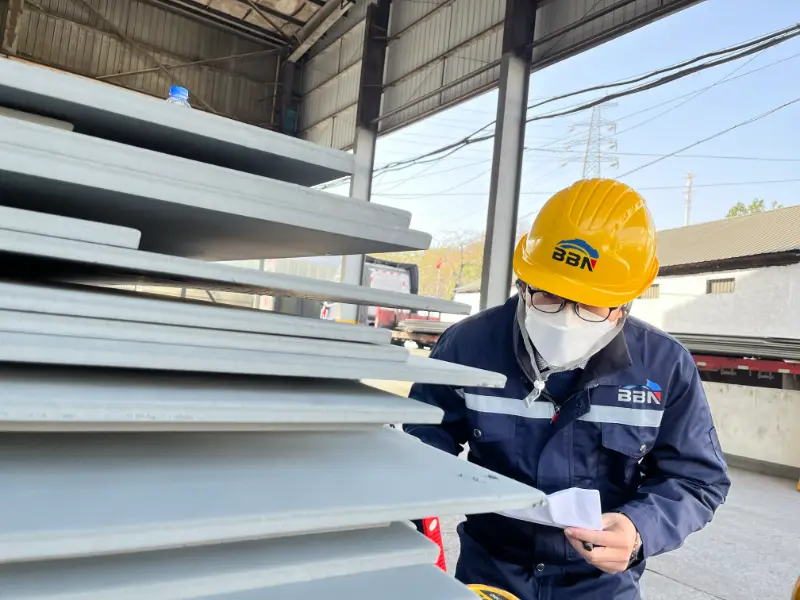
GL Grade D36 Shipbuilding Steel Plate
GL Grade D36 Shipbuilding Steel Plate: Technical Data, Properties & Global Equivalent Grades
Comprehensive technical analysis of GL Grade D36 shipbuilding steel plate covering chemical composition, mechanical and physical properties, global equivalents, and detailed application guidance.
Hot rolling, Normalizing, Thermo-Mechanical Control Process (TMCP), Cold forming, Cutting, Welding (all conventional methods)
- Phone : +8618037372205
- Email : [email protected]
- WhatsApp: Contact via Whtsapp
- WeChat: +8618037372205
GL Grade D36 Shipbuilding Steel Plate Introduction
GL Grade D36 is a high-strength, normalized, fine-grain structural steel plate primarily used in the shipbuilding and offshore engineering industries. Originally certified under the Germanischer Lloyd (GL) standard, it is now integrated into the unified DNV GL rules. This steel grade offers a minimum yield strength of 355 MPa and excellent weldability combined with good toughness at low temperatures, making it suitable for critical structural components in hulls, decks, and superstructures subjected to heavy loads and harsh marine environments. Its controlled chemical composition, emphasizing low carbon equivalent (Ceq), ensures reliable performance in welded joints without post-weld heat treatment in many applications. The material is designed to maintain its mechanical properties in plate thicknesses commonly used in marine construction, providing a robust balance of strength, ductility, and corrosion fatigue resistance.
GL Grade D36 Shipbuilding Steel Plate GL D36 Steel Plate Chemical Composition
The chemical composition of GL Grade D36 is strictly controlled to balance high strength with exceptional weldability and notch toughness. The following values, based on the DNV GL rules for thicknesses ≤ 100 mm, define the ladle analysis limits. Key micro-alloying elements such as niobium, vanadium, and titanium are used individually or in combination to achieve grain refinement. The carbon equivalent (Ceq) is typically maintained below 0.38% to 0.43%, depending on thickness, to eliminate cold cracking risk during fabrication.
- Values shown are the maximum limits unless a range is provided.
- Sufficient other grain-refining elements may be present to meet property requirements.
| Chemical Element | Standard Value (% max) | Remarks |
|---|---|---|
| Carbon (C) | 0.18 | Nominal max. Provides base strength. Ceq control is critical. |
| Manganese (Mn) | 0.90 - 1.60 | Range. Contributes to strength and toughness. |
| Silicon (Si) | 0.10 - 0.50 | Range. Deoxidizer, strength enhancer. |
| Phosphorus (P) | 0.035 | Maximum limit for ductility and toughness. |
| Sulfur (S) | 0.035 | Maximum limit for internal soundness. |
| Aluminum (Al) total | ≥ 0.020 | Minimum for fine-grain practice (acid soluble). |
| Niobium (Nb) | 0.02 - 0.05 | Micro-alloy for grain refinement and precipitation strengthening. |
| Vanadium (V) | 0.05 - 0.10 | Micro-alloy for precipitation strengthening. |
| Titanium (Ti) | ≤ 0.02 | Optional. Nitrogen scavenger for improved HAZ toughness. |
| Nitrogen (N) | ≤ 0.009 | Bound by Al, Ti to avoid aging effects if applicable. |
| Carbon Equivalent (Ceq) | ≤ 0.38 | Ceq = C + Mn/6 + (Cr+Mo+V)/5 + (Ni+Cu)/15. Typical target for guaranteed weldability. |
GL Grade D36 Shipbuilding Steel Plate Thermal and Electrical Physical Properties
The physical properties outlined below are typical reference values for carbon-manganese structural steels like GL D36 at room temperature unless specified otherwise. These values are crucial for designing heat transfer calculations, assessing structural rigidity, thermal stress analysis, and welding procedure specifications. Variations can occur due to exact chemical composition and manufacturing process. These data are not mandatory specification requirements but are provided for engineering design purposes.
- Properties are valid for ambient temperature (approx. 20°C) unless a range is specified.
- The values are generally consistent across normalized and TMCP delivery conditions for this grade.
| Property | Typical Reference Value | Unit | Test Condition / Remarks |
|---|---|---|---|
| Density (ρ) | 7.85 | g/cm³ | Standard for structural steel at 20°C |
| Elastic Modulus (E) | 205 to 210 | GPa | Longitudinal, Ambient Temperature |
| Shear Modulus (G) | Approx. 80 | GPa | Calculated from E and ν (G = E/[2(1+ν)]) |
| Poisson's Ratio (ν) | 0.28 to 0.30 | — | Ambient Temperature, linear elastic range |
| Thermal Expansion Coefficient (α), 20-100°C | 11.0 x 10⁻⁶ | K⁻¹ | Average linear expansion |
| Thermal Expansion Coefficient (α), 20-200°C | 11.5 x 10⁻⁶ | K⁻¹ | Average linear expansion |
| Thermal Expansion Coefficient (α), 20-300°C | 12.0 x 10⁻⁶ | K⁻¹ | Average linear expansion |
| Thermal Conductivity (λ) | Approx. 45 to 50 | W/(m·K) | At 20°C. Decreases slightly with temperature increase. |
| Specific Heat Capacity (Cp) | Approx. 460 to 480 | J/(kg·K) | At 20°C. Typically increases with temperature. |
| Electrical Resistivity (ρₑ) | Approx. 0.20 to 0.25 | µΩ·m | At 20°C, standard for shipbuilding steel grades. |
GL Grade D36 Shipbuilding Steel Plate GL D36 Steel Mechanical Properties
The mechanical property requirements for GL D36 plates are defined to ensure structural integrity under design loads. Minimum values are specified for tensile properties and charpy V-notch impact toughness. The test specimens are generally taken transverse to the rolling direction. Impact test temperatures are specifically -20°C for the "D" designator. Trends shown are typical; specific values must be verified against mill test certificates (MTC) for the delivered batch.
- Properties depend on plate thickness (t). The table lists standard specification minima for various thickness ranges.
- Through-thickness (Z-direction) properties (Z25, Z35) are available upon special agreement.
| Property | Specification Requirement Value | Unit | Test Condition / Thickness (t) |
|---|---|---|---|
| Yield Strength (ReH) min. | 355 | MPa | t ≤ 50 mm |
| Yield Strength (ReH) min. | 355 | MPa | 50 mm < t ≤ 70 mm |
| Yield Strength (ReH) min. | 355 | MPa | 70 mm < t ≤ 100 mm |
| Tensile Strength (Rm) | 490 - 630 | MPa | t ≤ 50 mm |
| Tensile Strength (Rm) | 490 - 630 | MPa | 50 mm < t ≤ 70 mm |
| Tensile Strength (Rm) | 490 - 630 | MPa | 70 mm < t ≤ 100 mm |
| Elongation (A) min., 5.65√So | 21 | % | t ≤ 50 mm (Transverse test piece) |
| Elongation (A) min., 5.65√So | 21 | % | 50 mm < t ≤ 70 mm (Transverse test piece) |
| Elongation (A) min., 5.65√So | 21 | % | 70 mm < t ≤ 100 mm (Transverse test piece) |
| Charpy V-Notch Impact (KV) min., Transverse | 34 (Avg), 24 (Single) | J (Joule) | Test at -20°C; t ≤ 50 mm |
| Charpy V-Notch Impact (KV) min., Transverse | 34 (Avg), 24 (Single) | J (Joule) | Test at -20°C; 50 mm < t ≤ 70 mm |
| Charpy V-Notch Impact (KV) min., Transverse | 34 (Avg), 24 (Single) | J (Joule) | Test at -20°C; 70 mm < t ≤ 100 mm |
GL Grade D36 Shipbuilding Steel Plate Completely Equivalent Material Standards and Replaceable Grades for GL D36
| Country/Region | Standard | Equivalent Grade | Remarks |
|---|---|---|---|
| International | IACS (International Association of Classification Societies) | D36 | Unified Requirement UR W11 for all IACS members including GL/DNV GL. |
| Norway / Germany | DNV GL | D36 | Direct successor standard. Identical chemical and mechanical requirements. |
| UK | LR (Lloyd's Register) | DH36 | Full equivalence. Part 2, Chapter 3. 'D' toughness designation for -20°C. |
| USA | ABS (American Bureau of Shipping) | DH36 | Full equivalence. Part 2, Chapter 1, Section 6. DH36 for -20°C impact. |
| France | BV (Bureau Veritas) | DH36 | Full equivalence. Rule Note NR 216 Materials, D36/-20°C grade. |
| China | CCS (China Classification Society) | DH36 | Full equivalence. Part 1, Chapter 3, Section 2. DH36 grade. |
| Japan | NK (Nippon Kaiji Kyokai / ClassNK) | KD36 | Full equivalence. Part K, Chapter 3. KD36 for -20°C impact test. |
| South Korea | KR (Korean Register) | RD36 | Full equivalence. Part 2, Ch. 1. RD36 for -20°C impact test. |
| Italy | RINA (Registro Italiano Navale) | D36 | Full equivalence. Part D, Chapter 2. HD36/-20°C grade. |
GL Grade D36 Shipbuilding Steel Plate Application Introduction
GL Grade D36 is a workhorse material in marine and offshore engineering, selected for its reliable combination of high strength and fabrication versatility. It is engineered for structures that are heavily loaded both statically and dynamically. The material's fine-grain structure and low carbon equivalent ensure it can be cut, formed, and welded using standard shipyard practices. Its application is mandatory where design calculations call for higher strength than general Grade A/B/D steels, allowing for weight savings in large structures without compromising safety or durability, especially in low-temperature service conditions.
Product Applications: Ship Hulls and Decks, Offshore Platform Jacket Structures, Modular Building Frames for Offshore Living Quarters, Pressure Vessels for low-temperature LPG/ammonia storage (with supplemental testing), Crane Booms and Heavy-Lift Equipment, Bridge Girders in cold climate zones
Processed into products: Bilge strakes and sheer strakes, Deck stringer plates, Hatch coamings and corners, Longitudinals and frames, Transverse bulkheads and web frames, Rudder horns and stocks (forgings equivalent), Jack-up rig leg chords and racks, Padeyes and heavy lift points, Transition pieces and connection flanges for wind turbine towers, Structural nodes (cast or built-up)
Application industries: Commercial Shipbuilding (Container ships, bulk carriers, tankers, cruise ships, ferries), Naval Shipbuilding (Hulls, decks, internal structures), Offshore Oil and Gas (Jack-up rig legs, topside modules, flare booms), Renewable Energy (Offshore wind turbine foundations, transition pieces, substation jackets), Heavy Civil Engineering (Bridges, locks, gates, piling subjected to low temperatures)
GL Grade D36 Shipbuilding Steel Plate Similar or Analogous Substitute Materials Recommendations
| Country/Region | Standard | Similar Grade | Remarks / Analysis |
|---|---|---|---|
| European Union | EN 10025-4 | S355ML (-20°C variant) | Structural steel for offshore structures, TMCP delivery. Very close analog to D36 for non-classed structural applications. Minimum yield 355 MPa, good low-temp toughness. CEV limited to ≤0.39 typically. Substitution requires verification of through-thickness properties. |
| USA | ASTM A131 / A131M | Grade DH36 | Standard Specification for Structural Steel for Ships. DH36 defines -20°C impact toughness. Chemically almost identical. Directly interchangeable for many non-critical structural parts upon approval of the responsible engineer. |
| Japan | JIS G 3106 | SM490B, SM490C (if controlled rolling/TMCP) | High strength rolled steel for welded structures. Yield ≥ 325-365 MPa depending on thickness. SM490C has a guaranteed Charpy absorption at 0°C, which is less demanding than -20°C for D36. SM490B is more analogous to A36. Requires careful verification for substitution. |
| European Union | EN 10025-3 | S355NL | Normalized fine-grain structural steel. Min. 355 MPa yield, impact tested at -50°C ('L' designation). Superior toughness, making it a viable, though often more expensive, substitute for critical components where enhanced safety margins are desired. |
Notes:
Processing and Welding Considerations:
- Preheating: Generally not required for plates up to 50 mm thick when using low-hydrogen processes and the work temperature is above +5°C. For thicker sections or high restraint joints, a preheat of 75-125°C is advised.
- Welding Consumables: Use basic-coated electrodes (AWS E7016/E7018) or submerged arc wire/flux combinations yielding a matching strength weld metal (min. 490 MPa tensile).
- Post-Weld Heat Treatment (PWHT): Not typically required for normal thicknesses but may be specified to relieve stress for highly restrained heavy sections or after cold forming > 5% strain. PWHT temperature is usually 530-580°C.
- Certification: Plates must be stamped by the classification society surveyor with the grade, heat number, and mill identity. Mill test certificates (EN 10204 Type 3.1 or 3.2) are mandatory.
- Tolerances: Thickness, width, and length tolerances are as per the relevant DNV GL rules and the underlying dimensional standard, typically EN 10029 Class A or B for flatness.
- Share



