
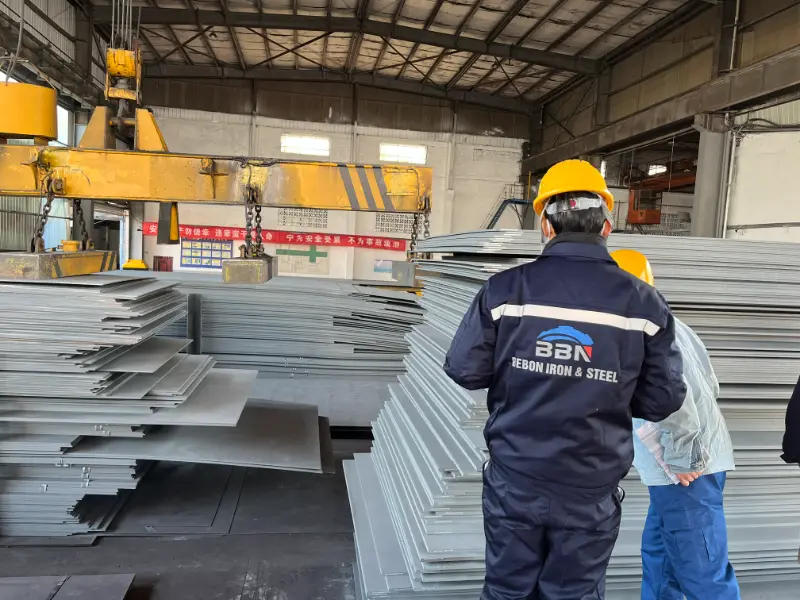
GL Grade E36 Shipbuilding Steel Plate
GL Grade E36 Shipbuilding Steel Plate: High-Strength Hull Structural Steel with Excellent Low-Temperature Toughness
Explore detailed technical data for GL Grade E36 shipbuilding steel, including chemical composition, mechanical properties, thermal properties, international equivalents, and application guidelines. Fully compliant with GL and IACS standards.
Hot rolling, normalizing, TMCP, welding, cutting, forming
- Phone : +8618037372205
- Email : [email protected]
- WhatsApp: Contact via Whtsapp
- WeChat: +8618037372205
GL Grade E36 Shipbuilding Steel Plate Introduction
GL Grade E36 is a high-strength structural steel for shipbuilding, certified by Germanischer Lloyd (now part of DNV GL). It belongs to the E class of the 36 ksi (355 MPa) series, ensuring excellent low-temperature impact toughness at -40°C. Key characteristics:
- Minimum yield strength of 355 MPa
- Excellent weldability with controlled carbon equivalent (Ceq ≤ 0.38%)
- Supplied in normalized or thermo-mechanically controlled processed (TMCP) condition
- Stringent impact testing at -40°C conforming to IACS UR W11
Typical applications include hull structures, decks, bulkheads, and offshore platforms operating in cold climates.
GL Grade E36 Shipbuilding Steel Plate Chemical Composition
Chemical composition according to GL rules for Grade E36 steel. Values are maximum unless a range is shown. Fine grain practice requires the addition of grain-refining elements such as Al, Nb, V, or Ti. Carbon equivalent (Ceq) is controlled to ensure weldability.
| Element | Standard Value (max %) | Remarks |
|---|---|---|
| Carbon, C | 0.18 | Ladle analysis |
| Silicon, Si | 0.10-0.50 | |
| Manganese, Mn | 0.90-1.60 | |
| Phosphorus, P | 0.035 | |
| Sulfur, S | 0.035 | |
| Chromium, Cr | 0.20 | |
| Molybdenum, Mo | 0.08 | |
| Nickel, Ni | 0.40 | |
| Copper, Cu | 0.35 | |
| Aluminum (total), Al | ≥ 0.020 | Acid soluble Al or total Al |
| Niobium, Nb | 0.02-0.05 | Optional alone or in combination |
| Vanadium, V | 0.05-0.10 | Optional alone or in combination |
| Titanium, Ti | 0.007-0.05 | Optional alone or in combination |
| Nb+V+Ti | ≤ 0.12 | If combination used |
| Carbon Equivalent, Ceq | ≤ 0.38 | Ceq = C + Mn/6 + (Cr+Mo+V)/5 + (Ni+Cu)/15 |
GL Grade E36 Shipbuilding Steel Plate Typical Physical Properties
The following physical property data are typical values for carbon-manganese structural steel, applicable to GL E36 at room temperature unless otherwise noted. Actual values may vary slightly depending on exact composition and processing.
| Property | Typical Value | Unit | Test Conditions |
|---|---|---|---|
| Density, ρ | 7850 | kg/m³ | 20°C |
| Modulus of elasticity, E | 205 | GPa | 20°C |
| Shear modulus, G | ~80 | GPa | 20°C |
| Poisson's ratio, ν | 0.3 | — | |
| Thermal expansion coefficient, α | 11.5 - 12.5 × 10⁻⁶ | K-1 | 20-100°C; typical 12.0 |
| Thermal conductivity, λ | ~50 | W/(m·K) | 20°C |
| Specific heat capacity | ~460 | J/(kg·K) | 20°C |
| Electrical resistivity, ρe | ~0.15 - 0.20 | µΩ·m | 20°C |
GL Grade E36 Shipbuilding Steel Plate Mechanical Properties
Minimum mechanical properties for GL E36 steel plates (thickness ≤ 50 mm) based on GL/IACS requirements. Transverse tensile properties may be specified for certain applications. Impact test temperature is -40°C (E-grade).
| Property | Standard Value | Unit | Test Condition |
|---|---|---|---|
| Yield strength, ReH | ≥ 355 | MPa | Thickness ≤ 100 mm (may vary slightly with thickness) |
| Tensile strength, Rm | 490 - 630 | MPa | Thickness ≤ 100 mm |
| Elongation, A5 | ≥ 21 | % | Gauge length 5.65√S0, thickness ≤ 50 mm |
| Charpy impact energy (KV, longitudinal) | ≥ 34 (average) / ≥ 24 (single) | J | -40°C, standard specimen 10x10 mm |
| Charpy impact energy (KV, transverse) | ≥ 24 (average) / ≥ 17 (single) | J | -40°C |
GL Grade E36 Shipbuilding Steel Plate Exact Equivalent Standards and Grades
| Country / Region | Standard | Grade | Remarks |
|---|---|---|---|
| International (IACS) | IACS UR W11 | EH36 | High-strength hull structural steel, E-grade |
| USA | ABS Rules | ABS EH36 | |
| France | BV Rules | BV EH36 | |
| China | CCS Rules | CCS EH36 | |
| Norway/Germany | DNV GL Rules | DNV EH36 | Since 2013 merged rules; formerly DNV EH36 |
| South Korea | KR Rules | KR EH36 | |
| United Kingdom | LR Rules | LR EH36 | |
| Japan | NK Rules | NK EH36 | |
| Italy | RINA Rules | RINA EH36 | |
| Germany (before merger) | GL Rules | GL E36 | Identified as E36 in old GL notation |
GL Grade E36 Shipbuilding Steel Plate Application Introduction
GL E36 steel is designed for critical structural components in shipbuilding where high strength and excellent low-temperature toughness are required. It is widely used in hulls of vessels operating in cold waters, offshore structures, and heavy construction. The steel can be shaped by cutting, bending, and welding, and is compatible with standard shipyard fabrication processes.
Product Applications: Bulk carriers, container ships, tankers, Icebreakers and Arctic supply vessels, FPSO (Floating Production Storage and Offloading) hulls, Offshore wind turbine foundations (jackets, monopiles), Naval vessels with enhanced survivability
Processed into products: Hull shell plates, Deck plates and stringers, Bulkheads and stiffeners, Keel and bottom plates, Longitudinal and transverse frames, Web frames and girders, Hatch coamings, Offshore structural braces and nodes
Application industries: Shipbuilding and marine engineering, Offshore oil and gas platforms, Polar and ice-class vessel construction, Heavy steel structures
GL Grade E36 Shipbuilding Steel Plate Similar and Alternative Materials
| Country / Region | Standard | Grade | Remarks |
|---|---|---|---|
| International | ISO 630-4 | S355ML | Thermomechanical rolled structural steel with minimum impact energy at -50°C; similar strength but low-temperature toughness grade may differ |
| EU | EN 10025-4 | S355ML | Weldable fine grain structural steel, thermomechanical rolled, low-temperature properties |
| EU | EN 10025-6 | S460QL | Higher strength quenched and tempered steel, impact at -40°C, for thicker sections; not identical but can be considered for higher strength needs |
| Russia | GOST 5521 | E36 | Shipbuilding steel grade E36, similar requirements |
| International | IACS UR W11 | EH32, EH40 | Other strength levels in the same series for different design requirements |
Notes:
Welding: GL E36 has excellent weldability with low-hydrogen processes; preheating may be required for thick sections. It is important to follow approved welding consumables and procedures in accordance with GL requirements.
Certification: All plates are supplied with GL material certificates (e.g., 3.1 or 3.2 per EN 10204) confirming compliance with the rules.
Thickness tolerances: According to GL or EN 10029 for plates.
- Share



