
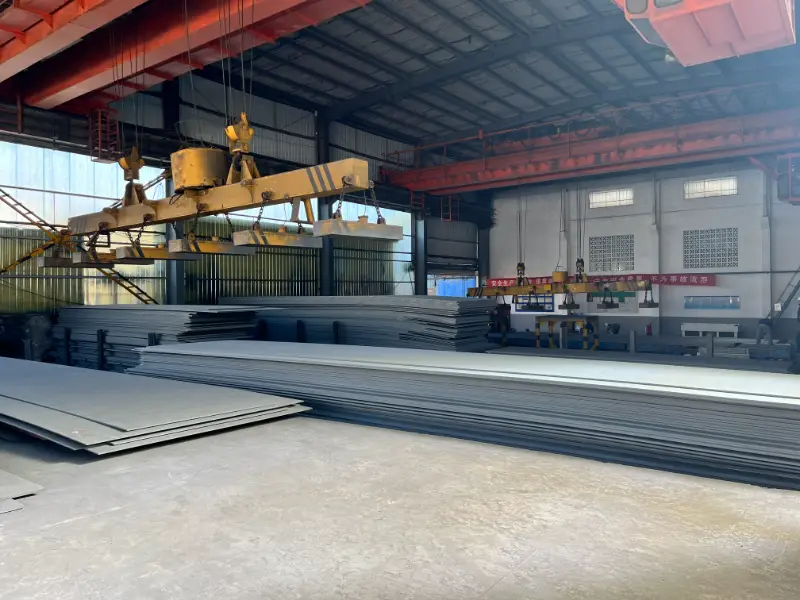
GL Grade F36 Shipbuilding Steel Plate
GL Grade F36 Shipbuilding Steel Plate: High-Strength Low-Temperature Toughness Material
Comprehensive data for GL Grade F36 shipbuilding steel plate, a high-strength structural steel with guaranteed impact toughness at -60°C, certified by Germanischer Lloyd (now DNV GL). Includes chemical composition, mechanical properties, physical properties and international equivalent grades.
Hot rolling, normalizing, TMCP, cutting, welding, forming
- Phone : +8618037372205
- Email : [email protected]
- WhatsApp: Contact via Whtsapp
- WeChat: +8618037372205
GL Grade F36 Shipbuilding Steel Plate Introduction
GL Grade F36 is a high-strength hull structural steel plate conforming to the rules of Germanischer Lloyd (GL) and the International Association of Classification Societies (IACS) Unified Requirement W11. It offers a minimum yield strength of 355 MPa and excellent toughness down to -60°C, making it suitable for critical structural parts in ships and offshore platforms operating in severe low-temperature environments. The steel is typically supplied in normalized or thermo-mechanical controlled processed (TMCP) condition, ensuring a fine-grained microstructure that balances strength, weldability and ductility. Key applications include decks, hulls, stiffeners and ice-strengthened structures.
GL Grade F36 Shipbuilding Steel Plate Chemical Composition
Typical chemical composition according to GL Rules and IACS UR W11. Fine grain treatment with sufficient aluminum content is mandatory. Microalloying elements (Nb, V, Ti) may be added singly or in combination to achieve the required mechanical properties. The carbon equivalent (CEV) is controlled to ensure good weldability.
| Element | Standard Value | Remarks |
|---|---|---|
| Carbon (C) | ≤0.16% | Higher strength requires lower carbon for weldability |
| Silicon (Si) | ≤0.50% | Deoxidation element |
| Manganese (Mn) | 0.90–1.60% | Main strength- and toughness-enhancing element |
| Phosphorus (P) | ≤0.025% | Strict control for low-temperature toughness |
| Sulfur (S) | ≤0.025% | Strict control to avoid hot cracking |
| Aluminum (acid-soluble) | ≥0.015% | Fine grain practice, mandatory |
| Niobium (Nb) | ≤0.05% | Optional microalloying, grain refinement |
| Vanadium (V) | ≤0.10% | Optional microalloying, precipitation strengthening |
| Titanium (Ti) | ≤0.02% | Optional, nitrogen binding and grain refinement |
| Nitrogen (N) | ≤0.009% | If sufficient aluminum or other binders present |
| Carbon Equivalent (CEV) | Typical max. 0.38% | CEV = C + Mn/6 + (Cr+Mo+V)/5 + (Ni+Cu)/15 |
GL Grade F36 Shipbuilding Steel Plate Thermal and Electrical Physical Properties
Typical physical properties for carbon-manganese structural steels similar to GL F36. Values are nominal and may vary slightly with actual composition and heat treatment. These data are guidance for design purposes.
| Property | Standard Value | Unit | Test Condition |
|---|---|---|---|
| Density (ρ) | 7.85 ×1000 | kg/m³ | At 20°C |
| Modulus of Elasticity (E) | 206 ×10^9 | Pa | At 20°C |
| Shear Modulus (G) | 79 ×10^9 | Pa | At 20°C |
| Poisson's Ratio (ν) | 0.3 | – | At 20°C |
| Thermal Expansion Coefficient (α) | 11.5 ×10^-6 | /K | 20–100°C |
| Thermal Expansion Coefficient (α) | 12.5 ×10^-6 | /K | 20–200°C |
| Thermal Conductivity (λ) | 52 | W/(m·K) | At 20°C |
| Specific Heat Capacity | 460 | J/(kg·K) | At 20°C |
| Electrical Resistivity (ρ_e) | 0.20 ×10^-6 | Ω·m | At 20°C |
GL Grade F36 Shipbuilding Steel Plate Mechanical Properties
Mechanical properties are determined on test specimens taken in the transverse direction (unless longitudinal agreed). Tensile and impact tests are required. Impact test temperature for F36 grade is -60°C. Bending test performed with a mandrel diameter related to the plate thickness a.
| Property | Required Value | Unit | Test Condition |
|---|---|---|---|
| Yield Strength (ReH) | ≥355 | MPa | Ambient temperature; for thickness ≤150 mm |
| Tensile Strength (Rm) | 490–620 | MPa | Ambient temperature |
| Elongation (A) | ≥21 | % | Gauge length 5.65√So (proportional), transverse |
| Bend Test (mandrel diameter) | 3 a (180° bend) | – | Thickness ≤25 mm, no cracks, a = specimen thickness |
| Impact Energy (KV, L-transverse) | ≥34 (average) / ≥24 (individual) | J | At -60°C |
| Impact Energy (KV, T-longitudinal) | ≥34 (average) / ≥24 (individual) | J | At -60°C (when specified) |
GL Grade F36 Shipbuilding Steel Plate Full Equivalent Material Standards and Replaceable Grades
| Country/Region | Standard | Grade | Remarks |
|---|---|---|---|
| USA | ABS Rules | ABS FH36 | Identical requirements under IACS UR W11 |
| France | BV Rules | BV FH36 | Identical requirements |
| China | CCS Rules | CCS FH36 | Identical requirements |
| Norway/Germany | DNV Rules | DNV F36 | Identical requirements (DNV GL classification) |
| South Korea | KR Rules | KR FH36 | Identical requirements |
| UK | LR Rules | LR FH36 | Identical requirements |
| Japan | NK Rules | NK KF36 | Identical requirements |
| Italy | RINA Rules | RINA FH36 | Identical requirements |
GL Grade F36 Shipbuilding Steel Plate Application Introduction
GL F36 steel is specifically designed for marine and offshore structures that require high strength and guaranteed notch toughness at extremely low temperatures (-60°C). Its good weldability and formability make it suitable for a wide range of shipbuilding and offshore engineering applications.
Product Applications: Hull plates and stiffeners, Weather decks and hatch coamings, Bulkheads and deck girders, Ice belts and collision bulkheads, Offshore module support beams and columns, Pressure hulls for submersibles
Processed into products: Ship frames and brackets, Reinforced plates for helicopter decks, Crane pedestals and king posts, Bottom shell plates and bilge keels, Rudder horn and stern frame, Anchor handling brackets and towing pads
Application industries: Shipbuilding (commercial and naval vessels), Offshore oil & gas platforms, Marine heavy lifting and transport, Ice-going vessels and icebreakers, Port and harbor construction, Renewable energy (offshore wind turbine foundations)
GL Grade F36 Shipbuilding Steel Plate Similar/Substitute Material Recommendation
| Country/Region | Standard | Grade | Remarks |
|---|---|---|---|
| International | IACS UR W11 | EH36 | Same yield & tensile, impact at -40°C (less demanding) |
| International | IACS UR W11 | AH36 / DH36 | Same strength, impact at 0°C/-20°C |
Notes:
- Weldability: CEV controlled, suitable for all common shipyard welding methods with low hydrogen consumables.
- Tolerances meet GL rules and EN 10029/EN 10051.
- Ultrasonic testing according to EN 10160 or GL requirements may be specified.
- Surface condition and freedom from defects to GL standard.
- Certification: GL material certificate 3.1 or 3.2 according to EN 10204.
- Share



