
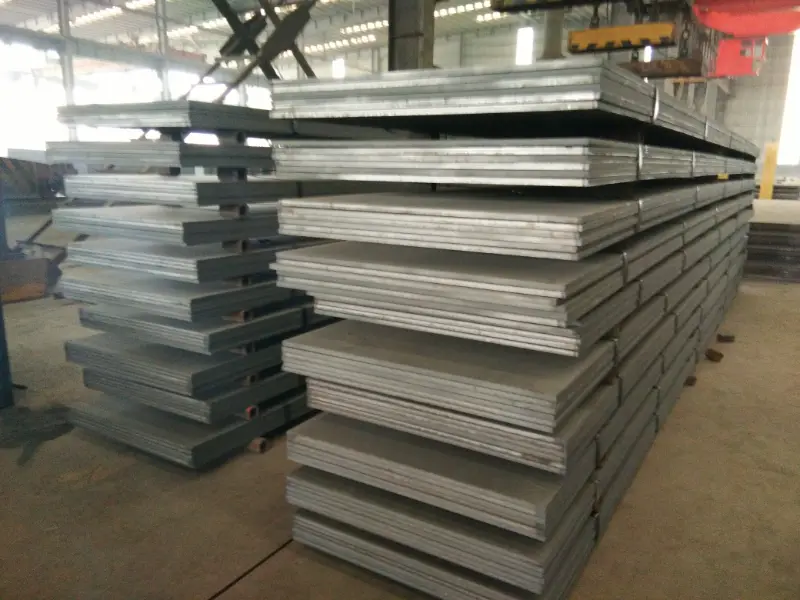
GL Grade A40 Shipbuilding Steel Plate
GL Grade A40 Shipbuilding Steel Plate - High-Strength Hull Structural Steel for Shipbuilding & Offshore Applications
Complete material data for GL Grade A40 (AH40) high-strength shipbuilding steel plate according to Germanischer Lloyd (now DNV GL) rules. Includes chemical composition, mechanical and physical properties, international equivalents, and application guidance.
Cutting, hot and cold forming, welding, machining, surface treatment
- Phone : +8618037372205
- Email : [email protected]
- WhatsApp: Contact via Whtsapp
- WeChat: +8618037372205
GL Grade A40 Shipbuilding Steel Plate Introduction
GL Grade A40 is a high-strength hull structural steel plate approved by Germanischer Lloyd (now part of DNV GL) under the classification of AH40 in the GL Rules for Materials and Welding, Part 1, Chapter 2. It belongs to the family of normal and high-strength steels for shipbuilding and offshore structures, offering a minimum yield strength of 390 MPa and excellent weldability and toughness at low temperatures. The "A" designation indicates that the steel is tested for impact toughness at 0°C. GL Grade A40 is typically supplied in the normalized (N), thermomechanically controlled processed (TMCP), or quenched and tempered (QT) condition, depending on thickness requirements. The steel exhibits good formability, through-thickness properties, and resistance to brittle fracture, making it suitable for critical structural components in ships, mobile offshore units, and other marine structures. It is produced as plates, sheets, and sections, and can be welded using conventional shipyard methods. The chemical composition is carefully balanced with microalloying elements (Nb, V, Ti, Al) to refine grain size and enhance strength and toughness. Stricter limits on phosphorus and sulfur ensure high cleanliness. GL Grade A40 complies with the IACS Unified Requirement W11 for high-strength hull structural steels, ensuring its equivalence with similar grades from other classification societies such as ABS AH40, DNV AH40, BV AH40, and LR AH40.
GL Grade A40 Shipbuilding Steel Plate Chemical Composition
The chemical composition of GL Grade A40 (AH40) is defined according to the ladle analysis limits specified in the GL Rules for Materials and Welding. The steel is microalloyed with niobium, vanadium, titanium, and aluminum to achieve high strength and fine grain size. Residual elements such as chromium, nickel, molybdenum, and copper are kept within strict limits.
- Values are maximum unless a range is indicated.
- The sum of Nb+V+Ti shall not exceed 0.12%.
- Aluminum is used as a grain-refining element; acid-soluble aluminum content is specified.
- Nitrogen is limited to avoid strain aging effects.
| Chemical Element | Standard Value | Remarks |
|---|---|---|
| Carbon (C) | ≤ 0.18 % | |
| Manganese (Mn) | 0.90 – 1.60 % | For thickness ≤ 12.5 mm, Mn may be ≥ 0.70 % |
| Silicon (Si) | ≤ 0.50 % | |
| Phosphorus (P) | ≤ 0.035 % | |
| Sulfur (S) | ≤ 0.035 % | |
| Chromium (Cr) | ≤ 0.20 % | Residual element |
| Nickel (Ni) | ≤ 0.40 % | Residual element |
| Molybdenum (Mo) | ≤ 0.08 % | Residual element |
| Copper (Cu) | ≤ 0.35 % | Residual element |
| Niobium (Nb) | 0.02 – 0.05 % | |
| Vanadium (V) | 0.05 – 0.10 % | |
| Titanium (Ti) | ≤ 0.02 % | Total Nb+V+Ti ≤ 0.12 % |
| Aluminum (Al), acid soluble | ≥ 0.015 % | Grain-refining element |
| Nitrogen (N) | ≤ 0.009 % | Typically ≤ 0.012 % is allowed |
GL Grade A40 Shipbuilding Steel Plate Thermal and Electrical Physical Properties
The following physical properties are typical for CMn microalloyed shipbuilding steels at room temperature and ambient pressure. They are not part of the mandatory certification requirements but are useful for design and process engineering. Slight variations may occur depending on exact composition and heat treatment.
- Density is essentially constant across all low-alloy steels.
- Elastic and shear moduli are representative of structural steels.
- Thermal expansion coefficient is linear average between 20°C and 100°C; higher temperature ranges will show different values.
- Thermal conductivity decreases with increasing temperature; the value given is for approximately 20°C.
- Electrical resistivity is typical for ferritic-pearlitic steels.
| Property | Typical Value | Unit | Test Condition |
|---|---|---|---|
| Density (ρ) | 7.85 | g/cm³ (kg/dm³) | 20 °C |
| Elastic Modulus (E) | 205 – 210 | GPa | 20 °C, tension |
| Shear Modulus (G) | 80 – 84 | GPa | 20 °C, calculated |
| Poisson's Ratio (ν) | 0.30 | - | Elastic range |
| Thermal Expansion Coefficient (α) | 12.0 × 10⁻⁶ | K⁻¹ | 20 – 100 °C |
| Thermal Conductivity (λ) | 50 – 52 | W/(m·K) | 20 °C |
| Specific Heat Capacity (cp) | 460 – 480 | J/(kg·K) | 20 °C |
| Electrical Resistivity (ρe) | 0.22 – 0.25 | µΩ·m | 20 °C |
GL Grade A40 Shipbuilding Steel Plate Mechanical Properties
Mechanical properties are determined on test pieces taken in the delivery condition according to GL rules. Tensile testing is performed at room temperature, and impact tests are conducted at 0°C for the A-grade designation. The values shown are minimum requirements for longitudinal test pieces from plates with thickness ≤ 50 mm, unless otherwise stated. For thicker products or transverse specimens, reduced impact energy values may apply.
- Yield strength (ReH) is the upper yield strength or 0.2% proof strength.
- Tensile strength (Rm) range ensures a proper strength-to-toughness balance.
- Elongation (A) is measured on a proportional gauge length of 5.65√So.
- Charpy V-notch impact energy is averaged over three specimens; one individual value may be lower but not less than 70% of the specified minimum.
| Property | Standard Requirement | Unit | Test Condition |
|---|---|---|---|
| Yield Strength (ReH) | ≥ 390 | MPa | Room temperature, longitudinal, t ≤ 50 mm |
| Tensile Strength (Rm) | 510 – 650 | MPa | Room temperature, longitudinal, t ≤ 50 mm |
| Elongation (A) | ≥ 20 | % | Gauge length 5.65√So, longitudinal, t ≤ 50 mm |
| Impact Energy (KV) | ≥ 34 (longitudinal) | J | Charpy V-notch at 0°C, t ≤ 50 mm |
| Impact Energy (KV) | ≥ 24 (transverse) | J | Charpy V-notch at 0°C, t ≤ 50 mm |
| Bend Test | No cracks or defects | - | 180° cold bend, mandrel diameter d = 3a (t ≤ 25 mm) or d = 4a (t > 25 to 50 mm) |
GL Grade A40 Shipbuilding Steel Plate Exact Equivalent Material Standards and Replaceable Grade Designations
| Country/Region | Standard | Grade | Remarks |
|---|---|---|---|
| International (IACS) | IACS UR W11 | AH40 | Unified requirement for high-strength hull steels, basis for all classification societies |
| USA | ABS Rules | ABS AH40 | Identical grade under American Bureau of Shipping |
| Norway/Germany | DNV GL Rules | DNV AH40 | Continuous standard, previously GL & DNV merged |
| France | BV Rules | BV AH40 | Bureau Veritas high-strength hull steel |
| United Kingdom | LR Rules | LR AH40 | Lloyd's Register equivalent |
| China | CCS Rules | CCS AH40 | China Classification Society data |
| Korea | KR Rules | KR AH40 | Korean Register of Shipping |
| Japan | NK Rules | NK AH40 | Nippon Kaiji Kyokai (ClassNK) |
| Italy | RINA Rules | RINA AH40 | Registro Italiano Navale |
| Russia | RS Rules | RS AH40 | Russian Maritime Register of Shipping |
GL Grade A40 Shipbuilding Steel Plate Application Introduction
GL Grade A40 (AH40) is a workhorse high-strength steel for the shipbuilding and offshore industry. Its balanced combination of strength, toughness, and weldability allows efficient design of lightweight structures while maintaining safety and durability. Typical applications extend beyond ship hulls to include various marine and offshore constructions where classification society approval is mandatory.Key application areas:
Product Applications: Hull plating (bottom, side, deck), Bulkheads and longitudinal girders, Transverse frames and floor plates, Stringer plates and sheerstrakes, Offshore jacket legs, braces, and nodes, Deckhouses and accommodation modules, Helideck structures, Caisson and pile clamps
Processed into products: Deck plates, bottom shell plates, bilge strakes, Longitudinal stiffeners (flat bars, bulb profiles), Web frames, T-beams, and angle sections, Bracket plates and connection elements, Mooring system supports and fairlead foundations, Crane pedestal and boom rest foundations, Hatches, coaming, and manhole rings, Rudder horns and propeller shaft brackets
Application industries: Commercial and naval shipbuilding, Offshore oil & gas platforms (fixed and floating), Wind turbine foundations and transition pieces, Marine heavy engineering and crane structures, Bridge and infrastructure construction in aggressive marine environments, Pressure vessels and storage tanks for marine applications
GL Grade A40 Shipbuilding Steel Plate Similar or Alternative Material Recommendations
| Country/Region | Standard | Grade | Remarks |
|---|---|---|---|
| International | ASTM A131 / A131M | Grade AH40 | Shipbuilding structural steel, same strength/toughness class, fully comparable |
| EU | EN 10025-4 | S420M / S420ML | Thermomechanical rolled structural steel with similar yield strength but different application focus; ML grade offers low-temperature toughness |
| EU | EN 10025-3 | S420NL | Normalized fine-grain steel with comparable strength, good weldability, suitable for some offshore uses |
| China | GB 712 | AH40 | Chinese shipbuilding steel standard, nearly identical composition and properties |
| Japan | JIS G 3106 | SM490A / SM490YA | Welded structural steels, yield ~325–365 MPa lower than AH40, but sometimes used in less demanding hull sections |
| USA | ASTM A572 | Grade 65 | High-strength low-alloy structural steel, minimum yield 450 MPa, not specifically for shipbuilding, may substitute in non-classed structures |
Notes:
Special notes:
- All GL Grade A40 plates must be delivered with GL surveyor's stamp and certification (3.1/3.2 certificate).
- For thicknesses above 20 mm, through-thickness (Z-direction) properties may be required; GL Z25 or Z35 quality can be specified.
- Welding consumables must be approved for use with high-strength steels; pre-heating may be required for thicker sections or lower ambient temperatures.
- Non-destructive testing (ultrasonic) is often carried out to ensure freedom from laminations and internal defects, in accordance with GL rules and EN 10160.
- Plates should be stored in a dry environment and protected from mechanical damage that could affect surface condition and subsequent coating adhesion.
- Share



