
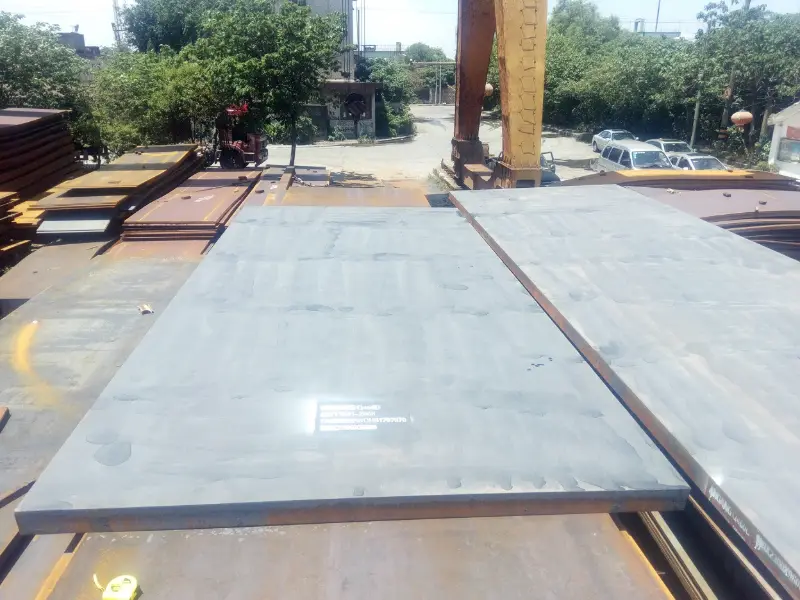
GL Grade D40 Shipbuilding Steel Plate
GL Grade D40 Shipbuilding Steel Plate - High Strength Marine Structural Steel Data
In-depth material data for GL D40 shipbuilding steel plate: chemical composition, mechanical properties, thermal properties, equivalent grades, and application guidance.
Hot rolling, normalizing, thermomechanical controlled processing (TMCP), welding
- Phone : +8618037372205
- Email : [email protected]
- WhatsApp: Contact via Whtsapp
- WeChat: +8618037372205
GL Grade D40 Shipbuilding Steel Plate Introduction
GL Grade D40 is a high strength hull structural steel specified by Germanischer Lloyd (now DNV GL) for ship and offshore construction. It belongs to the 400 MPa minimum yield strength category with a D-grade low temperature toughness designation, indicating impact testing at -20 °C. The steel is typically supplied in normalized (N) or thermomechanical controlled processed (M) condition, offering excellent weldability, strength, and resistance to brittle fracture in cold environments. It complies with the IACS UR W11 unified requirements for hull steels, ensuring global recognition and acceptance by major classification societies. Key characteristics include:
- Minimum yield strength of 400 MPa
- Good notch toughness at sub-zero temperatures
- Balanced chemistry for welding without high preheat
- Available in various thicknesses up to 100 mm depending on supplier capability
This grade is widely used in critical structural components of ships, offshore platforms, and marine equipment.
GL Grade D40 Shipbuilding Steel Plate Chemical Composition
The chemical composition aligns with IACS UR W11 for DH40/EH40 grades. Microalloying elements (Nb, V, Ti) may be added singly or in combination to achieve strength and toughness, while low phosphorus and sulfur ensure cleanliness. Carbon equivalent (CEV) is controlled to guarantee weldability.
- CEV = C + Mn/6 + (Cr+Mo+V)/5 + (Ni+Cu)/15, max 0.38% for thickness ≤50 mm, and 0.40% for 50-100 mm.
| Element | Standard Value (%) | Remarks |
|---|---|---|
| Carbon (C) | ≤ 0.18 | Ladle analysis |
| Silicon (Si) | ≤ 0.50 | |
| Manganese (Mn) | 0.90 – 1.60 | |
| Phosphorus (P) | ≤ 0.025 | Low P for toughness |
| Sulfur (S) | ≤ 0.025 | Low S for ductility |
| Aluminum (Acid Soluble) | ≥ 0.015 | Fine grain practice |
| Niobium (Nb) | ≤ 0.05 | Single or combined microalloy |
| Vanadium (V) | ≤ 0.10 | Single or combined |
| Titanium (Ti) | ≤ 0.02 | Single or combined |
| Copper (Cu) | ≤ 0.35 | |
| Chromium (Cr) | ≤ 0.20 | |
| Nickel (Ni) | ≤ 0.40 | |
| Molybdenum (Mo) | ≤ 0.08 | |
| Carbon Equivalent (CEV) | ≤ 0.38 (t≤50mm) / ≤ 0.40 (50| Based on ladle analysis | |
GL Grade D40 Shipbuilding Steel Plate Physical Properties
The following physical data are typical for rolled carbon-manganese structural steels at room temperature, unless otherwise noted. They are not mandatory specification values but serve as design references.
| Property | Typical Value | Unit | Condition / Notes |
|---|---|---|---|
| Density (ρ) | 7850 | kg/m³ | 20 °C |
| Modulus of Elasticity (E) | 205 | GPa | 20 °C |
| Shear Modulus (G) | ~ 80 | GPa | 20 °C (estimated, ν=0.3) |
| Poisson's Ratio (ν) | 0.3 | – | Within elastic range |
| Thermal Expansion Coeff. (α) | 11.5 x 10⁻⁶ | K⁻¹ | 20–100 °C |
| Thermal Expansion Coeff. (α) | 12.3 x 10⁻⁶ | K⁻¹ | 20–200 °C |
| Thermal Expansion Coeff. (α) | 13.2 x 10⁻⁶ | K⁻¹ | 20–400 °C |
| Thermal Conductivity (λ) | 52 | W/(m·K) | 20 °C, typical for mild C-Mn steel |
| Specific Heat Capacity (cp) | 460 | J/(kg·K) | 20 °C |
| Electrical Resistivity (ρe) | 0.15 – 0.20 | µΩ·m | 20 °C |
GL Grade D40 Shipbuilding Steel Plate Mechanical Properties
Mechanical properties are determined in accordance with GL/IACS requirements, tested on transverse or longitudinal specimens depending on thickness and agreement. The minimum values for yield, tensile, elongation, and impact energy are guaranteed at the specified test temperature.
- Impact test temperature: -20 °C (D-grade).
- Bend test: no cracks after 180° bending on a mandrel of specified diameter.
| Property | Standard Requirement | Unit | Test Condition / Remarks |
|---|---|---|---|
| Yield Strength (ReH) | ≥ 400 | MPa | Thickness ≤ 100 mm, transverse |
| Tensile Strength (Rm) | 500 – 650 | MPa | All thickness |
| Elongation (A5) | ≥ 22 | % | Longitudinal, gauge 5.65√So, t ≤ 40 mm |
| Elongation (A5) | ≥ 20 | % | Longitudinal, t 40-63 mm |
| Elongation (A5) | ≥ 19 | % | Longitudinal, t 63-100 mm |
| Charpy V-Notch Impact (KV2) | ≥ 34 (average) | J | -20 °C, longitudinal, min. single 24 J |
| Charpy V-Notch Impact (KV2) | ≥ 24 (average) | J | -20 °C, transverse, min. single 17 J |
| Bend Test (180°) | d=3a (t≤30mm), d=4a (30| – | No cracks, a = specimen thickness | |
GL Grade D40 Shipbuilding Steel Plate Equivalent Material Standards and Replaceable Grades
| Country / Region | Standard / Class Society | Grade | Remarks |
|---|---|---|---|
| International | IACS UR W11 | DH40 / EH40 | Base unified requirement; EH40 also has -40°C option |
| Norway / Global | DNV (DNV GL) | E40 | High strength, low temperature, -20°C impact |
| USA | ABS | EH40 | Equivalent to GL D40 in strength and toughness |
| France | BV (Bureau Veritas) | EH40 | Same mechanical properties and temperature grade |
| China | CCS (China Classification Society) | E40 | Direct equivalent |
| UK | LR (Lloyd's Register) | EH40 | -20°C notch toughness, 400 MPa min yield |
| South Korea | KR (Korean Register) | EH40 | Equivalent ship structure grade |
| Japan | NK (ClassNK) | KE40 | K-EH40 in NK nomenclature |
| Italy | RINA | E40 | Matching high strength hull steel |
GL Grade D40 Shipbuilding Steel Plate Application Introduction
GL D40 steel plates are extensively employed in the construction of critical marine and offshore structures where weldability, high strength, and reliable low-temperature toughness are essential. Common applications include:
- Hull envelope, decks, and bottom structures of merchant ships, tankers, and bulk carriers
- Offshore platform topsides, jackets, and substructures
- Polar-class vessels and ice-strengthened hulls
- Marine equipment such as crane pedestals, winch foundations, and heavy lifting appliances
Product Applications: Ship hulls: longitudinal and transverse bulkheads, side shells, strength decks, Offshore modules: process skids, pipe racks, helideck structures, Wind turbine transition pieces and monopiles, Heavy-lift crane booms and pedestals, Pressure vessels for cold service (e.g., LPG tanks) when certified by class
Processed into products: Stiffened plate panels (shell plates, deck plates), Web frames and girders, Watertight doors and hatch covers, Keel plates and bilge strakes, Rudder horns and shaft brackets, Anchor foundations and fairleads
Application industries: Shipbuilding (commercial, naval, special purpose), Offshore Oil & Gas (fixed platforms, FPSOs, wind turbine foundations), Marine Equipment Manufacturing, Port and Harbor Construction, Heavy Machinery (marine cranes, lifting gear)
GL Grade D40 Shipbuilding Steel Plate Similar or Alternative Materials
| Country / Region | Standard | Grade | Remarks |
|---|---|---|---|
| Europe | EN 10025-4 | S420ML (1.8836) | Thermomechanical rolled, comparable strength, not classed for marine; CEV ≤0.40; impact -50°C available |
| USA | ASTM A572 / A572M | Grade 60 [415] | High-strength low-alloy structural steel; 415 MPa min yield; not certified for ships but often used in structural applications |
| Germany | DIN EN 10025-3 | S420N | Normalized structural steel; similar mechanical properties; requires impact testing at -20°C for N quality |
| International | ISO 630-3 | S420N | Structural steels — Part 3: Fine grain steels, normalized |
| China | GB/T 1591 | Q420D | HSLA steel with 420 MPa yield; D quality requires -20°C impact; not ship classed unless additional certification is obtained |
Notes:
Additional requirements typical for GL D40 may include:
- Through-thickness tensile testing (Z-quality) according to EN 10164 if required by the design
- Ultrasonic examination per GL rules or EN 10160, class S2/E2 depending on application
- Control of carbon equivalent CEV to not exceed 0.38% (thin gauges) to ensure good weldability without high preheat
- Surface condition and dimensional tolerances per GL or equivalent EN 10029
- Marking includes manufacturer's name, grade, heat number, and class society stamps
End users should always consult the latest GL/DNV-GL rules and the specific material certificate for the delivered product.
- Share



