
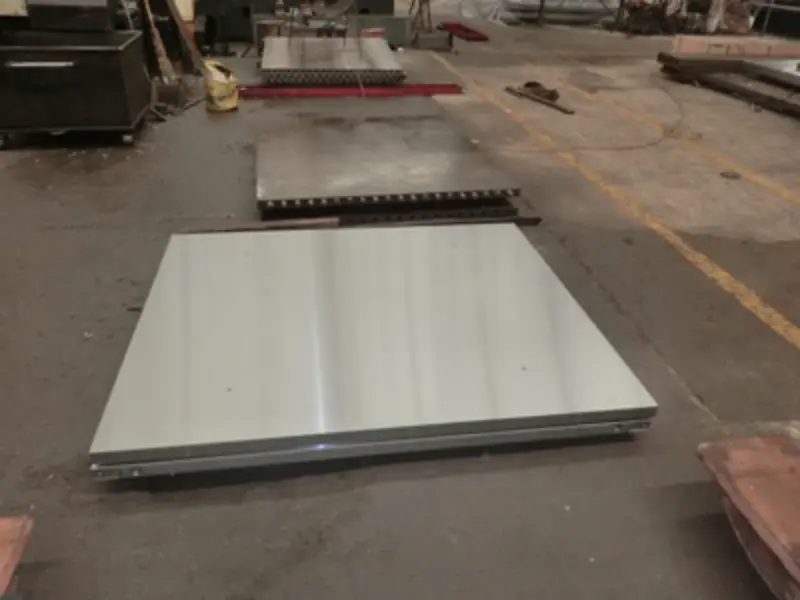
GL Grade E40 Shipbuilding Steel Plate
GL Grade E40 Shipbuilding Steel Plate - High-Strength Hull Structural Steel
Comprehensive material data sheet for GL Grade E40 shipbuilding steel plate: chemical composition, mechanical and physical properties, equivalent grades, and applications in marine and offshore structures.
Thermo-mechanical controlled processing (TMCP), normalizing, normalizing plus tempering, quenching and tempering; suitable for welding, bending, and cutting
- Phone : +8618037372205
- Email : [email protected]
- WhatsApp: Contact via Whtsapp
- WeChat: +8618037372205
GL Grade E40 Shipbuilding Steel Plate Introduction
GL Grade E40 is a high-strength hull structural steel plate classified by Germanischer Lloyd (GL, now DNV GL). It belongs to the 390 MPa yield strength category with improved low-temperature toughness, specifically meeting -40°C impact requirements. This steel is primarily used for constructing ship hulls, offshore platforms, and marine equipment where high strength and excellent weldability are essential. Its production typically involves thermo-mechanical controlled processing (TMCP), normalizing, or quenching and tempering, ensuring fine grain structure and consistent mechanical properties. The steel combines good formability, corrosion resistance in marine environments, and strict quality assurance per classification society rules, making it a trusted choice in modern shipbuilding and ocean engineering.
GL Grade E40 Shipbuilding Steel Plate Chemical Composition
The ladle analysis limits for GL Grade E40 are specified by the classification society rules. The steel is fully killed and fine-grained, typically containing aluminum as a grain refiner. Carbon equivalent (CEV) is controlled, usually ≤0.40% for thickness up to 50 mm, to ensure weldability. The table below presents the standard chemical requirements.
| Chemical Element | Standard Value (Ladle Analysis, %) | Remarks |
|---|---|---|
| C | ≤0.18 | Carbon equivalent CEV ≤0.40 (typical for t≤50mm) |
| Mn | 0.90 - 1.60 | Higher Mn content enhances strength and toughness |
| Si | ≤0.50 | Silicon for deoxidation |
| P | ≤0.035 | Phosphorus - detrimental impurity |
| S | ≤0.035 | Sulfur - detrimental impurity |
| Cu | ≤0.35 | Residual element; may be specified for atmospheric corrosion resistance |
| Cr | ≤0.20 | Residual element; max 0.20% unless otherwise agreed |
| Ni | ≤0.40 | Residual element; max 0.40% unless otherwise agreed |
| Mo | ≤0.08 | Residual element; max 0.08% unless otherwise agreed |
| Nb | 0.02 - 0.05 | Microalloying for grain refinement |
| V | 0.05 - 0.10 | Microalloying for precipitation strengthening |
| Ti | ≤0.02 | Optional for grain refinement |
| Al (total) | ≥0.020 | Minimum total aluminum for deoxidation and grain refinement |
| N | ≤0.009 | High nitrogen can cause strain aging; controlled low |
| CEV | ≤0.40 (typical) | Carbon equivalent based on thickness and delivery condition |
GL Grade E40 Shipbuilding Steel Plate Thermal and Electrical Physical Properties
Physical properties are not mandated by the classification society rules. The values provided below are typical for carbon-manganese structural steels of this category. They can be used for design and engineering calculations. Actual values may vary slightly depending on exact chemistry and heat treatment.
| Property Item | Typical Reference Value | Unit | Test Condition |
|---|---|---|---|
| Density (ρ) | 7.85 | g/cm³ | At room temperature |
| Modulus of elasticity (E) | 200 - 210 | GPa | At room temperature |
| Shear modulus (G) | 75 - 80 | GPa | Estimated from E and ν |
| Poisson's ratio (ν) | 0.30 | — | At room temperature |
| Thermal expansion coefficient (α) | 11.5 - 12.5 ×10⁻⁶ | 1/K | From 20°C to 100°C |
| Thermal expansion coefficient (α) | 12.5 - 13.5 ×10⁻⁶ | 1/K | From 20°C to 200°C |
| Thermal conductivity (λ) | 45 - 55 | W/(m·K) | At room temperature |
| Specific heat capacity (c) | 460 - 500 | J/(kg·K) | At room temperature |
| Electrical resistivity (ρ_e) | 0.15 - 0.25 ×10⁻⁶ | Ω·m | At room temperature (typical mild steel) |
GL Grade E40 Shipbuilding Steel Plate Mechanical Properties
The mechanical tests are conducted on transverse specimens (perpendicular to rolling direction) unless specified otherwise. The properties below are based on standard test conditions and apply to plate thickness ≤50 mm or as indicated. Impact tests are performed at -40°C on Charpy V-notch specimens, with minimum average energy of 31 J for transverse samples (longitudinal typically higher).
| Property Item | Standard Required Value | Unit | Test Condition |
|---|---|---|---|
| Minimum yield strength (ReH) | ≥390 | MPa | Thickness ≤50 mm, transverse |
| Minimum yield strength (ReH) | ≥370 | MPa | Thickness >50 mm to 70 mm, transverse |
| Tensile strength (Rm) | 510 - 650 | MPa | Thickness ≤70 mm, transverse |
| Minimum elongation after fracture (A) | ≥20 | % | Gauge length 5.65√S0, transverse, thickness ≤50 mm |
| Minimum elongation after fracture (A) | ≥19 | % | Gauge length 5.65√S0, transverse, thickness >50 mm to 70 mm |
| Bending test (bending angle 180°) | D=3a (no cracks or defects) | — | a = specimen thickness; mandrel diameter D=3a |
| Impact energy (KV) at -40°C, transverse | ≥31 | J | Average of 3 specimens; min single value ≥22 J |
| Impact energy (KV) at -40°C, longitudinal | ≥41 (typical) | J | Average of 3 specimens; value for longitudinal is often higher |
GL Grade E40 Shipbuilding Steel Plate Fully Equivalent Standards and Replaceable Grades
| Country/Region | Standard | Grade | Remarks |
|---|---|---|---|
| Internationally (IACS) | IACS UR W11 | E40 | Common unified requirement for all major classification societies |
| American Bureau of Shipping | ABS Rules | ABS E40 | Identical mechanical requirements; may have slight chemistry differences |
| Bureau Veritas | BV Rules | BV E40 | Material approved under BV regime |
| China Classification Society | CCS Rules | CCS E40 | Same grade in CCS rules |
| DNV (now DNV GL) | DNV GL Rules | E40 | DNV GL grade identical to former GL E40 |
| Korean Register | KR Rules | KR E40 | Korean Register equivalent |
| Lloyd's Register | LR Rules | LR E40 | Lloyd's Register equivalent |
| Nippon Kaiji Kyokai (ClassNK) | NK Rules | NK E40 | ClassNK equivalent |
| Registro Italiano Navale | RINA Rules | RINA E40 | RINA equivalent |
| European standard (comparable) | EN 10025-4:2019 | S420M/ML | Not fully equivalent; may require supplementary testing for ship use |
GL Grade E40 Shipbuilding Steel Plate Application Introduction
GL Grade E40 is extensively used in ship construction and offshore marine engineering. Its high strength allows lighter structural weight without compromising safety, while the -40°C impact toughness ensures reliable performance in cold waters. It is delivered with classification society certificates and is suited for welding, forming, and machining.
Product Applications: Hull plates and shell plates, Deck plates and bulkheads, Stiffeners, beams, and girders, Offshore module structural components, Jacket legs and brace members, Pressure vessel shells (subject to additional approval)
Processed into products: Main deck and bottom plates, Transverse and longitudinal frames, Bilge keels and stringer plates, Foundation plates for engines and equipment, Offshore crane booms and pedestal mounts, Helideck support structures
Application industries: Shipbuilding (commercial and naval vessels), Offshore oil & gas platforms and FPSOs, Marine crane and heavy lift equipment, Port and harbor infrastructure (quay walls, locks), Wind energy (foundations for offshore wind turbines), Ice-class vessel construction
GL Grade E40 Shipbuilding Steel Plate Similar or Comparable Alternative Materials
| Country/Region | Standard | Grade | Remarks |
|---|---|---|---|
| USA | ASTM A131/A131M | EH40 | High-strength hull structural steel; similar strength and impact temperature. Must verify classification society acceptance. |
| European Union | EN 10025-4:2019 | S420ML | Thermo-mechanical rolled weldable fine grain structural steel; yield ≥420 MPa, but CEV and thickness limits differ; not automatically accepted for shipbuilding unless certified. |
| Japan | JIS G 3106 | SM490YA/YB | Weldable structural steel with yield 365-460 MPa; impact test at -20°C only. Not a direct substitute without proving -40°C toughness. |
| China | GB/T 712 | E40 | Chinese national shipbuilding steel standard; identical strength and chemical limits; usually accepted by many classification societies. |
Notes:
Certification: All plates must be tested and certified by a surveyor from GL/DNV GL or a recognized independent body. Weldability: Appropriate welding consumables and preheat may be required based on thickness and CEV. Tolerances: Thickness, flatness, and surface quality comply with GL rules and EN 10029. Additional tests: Ultrasonic testing per EN 10160 or ASTM A435/A578 is normally mandated. Through-thickness properties: If required, Z-quality (e.g., Z25, Z35) can be specified per EN 10164 or GL rules.
- Share



