
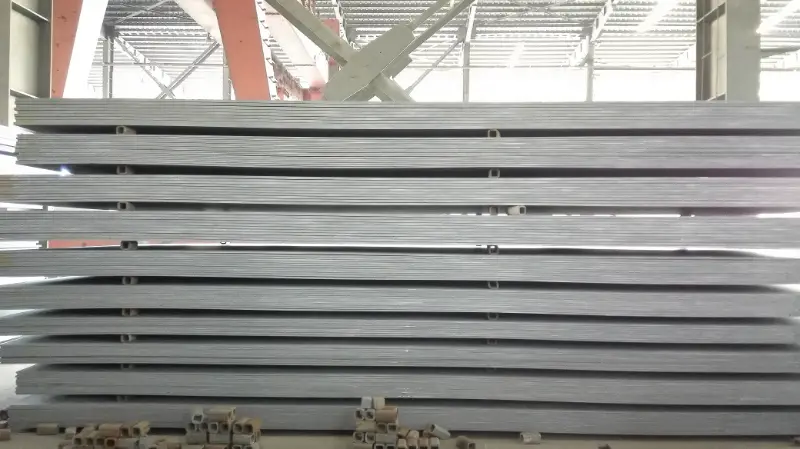
GL Grade A32 Shipbuilding Steel Plate
GL Grade A32 Shipbuilding Steel Plate: High Strength Hull Structural Steel per Germanischer Lloyd Rules
Comprehensive technical data for GL A32 shipbuilding steel plate including chemical composition, mechanical properties, thermal and electrical physical properties, international equivalents, and application guidelines.
Hot rolling, normalizing, thermo-mechanical controlled processing (TMCP), welding, bending, cutting, forming
- Phone : +8618037372205
- Email : [email protected]
- WhatsApp: Contact via Whtsapp
- WeChat: +8618037372205
GL Grade A32 Shipbuilding Steel Plate Introduction
GL Grade A32 is a high strength hull structural steel defined under the rules of Germanischer Lloyd (GL), now part of DNV GL. It is widely applied in shipbuilding and offshore engineering for critical structural components requiring good weldability, excellent toughness, and reliable strength. The grade meets the requirements of IACS UR W11 for normal and high strength steels used in ship construction.
- Minimum yield strength of 315 MPa for thicknesses up to 100 mm.
- Guaranteed Charpy V-notch impact energy at 0 °C (longitudinal 31 J, transverse 27 J).
- Good formability and weldability due to controlled carbon equivalent.
- Supplied in normalized or thermo-mechanical controlled rolled condition, depending on thickness.
GL Grade A32 Shipbuilding Steel Plate Chemical Composition
The chemical composition of GL Grade A32 is defined by the GL rules and IACS UR W11 for high strength steels. Values are maximum unless a range is given. Total aluminum (Alt) is required for grain refinement.
- Carbon equivalent is controlled to ensure weldability.
- Niobium, vanadium, and titanium may be added singly or in combination to achieve mechanical properties, subject to the supplier's practice.
| Element | Standard Value | Remarks |
|---|---|---|
| Carbon (C) | 0.18% max | For thickness ≤ 100 mm. Lower values improve weldability. |
| Silicon (Si) | 0.50% max | Deoxidizer; may be adjusted to meet tensile requirements. |
| Manganese (Mn) | 0.90 – 1.60% | Required for strength and toughness. |
| Phosphorus (P) | 0.035% max | Maximum for standard grades. |
| Sulfur (S) | 0.035% max | Low sulfur improves through-thickness properties. |
| Chromium (Cr) | 0.20% max | Residual content. |
| Nickel (Ni) | 0.40% max | Residual content. |
| Molybdenum (Mo) | 0.08% max | Residual content. |
| Copper (Cu) | 0.35% max | Residual content. |
| Aluminum (Alt) | 0.015% min | Total aluminum, for fine grain practice. |
| Niobium (Nb) | 0.02 – 0.05% | Optional microalloying element; typical for grain refinement and precipitation strengthening. |
| Vanadium (V) | 0.05 – 0.10% | Optional microalloying element. |
| Titanium (Ti) | 0.02% max | Optional; for grain refinement and sulfide shape control. |
| Nitrogen (N) | 0.009% max | Not specified but typically controlled. |
| Other elements (total) | 0.35% max | Sum of Cr, Ni, Mo, Cu, and other unspecified residuals. |
GL Grade A32 Shipbuilding Steel Plate Thermal & Electrical Physical Properties
These physical properties are typical for high strength low alloy structural steels and are not mandatory requirements in the GL standard. Actual values may vary slightly with composition and condition. Values provided are for general engineering calculations.
- Density is based on 7.85 g/cm³ for steel.
- Thermal expansion and thermal conductivity are given for normal operating temperature ranges.
- Electrical resistivity is approximate for low-carbon alloy steels.
| Property | Typical Value | Unit | Test Conditions / Remarks |
|---|---|---|---|
| Density (ρ) | 7.85 | g/cm³ | At 20 °C |
| Elastic modulus (E) | 205 | GPa | At room temperature; transverse and longitudinal similar |
| Shear modulus (G) | 80 | GPa | Calculated from E and Poisson ratio |
| Poisson's ratio (ν) | 0.29 | — | In elastic range |
| Thermal expansion coefficient (α) | 12.0 | ×10⁻⁶/K | Between 20 °C and 100 °C |
| Thermal expansion coefficient (α) | 12.5 | ×10⁻⁶/K | Between 20 °C and 200 °C |
| Thermal expansion coefficient (α) | 13.0 | ×10⁻⁶/K | Between 20 °C and 300 °C |
| Thermal conductivity (λ) | 50 | W/(m·K) | At 20 °C |
| Thermal conductivity (λ) | 48 | W/(m·K) | At 100 °C |
| Specific heat capacity (cp) | 0.46 | kJ/(kg·K) | At 20 °C (approx. 460 J/(kg·K)) |
| Electrical resistivity (ρe) | 0.20 – 0.25 | μΩ·m | At 20 °C; typical for carbon-manganese steel |
GL Grade A32 Shipbuilding Steel Plate Mechanical Properties
Mechanical properties are determined from test pieces taken in the delivery condition and direction. Tensile testing is performed in accordance with GL rules (ISO 6892-1 or equivalent).
- Yield strength (ReH) is guaranteed at minimum 315 MPa for thickness ≤ 100 mm.
- Elongation after fracture (A%) based on gauge length 5.65√So (proportional test piece).
- Impact test temperature is 0 °C for Grade A32; longitudinal and transverse values are given.
- Bend test ensures sufficient ductility: bend angle 180° over a mandrel diameter specified.
| Property | Minimum / Range Value | Unit | Test Conditions |
|---|---|---|---|
| Yield Strength (ReH) | 315 MPa min | MPa | For thickness ≤ 100 mm, transverse or longitudinal, room temperature |
| Tensile Strength (Rm) | 440 – 570 MPa | MPa | For thickness ≤ 100 mm, transverse or longitudinal |
| Elongation after fracture (A) | 22% min | % | Proportional test piece, gauge length 5.65√So, longitudinal direction |
| Charpy V-notch impact energy (KV) | 31 J min (longitudinal) | J | Test temperature 0 °C, standard test piece 10x10 mm |
| Charpy V-notch impact energy (KV) | 27 J min (transverse) | J | Test temperature 0 °C, standard test piece 10x10 mm |
| Bend test (bend angle 180°) | Mandrel diameter = 3t (where t = plate thickness) | Bend specimen thickness = as rolled; no cracks after bending |
GL Grade A32 Shipbuilding Steel Plate Equivalent Standards & Direct Replacement Grades
| Country / Region | Standard / Classification Society | Grade | Remarks |
|---|---|---|---|
| International | IACS UR W11 | A32 | All IACS societies recognize A32 as grade for high strength hull steel. |
| Germany / GL (now DNV GL) | GL Rules | GL A32 | Original Germanischer Lloyd designation. |
| United States | ABS Rules | ABS A32 | American Bureau of Shipping equivalent. |
| Norway / DNV GL | DNV GL Rules | DNV GL A32 | DNV GL unified class; technically identical. |
| France | BV Rules | BV A32 | Bureau Veritas equivalent. |
| China | CCS Rules | CCS A32 | China Classification Society equivalent. |
| United Kingdom | LR Rules | LR A32 | Lloyd's Register equivalent. |
| Italy | RINA Rules | RINA A32 | Registro Italiano Navale equivalent. |
| Japan | NK (ClassNK) Rules | NK A32 | Nippon Kaiji Kyokai equivalent. |
| South Korea | KR Rules | KR A32 | Korean Register equivalent. |
| Russia | RS Rules | RS A32 | Russian Maritime Register of Shipping equivalent. |
GL Grade A32 Shipbuilding Steel Plate Application Introduction
GL A32 steel plate is designed for welded construction in ships and offshore units. It offers excellent balance of strength, toughness, and weldability. The guaranteed impact properties at 0 °C make it suitable for hull structures operating in normal to moderately low ambient temperatures.
- Delivered in normalized or TMCP condition, ensuring consistent mechanical properties across the plate.
- Pre-qualified for welding with common procedures (SAW, SMAW, FCAW, GMAW) when using appropriate consumables and preheat/interpass temperatures.
- Available in a wide range of thicknesses from 6 mm up to 100 mm, and widths up to 4500 mm depending on the mill capability.
Product Applications: Ship hulls and deck plating, Longitudinal and transverse framing, Bulkheads and stiffening members, Deckhouses and superstructure components, Offshore platform topside structural members, Caissons and submerged structures, Heavy-lift crane pedestals for marine application
Processed into products: Shell plates (bottom, side, bilge), Weather and internal decks, Bottom and side longitudinals, Floors and girders, Web frames and stringers, Transverse and longitudinal bulkheads, Rudder and rudder horn components, Engine room seating and foundation plates, Mooring and towing equipment support structures
Application industries: Commercial shipbuilding (bulk carriers, tankers, container ships, passenger vessels), Naval shipbuilding (frigates, auxiliary vessels), Offshore oil and gas (platform substructures, module support beams, flare booms), Offshore wind energy (transition pieces, monopile reinforcement), Barge and inland waterway vessel construction, Heavy structural engineering for marine environments
GL Grade A32 Shipbuilding Steel Plate Similar / Alternative Materials for Consideration
For applications where GL A32 is specified, the following steels may be considered as substitutes subject to classification approval. They have comparable mechanical properties but may differ in chemical composition and delivery condition.
| Country / Region | Standard / Specification | Grade | Remarks |
|---|---|---|---|
| Europe | EN 10025-4 | S355ML | Hot-rolled thermo-mechanical rolled fine grain structural steel with minimum yield 355 MPa for t≤16; requires assessment for marine use. |
| Europe | EN 10025-3 | S355N/NL | Normalized fine grain steel; -NL provides low-temperature toughness comparable to A32. |
| China | GB/T 712 | A32 | Chinese national standard for shipbuilding steel; directly aligned with IACS UR W11. |
| Japan | JIS G 3106 | SM490A/B/C | Welded structure steel; SM490C at 0°C may be considered but not automatically approved for ship classification. |
| USA | ASTM A572 / A572M | Grade 50 [345] | High-strength low-alloy structural steel with 345 MPa yield; not approved for ship classification without additional testing. |
| Russia | GOST R 52927 | A32 | Russian shipbuilding steel standard; equivalent in properties. |
Notes:
Certification: All GL A32 plates must be delivered with GL inspection certificate (class certificate 3.1 or 3.2 per EN 10204). Welding: Recommended preheat and interpass temperature depend on thickness and carbon equivalent; typically 20-50 °C for plates up to 30 mm, increasing for thicker sections. Supplementary tests: Through-thickness property testing (Z-quality) per GL Z25 or Z35 can be specified for critical tension joints. Dimensional tolerances: In accordance with GL Rules or by agreement. Surface condition: Plates are normally supplied with a primer shop coat for corrosion protection during construction. Equivalent notations: GL A32 is fully replaced by DNV GL A32 in the DNV GL unified class system; certificates may now be issued under DNV GL as the recognized society.
- Share



