
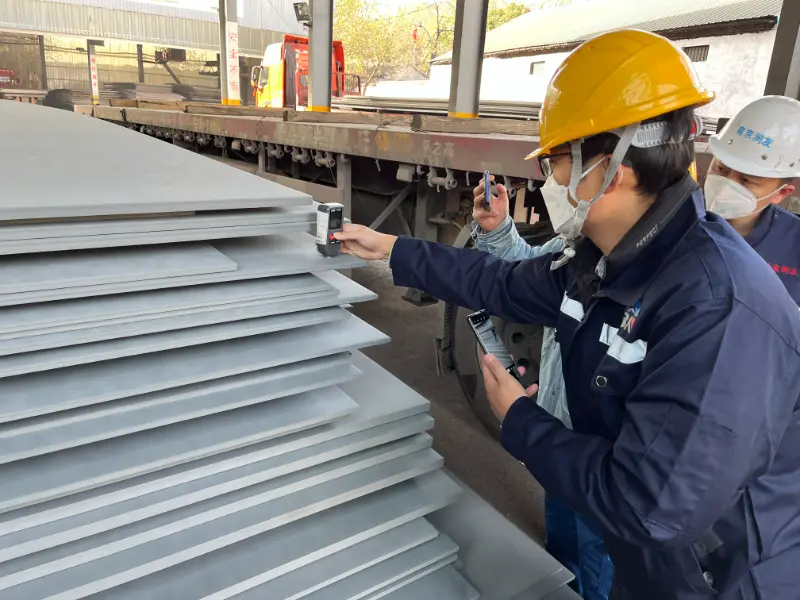
DNV GL Grade D32 Shipbuilding Steel
DNV GL Grade D32 Shipbuilding Steel: High-Strength Structural Application & Material Properties
Comprehensive technical data for GL Grade D32 shipbuilding steel plate per Germanischer Lloyd (now DNV) rules. Includes chemical composition, mechanical properties, physical constants, and international equivalent grades.
Hot rolling, Normalizing (N) or Thermo-Mechanical Controlled Processing (TMCP), Cutting, Cold forming, Welding (all common methods)
- Phone : +8618037372205
- Email : [email protected]
- WhatsApp: Contact via Whtsapp
- WeChat: +8618037372205
DNV GL Grade D32 Shipbuilding Steel Introduction
GL Grade D32 is a high-strength structural steel grade originally governed by the rules of Germanischer Lloyd (GL), now integrated into the DNV classification society. It belongs to the normalized or thermo-mechanically rolled fine-grain steel category used primarily for ship hulls and marine structures. The "D" designation indicates a guaranteed minimum impact toughness of 31 J longitudinal / 24 J transverse at a test temperature of -20°C. The "32" denotes a minimum yield strength specification of 315 MPa (32 kgf/mm²). This grade offers a balanced combination of weldability, strength, and low-temperature toughness, making it suitable for critical structural members such as decks, sides, and bottom shell plates in seagoing vessels and offshore installations.
DNV GL Grade D32 Shipbuilding Steel Chemical Composition
The chemical requirements for GL Grade D32 conform to the standard specifications for normalized or TMCP high-strength ship steels.
- Fine grain practice is mandatory, typically using Al, Nb, V, or Ti additions.
- Carbon Equivalent (CEV) is controlled to ensure excellent weldability, typically below 0.38% for TMCP products.
- Residual elements (Cr, Ni, Mo, Cu) may be present but are generally not mandatory additions unless specified for increased thickness or specific toughness requirements.
| Element | Standard Value (Max %) | Remarks |
|---|---|---|
| Carbon (C) | 0.18 | Max |
| Silicon (Si) | 0.10 – 0.50 | Range |
| Manganese (Mn) | 0.90 – 1.60 | Range |
| Phosphorus (P) | 0.035 | Max |
| Sulfur (S) | 0.035 | Max |
| Aluminum (Al) (Total) | 0.015 – 0.080 | Min Acid-soluble or Total for fine grain |
| Niobium (Nb) | 0.02 – 0.05 | Optional grain refiner |
| Vanadium (V) | 0.05 – 0.10 | Optional grain refiner |
| Titanium (Ti) | 0.02 | Max, optional grain refiner |
| Nitrogen (N) | 0.009 | Max (if not bound by Ti/Al) |
| Copper (Cu) | 0.35 | Residual max if not specified |
| Chromium (Cr) | 0.20 | Residual max if not specified |
| Nickel (Ni) | 0.40 | Residual max if not specified |
| Molybdenum (Mo) | 0.08 | Residual max if not specified |
DNV GL Grade D32 Shipbuilding Steel Thermal and Electrical Physical Properties
Typical physical constants for GL Grade D32 fine-grain structural steel. These values are derived from standard data for low-alloy/high-strength structural steels and are not mandatory specification requirements but serve as engineering design references.
- Properties are density-dependent and show slight variations with temperature.
- Thermal conductivity decreases as temperature increases, while specific heat capacity increases.
- Values are valid for the normalized or TMCP condition.
| Property | Standard Requirement | Unit | Test Condition / Remarks |
|---|---|---|---|
| Density (ρ) | ~7.85 | g/cm³ | At 20°C |
| Elastic Modulus (E) | ~210 | GPa | At 20°C |
| Shear Modulus (G) | ~80 | GPa | At 20°C |
| Poisson's Ratio (ν) | ~0.30 | — | At 20°C |
| Thermal Expansion Coefficient (α) | ~11.5 | 10⁻⁶/K | Range 20 – 100°C |
| Thermal Expansion Coefficient (α) | ~12.2 | 10⁻⁶/K | Range 20 – 200°C |
| Thermal Expansion Coefficient (α) | ~13.0 | 10⁻⁶/K | Range 20 – 300°C |
| Thermal Conductivity (λ) | ~52 | W/(m·K) | At 20°C |
| Thermal Conductivity (λ) | ~49 | W/(m·K) | At 100°C |
| Thermal Conductivity (λ) | ~44 | W/(m·K) | At 200°C |
| Specific Heat Capacity (cp) | ~460 | J/(kg·K) | At 20°C |
| Specific Heat Capacity (cp) | ~480 | J/(kg·K) | At 100°C |
| Specific Heat Capacity (cp) | ~510 | J/(kg·K) | At 200°C |
| Electrical Resistivity (ρ_e) | ~0.25 | 10⁻⁶ Ω·m | At 20°C |
| Melting Point Range | ~1420 – 1460 | °C | Typical |
DNV GL Grade D32 Shipbuilding Steel Mechanical Properties
Specified tensile and impact properties for GL Grade D32 plates and sections.
- Yield strength and tensile strength specified at ambient temperature (room temp).
- Impact testing (Charpy V-notch) is mandatory at -20°C for grade D certification.
- Elongation values depend on the specimen gauge length; the standard gauge length for ship plates is 5.65√So (L0 = 200 mm for typical 40 mm thick plate).
- Bend tests are performed with 180° bending over a specific mandrel diameter depending on thickness.
| Property | Standard Requirement | Unit | Test Condition / Remarks |
|---|---|---|---|
| Yield Strength (ReH) | ≥ 315 | MPa | Room Temperature |
| Tensile Strength (Rm) | 440 – 570 | MPa | Room Temperature |
| Elongation (A5) (t ≤ 50 mm) | ≥ 22 | % | Gauge length L0 = 5.65√So |
| Elongation (A) (t > 50 mm) | ≥ 22 (min) | % | Specific gauge length agreed |
| Bend Test (Bending Angle) | 180 | Degree | Mandrel diameter: 3t (t=thickness) for t ≤ 25mm; values increase with thickness |
| Impact Energy (KV2) Longitudinal | ≥ 31 | J | At -20°C |
| Impact Energy (KV2) Transverse | ≥ 24 | J | At -20°C |
| Yield Strength at Elevated Temp (ReH) 100°C | ~285 | MPa | Typical / Reference only |
| Yield Strength at Elevated Temp (ReH) 200°C | ~255 | MPa | Typical / Reference only |
| Yield Strength at Elevated Temp (ReH) 300°C | ~215 | MPa | Typical / Reference only |
DNV GL Grade D32 Shipbuilding Steel Identical Equivalent Standards and Substitutable Grade Designations
| Country/Region/Society | Specification / Standard | Grade Designation | Remarks |
|---|---|---|---|
| International (IACS) | IACS Unified Requirement W | D32 | Internationally recognized equivalent basis for all classification societies |
| France (BV) | BV Rules Part 2 | D32 / BV D32 | Fully equivalent; same -20°C impact requirement |
| USA (ABS) | ABS Rules Part 2 | D32 / ABS D32 | Fully equivalent; often grouped under "ABS Grade D32" |
| UK (LR) | Lloyd's Register Rules | D32 / LR D32 | Fully equivalent; same yield and impact specification |
| China (CCS) | CCS Rules Part 1 | D32 / CCS D32 | Fully equivalent; mandated in Chinese shipbuilding |
| Japan (NK / ClassNK) | NK Rules Part K | D32 / NK D32 | Fully equivalent; used in Japanese and global yards |
| South Korea (KR) | KR Rules Pt. 2 | D32 / KR D32 | Fully equivalent; widely used in Korean major shipyards |
| Italy (RINA) | RINA Rules Part D | D32 / RINA D32 | Fully equivalent |
| Norway/Germany (DNV) | DNV-OS-B101 | D32 / DNV D32 | Direct successor standard to original GL D32; identical requirements |
DNV GL Grade D32 Shipbuilding Steel Application Introduction
GL Grade D32 is specifically designed for welded structures in shipbuilding and marine engineering. The controlled carbon equivalent ensures excellent weldability without the mandatory need for pre-heating under standard conditions. Its good low-temperature toughness makes it suitable for vessels operating in cold climates.
- Commonly delivered in plates with thicknesses ranging from 6 mm to 150 mm.
- Certification includes mandatory third-party inspection by a recognized classification society.
- Steel is marked with GL (now DNV) stamp, grade, and heat number for full traceability.
Product Applications: Hull side shells and bottom plates (longitudinal strength members), Deck plating and stringer plates in high stress areas, Transverse and longitudinal bulkheads, Hatch coamings and weather deck coamings, Boss plates and stern frame roots, Offshore module support stools and grillages, Heavy-duty lock gates and caissons
Processed into products: Cut and welded web frames and stiffeners, Bent bottom strakes and bilge keel plates, Machined porthole rings and bollard base plates, Drilled and bolted hull foundation pads for machinery, Laser-cut flat bar stiffeners and tripping brackets, Pressed and formed corrugated bulkhead sections, Welded T-bar and angle assembly primary structural members
Application industries: Commercial Shipbuilding (Container ships, Bulk carriers, Tankers), Naval and Defense Shipbuilding (Frigates, Support vessels), Offshore Oil & Gas (Jack-up rig legs, FPSO hull modules, Platform decks), Renewable Marine Energy (Offshore wind turbine foundations, Transition pieces), Port Infrastructure (Dock gates, Fender panels, Quay walls), Heavy Lifting Equipment (Crane pedestal bases, Offshore crane booms)
DNV GL Grade D32 Shipbuilding Steel Similar / Alternative Grade Recommendations
| Country/Region/Society | Specification / Standard | Grade Designation | Remarks |
|---|---|---|---|
| International (IACS) | IACS UR W | A32 | Comparable strength but only 0°C impact test (less toughness than D32) |
| International (IACS) | IACS UR W | E32 | Higher toughness variant with -40°C impact; superior to D32 but higher cost |
| International (IACS) | IACS UR W | D36 | Higher minimum yield strength (355 MPa) than D32; slightly different chemistry |
| European (EN) | EN 10025-4 | S355ML | Thermomechanical rolled structural steel with similar yield; equivalent for non-marine use |
| USA (ASTM) | ASTM A131 / A131M | Grade D32 | Direct equivalent in ASTM shipbuilding standards; interchangeable |
| Russia/CIS (GOST) | GOST 5521 | D32 / 09G2S | 09G2S is a functional equivalent often used in Russian shipbuilding; verify toughness |
| Japan (JIS) | JIS G 3106 | SM490B | Comparable tensile strength but different impact and certification; not a direct marine substitute without approval |
Notes:
Additional Technical Notes:
- Welding: Pre-heating is generally not required for thicknesses below 30 mm at ambient temperatures above 5°C. For thicker plates or cold conditions, a pre-heat temperature of 50–100°C is recommended. Consumables matching or slightly overmatching (e.g., E7018) are standard.
- NDT: Ultrasonic testing (UT) of plates is often mandatory per class rules for critical application thicknesses (typically > 25 mm), ensuring freedom from lamination and internal defects.
- Tolerances: Tolerances on thickness conform to EN 10029 (Class A or B) or equivalent class specifications, with a minus tolerance typically limited to -0.3 mm for thinner plates.
- Genuine Certification: Products must be stamped or marked with the classification society stamp, surveyor's mark, heat number, and manufacturer identification. This information must match the 3.1 inspection certificate according to EN 10204, issued and verified by the society's surveyor.
- Share



