
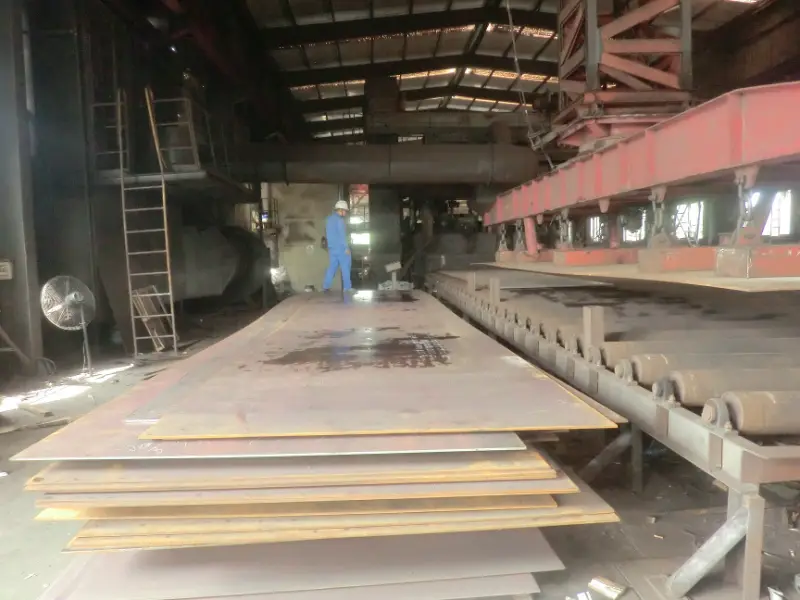
GL Grade E32 Shipbuilding Steel Plate
GL Grade E32 Shipbuilding Steel Plate: Comprehensive Properties and Industry Applications
Detailed material data for GL Grade E32 shipbuilding steel plate covering chemical composition, mechanical and thermal properties, equivalent standards, and application guidance.
Hot rolling, normalizing (N), thermo-mechanical controlled processing (TMCP), quenching and tempering (Q&T) on agreement; cold forming, bending, welding, machining
- Phone : +8618037372205
- Email : [email protected]
- WhatsApp: Contact via Whtsapp
- WeChat: +8618037372205
GL Grade E32 Shipbuilding Steel Plate Introduction
GL Grade E32 shipbuilding steel plate is a high-strength structural steel governed by the rules of Germanischer Lloyd (GL), a leading classification society. It belongs to the EH32 category according to IACS UR W11, offering a minimum yield strength of 315 MPa and excellent notch toughness at temperatures down to -40°C. The steel is specifically designed for critical marine and offshore structures where high strength, weldability, and resistance to brittle fracture under low-temperature service conditions are essential.
- Excellent low-temperature impact properties (KV at -40°C)
- Good weldability with controlled carbon equivalent (≤0.38%)
- Fine-grain practice with micro-alloying (Nb, V, Ti) for grain refinement and precipitation strengthening
- Suitable for thick plates up to 150 mm in normalized or thermo-mechanically rolled condition
E32 plates are widely used in the construction of hulls, decks, bulkheads, and offshore platforms, ensuring compliance with stringent safety regulations. The designation "E" indicates the Charpy impact test temperature of -40°C, while "32" points to the minimum yield strength level of 315 MPa (32 ksi-class). GL certification guarantees traceability and conformity to GL Rules for Materials and Welding.
GL Grade E32 Shipbuilding Steel Plate Chemical Composition
The chemical composition of GL Grade E32 is designed to achieve high strength and excellent low-temperature toughness. The steel is fully killed and fine-grain treated. Key alloying principles:
- Low carbon content maximizes weldability and impact properties.
- Manganese provides solid-solution strengthening and enhances hardenability.
- Micro-alloying elements (Nb, V, Ti) refine the grain structure and precipitation strengthen, particularly in TMCP plates.
- Strict control of phosphorus and sulfur minimizes centerline segregation and ensures clean steel.
Nitrogen is bound by aluminum or other nitride formers to avoid strain aging. Copper, chromium, nickel, and molybdenum are residual elements and kept to low levels unless otherwise agreed. The carbon equivalent value (CEV) is typically ≤ 0.38% to ensure good field weldability.
| Element | Standard Value (max, unless range given) | Remarks |
|---|---|---|
| C (Carbon) | ≤ 0.18 | Key for weldability; lower improves toughness |
| Si (Silicon) | ≤ 0.50 | Deoxidizer; higher values may be required for killed steel |
| Mn (Manganese) | 0.90 – 1.60 | Strength and toughness; upper limit for thick plates |
| P (Phosphorus) | ≤ 0.035 | Low for ductility and avoidance of temper embrittlement |
| S (Sulfur) | ≤ 0.035 | Low for formability and resistance to hot cracking |
| Al (Aluminum) | ≥ 0.015 (acid-soluble) | Ensures fine grain and full killing; total Al typically 0.020–0.060 |
| Nb (Niobium) | ≤ 0.05 | Grain refiner and precipitation hardener |
| V (Vanadium) | ≤ 0.10 | Precipitation strengthening; combined V+Nb+Ti may be limited |
| Ti (Titanium) | ≤ 0.02 | Grain refinement and nitrogen fixation; fine TiN particles |
| Cu (Copper) | ≤ 0.35 | Residual; may provide some corrosion resistance |
| Cr (Chromium) | ≤ 0.20 | Residual; higher by agreement for special properties |
| Ni (Nickel) | ≤ 0.40 | Residual; improves toughness; higher allowed when specified |
| Mo (Molybdenum) | ≤ 0.08 | Residual; minor effect on hardenability |
| N (Nitrogen) | ≤ 0.009 (if Al present) | Must be fixed by Al/Ti to avoid strain aging |
| CEV (Carbon Equivalent) | ≤ 0.38 (typical) | Formula: CEV = C + Mn/6 + (Cr+Mo+V)/5 + (Ni+Cu)/15 |
GL Grade E32 Shipbuilding Steel Plate Thermal and Electrical Physical Properties
The physical properties of GL E32 are representative of low-alloy structural steels. These values are typical for design purposes and may vary slightly with heat treatment, production route, and thickness.
- Density is used for weight calculations.
- Young's modulus and shear modulus are essential for structural stiffness analyses.
- Thermal expansion coefficient influences the design of hybrid structures and supports weld distortion predictions.
- Thermal conductivity affects cooling rates during welding and heat transfer in fire-engineering assessments.
The data below are based on literature and can be applied for temperatures up to approximately 200°C. For higher temperatures, property degradation must be considered.
| Property | Typical Value | Unit | Measurement Condition |
|---|---|---|---|
| Density (ρ) | 7850 | kg/m³ | 20°C |
| Elastic Modulus (E) | 210 | GPa | 20°C; tension/compression |
| Shear Modulus (G) | 81 | GPa | 20°C; calculated from E and ν |
| Poisson's Ratio (ν) | 0.3 | - | Within elastic range |
| Thermal Expansion Coefficient (α) | 12.0 × 10⁻⁶ | /K | 20–100°C; for 20–200°C: 12.5 × 10⁻⁶ /K |
| Thermal Conductivity (λ) | 50 | W/(m·K) | At 20°C; may reduce to ~45 at 200°C |
| Specific Heat Capacity (cp) | 460 | J/(kg·K) | 20°C; increases with temperature |
| Electrical Resistivity (ρ_e) | 0.20 – 0.25 | µΩ·m | 20°C; typical for low-carbon steel |
GL Grade E32 Shipbuilding Steel Plate Mechanical Properties
GL E32 shipbuilding plates must meet stringent tensile and impact requirements as part of the classification society certification. The values below are the specified minimums unless noted. Testing is carried out on specimens taken in the transverse direction for plates ≥ 12.5 mm thickness; for thinner material, longitudinal specimens may be used.
- Yield strength (ReH) is based on upper yield point or 0.2% proof stress.
- Elongation is measured on a gauge length of 5.65√So (A5) for standard proportional test pieces.
- Charpy V-notch impact energy (KV) is required at -40°C; the longitudinal minimum is 31 J up to 50 mm thickness, and transverse values are typically 22 J for the same range.
- Bend tests (180°) are conducted on strip specimens without cracking; the mandrel diameter depends on the specified strength level and plate thickness.
Actual achieved properties often exceed these minima, especially for TMCP products.
| Property | Specification | Unit | Test Condition / Remarks |
|---|---|---|---|
| Yield Strength (ReH) | ≥ 315 | MPa | Thickness ≤ 100 mm; for >100 mm see specific agreement |
| Tensile Strength (Rm) | 440 – 590 | MPa | Typical range; single values for acceptance |
| Elongation after fracture (A5) | ≥ 22 | % | Proportional gauge length L0=5.65√So; for thickness ≤ 50 mm |
| Charpy Impact (KV) longitudinal | ≥ 31 | J | At -40°C; specimen 10x10 mm; for thickness ≤ 50 mm |
| Charpy Impact (KV) transverse | ≥ 22 | J | At -40°C; specimen 10x10 mm; for thickness ≤ 50 mm |
| Bend Test | No cracks | - | 180° bending; mandrel diameter = 3a (a=specimen thickness) for t ≤ 25 mm; 4a for 25 < t ≤ 50 mm |
| Through-thickness reduction of area (Z) | ≥ 25 (if required) | % | For Z-quality plates per GL rules; class Z25 |
GL Grade E32 Shipbuilding Steel Plate Identical Grade Equivalents and Recommended Substitutes under International Rules
| Country / Region | Standard / Certification Body | Grade Designation | Remarks |
|---|---|---|---|
| International | IACS UR W11 | EH32 | Parent standard; all IACS members recognize this grade |
| Germany | Germanischer Lloyd (GL) | E32 (EH32) | Original specification; the term E32 is often used synonymously with EH32 |
| United States | American Bureau of Shipping (ABS) | EH32 | Identical in mechanical and impact requirements |
| France | Bureau Veritas (BV) | EH32 | Full equivalence under IACS |
| Norway/Germany | DNV (now DNV GL) | EH32 | Same requirements; EH32 in DNV rules corresponds to GL E32 |
| United Kingdom | Lloyd's Register (LR) | EH32 | Grade EH32 in LR Rules |
| Japan | Nippon Kaiji Kyokai (ClassNK) | EH32 | Equivalent under ClassNK Rules |
| Italy | Registro Italiano Navale (RINA) | EH32 | Recognized as equivalent grade |
| China | China Classification Society (CCS) | EH32 | CCS grade EH32 matches GL E32 |
| Russia | Russian Maritime Register of Shipping (RMRS) | EH32 | Grade EH32 in RMRS rules |
| USA | ASTM A131 / A131M | EH32 | ASTM standard for shipbuilding steel; EH32 is aligned with IACS |
GL Grade E32 Shipbuilding Steel Plate Application Introduction
GL E32 shipbuilding steel plates are optimized for welded structures requiring high strength and reliable low-temperature toughness. The steel is primarily used in marine environments but also finds application in offshore engineering and heavy civil structures where classification society certification is demanded. The combination of 315 MPa minimum yield strength with -40°C Charpy capability enables the design of lighter, safer vessels that can operate in cold waters.
- Excellent weldability reduces fabrication costs and minimizes preheat requirements.
- Uniform through-thickness properties, especially for normalized or TMCP plates, ensure reliability under multiaxial stress.
- Good formability allows cold forming of simple curvatures without cracking.
Product Applications: Hull shell plates and stiffeners, Deck and bottom plates for tankers, bulk carriers, container ships, Longitudinal and transverse bulkheads, Web frames and stringers, Superstructure components, Legs and spudcans of jack-up rigs (where certified), Structural members of floating production units (FPSOs, FLNGs)
Processed into products: Ship hull planking and seam welds, Reinforced panels for ice belt, Hatch coamings and coaming stays, Bracket plates and floor plates, Transverse rings in pressure hulls (submarines), Connections for mooring equipment, Offshore module support beams and columns (when GL certified required)
Application industries: Shipbuilding and ship repair, Offshore oil and gas platform construction, Naval and defense (e.g., amphibious vessels), Ice-class and arctic vessel construction, Heavy engineering for port and coastal infrastructure, Renewable energy (offshore wind turbine foundations subject to classification)
GL Grade E32 Shipbuilding Steel Plate Similar / Alternative Materials with Comparable Performance
| Country / Region | Standard | Grade | Remarks |
|---|---|---|---|
| EU | EN 10025-4 | S355ML | Thermo-mechanical rolled structural steel with min 355 MPa yield and -50°C impact; higher yield but not classified for marine use; close compositional match but lacks ship certification |
| International | IACS UR W11 | FH32 | Higher toughness grade (impact at -60°C) with same strength; suitable for more severe cold climate service |
| International | IACS UR W11 | EH36 | Higher strength variant (min yield 355 MPa) with same -40°C impact; for increased structural loads |
| Germany | DNVGL-OS-B101 | NV E32 | DNV GL offshore standard equivalent (E32) for marine structures; similar requirements |
| USA | ASTM A572 / A572M | Grade 50 [345] | Structural steel with 345 MPa yield; similar strength but different impact and certification scope; not for primary ship structures |
| EU | EN 10025-3 | S355N | Normalized fine-grain steel with -20°C impact; lower toughness temperature but may substitute for less critical applications if approved |
Notes:
Additional remarks:
- Plates are often supplied with Class 2 or Class 3 ultrasonic testing (UT) per EN 10160 or ASTM A578 to guarantee internal soundness for critical applications.
- In the context of DNV GL (the merged society), the grade is now listed as "EH32" in the DNV GL rules, but many contracts still refer to the historical "GL E32" designation.
- Thermo-mechanically rolled (TMCP) condition usually achieves better toughness and weldability compared to normalized condition; the choice should be specified in the purchase order.
- For thicknesses above 50 mm, Charpy energy values and test temperatures may be adjusted; always refer to the latest GL/DNV GL rules for exact requirements.
- The steel can be galvanized, but because of its silicon content, coating thickness may need adjustment; shot blasting is recommended before coating.
- Share



