
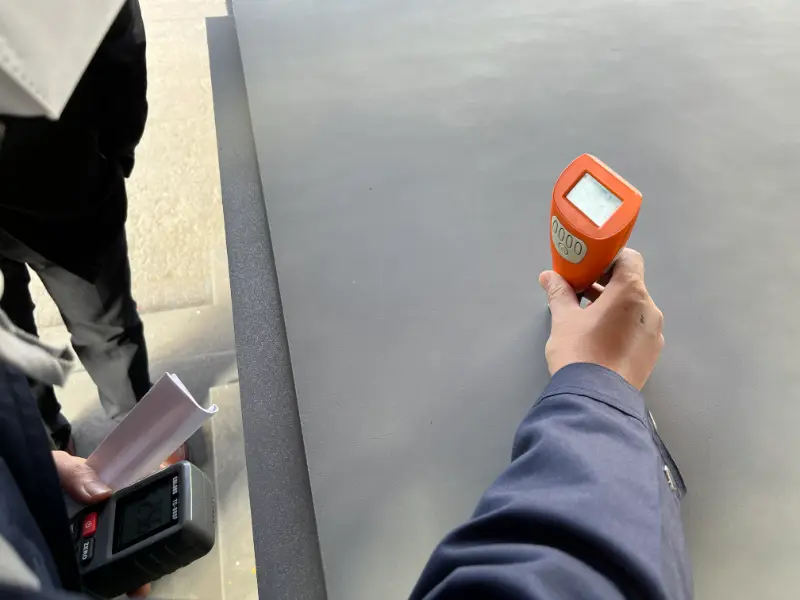
GL Grade D420 Shipbuilding Steel Plate
GL Grade D420 Shipbuilding Steel Plate - High Strength Marine Structural Steel
Detailed material data for GL Grade D420, a high-strength shipbuilding steel plate with minimum yield strength 420 MPa, excellent weldability, and impact toughness at -20°C.
Welding, gas cutting, cold forming, bending, machining
- Phone : +8618037372205
- Email : [email protected]
- WhatsApp: Contact via Whtsapp
- WeChat: +8618037372205
GL Grade D420 Shipbuilding Steel Plate Introduction
GL Grade D420 is a high-strength, thermo-mechanical control processed (TMCP) structural steel plate intended for shipbuilding and offshore applications. It is classified under the Germanischer Lloyd (GL) Rules (now DNV GL) as a Grade D420 material, offering a minimum yield strength of 420 MPa in thicknesses up to 100 mm. The steel combines good weldability with guaranteed notch toughness at -20°C, making it suitable for critical hull and structural members. The delivery condition is typically TMCP or normalized upon agreement. Its chemistry is controlled to limit carbon equivalent and improve weldability, often micro-alloyed with V, Nb, and Ti. This grade meets the requirements of IACS UR W11 and is fully equivalent to other major classification society designations such as ABS D420, DNV NV D420, BV D420, LR D420, and CCS D420. Typical applications include shell plates, decks, longitudinal stiffeners, and offshore platform components where high strength and impact resistance are essential.
GL Grade D420 Shipbuilding Steel Plate Chemical Composition
The chemical composition meets the requirements of IACS UR W11 and GL Rules for high-strength shipbuilding steel. Values are maximum unless a range is specified. Al is added for fine-grain practice, and the carbon equivalent (CEV) is controlled to ensure good weldability. The indicated CEV is valid for product thickness ≤ 100 mm; for thicker plates, lower limits may apply.
| Element | Specified Value | Remarks |
|---|---|---|
| C | ≤0.21 | |
| Si | 0.10–0.55 | |
| Mn | 0.80–1.70 | |
| P | ≤0.030 | |
| S | ≤0.030 | |
| Cr | ≤0.25 | |
| Ni | ≤0.25 | |
| Cu | ≤0.30 | |
| Mo | ≤0.08 | |
| Nb | ≤0.05 | |
| V | ≤0.10 | |
| Ti | ≤0.03 | |
| Al (total) | ≥0.015 | Fine grain practice |
| N | ≤0.012 | |
| CEV (Ceq) | ≤0.43 | Ceq = C+Mn/6+(Cr+Mo+V)/5+(Ni+Cu)/15 |
GL Grade D420 Shipbuilding Steel Plate Thermal and Electrical Physical Properties
The physical data provided are typical reference values for high-strength structural steel and may vary slightly with actual composition and processing. These values are useful for design calculations, heat transfer analysis, and electrical considerations. The properties are measured at room temperature unless otherwise indicated.
| Property | Typical Value | Unit | Condition / Temperature |
|---|---|---|---|
| Density ρ | 7850 | kg/m³ | 20°C |
| Modulus of elasticity E | 210 | GPa | 20°C |
| Shear modulus G | 81 | GPa | 20°C |
| Poisson's ratio ν | 0.3 | – | 20°C |
| Thermal expansion α (0–100°C) | 12.0 | 10⁻⁶/°C | 0–100°C |
| Thermal conductivity λ | 50 | W/(m·K) | 20°C |
| Specific heat capacity c | 460 | J/(kg·K) | 20°C |
| Electrical resistivity ρe | 0.20 | 10⁻⁶ Ω·m | 20°C |
GL Grade D420 Shipbuilding Steel Plate Mechanical Properties
Tensile and impact properties as per GL Rules and IACS UR W11, valid for plate thickness ≤100 mm. Yield strength (ReH) and tensile strength (Rm) are determined on longitudinal test specimens. Elongation (A) is measured on a gauge length of 5.65√S0. Charpy V‑notch impact energy (KV2) is tested at -20°C on longitudinal specimens. The cold bend test (180°) uses a mandrel diameter of 3 times the specimen thickness (a) when the specimen width is ≥50 mm.
| Property | Required Value | Unit | Test Conditions |
|---|---|---|---|
| Yield strength ReH | ≥420 | MPa | t ≤ 100 mm, longitudinal |
| Tensile strength Rm | 530–680 | MPa | t ≤ 100 mm, longitudinal |
| Elongation A (5.65√S0) | ≥18 | % | longitudinal |
| Charpy impact energy KV2 | ≥27 | J | -20°C, longitudinal |
| Bend test (180°) | mandrel diameter = 3a | – | t ≤ 20 mm, width ≥ 50 mm, no cracks |
GL Grade D420 Shipbuilding Steel Plate Fully Equivalent Standards and Replaceable Grades
| Country/Region | Standard / Class Society | Grade | Remarks |
|---|---|---|---|
| European Union | EN 10225 | S420G2+M | TMCP delivered, offshore structural steel, equivalent performance |
| USA | ABS Rules | ABS Grade D420 | American Bureau of Shipping, identical requirements |
| Norway | DNV Rules | DNV NV D420 | Part of DNV GL, same material specification |
| France | BV Rules | BV Grade D420 | Bureau Veritas, full equivalence |
| UK | LR Rules | LR Grade D420 | Lloyd's Register, fully interchangeable |
| China | CCS Rules | CCS Grade D420 | China Classification Society, equivalent grade |
| South Korea | KR Rules | KR Grade D420 | Korean Register, same mechanical and toughness requirements |
| Japan | NK Rules | NK Grade D420 | Nippon Kaiji Kyokai, equivalent high-strength grade |
| Italy | RINA Rules | RINA Grade D420 | Registro Italiano Navale, fully matching |
GL Grade D420 Shipbuilding Steel Plate Application Introduction
GL D420 steel is optimized for welded structures in marine environments. Its guaranteed low-temperature toughness makes it ideal for critical load-bearing members exposed to dynamic loads and cold climates. TMCP delivery provides a fine microstructure that balances high strength with excellent weldability, reducing pre-heat requirements.
Product Applications: Hull shell plates and strakes, Main deck and stringer plates, Longitudinal and transverse bulkheads, Stiffeners (angles, bulb flats, T-bars), Offshore platform deck plates and node cans, Foundation plates for heavy machinery
Processed into products: Longitudinal stiffeners and girders, Floor plates and web frames, Hatch coaming flanges, Rudder horn and stern frame reinforcements, Bracket plates at major intersections, Transition plates between deck and hull
Application industries: Shipbuilding (tankers, bulk carriers, container ships, naval vessels), Offshore engineering (jackets, topsides, semi-submersibles, FPSOs), Marine construction (port facilities, locks, gates, quay cranes)
GL Grade D420 Shipbuilding Steel Plate Similar / Nearby Substitute Materials
| Country/Region | Standard | Grade | Remarks |
|---|---|---|---|
| EU | EN 10025-4 | S420ML | Thermo-mechanically rolled weldable fine grain structural steel, not automatically class-certified for shipbuilding |
| EU | EN 10025-3 | S420NL | Normalized fine grain structural steel, similar strength, may need additional impact testing for marine use |
| USA | API 2W | Grade 50 (420) | Offshore structural steel plate, supplied in TMCP condition; verify class approval |
| USA | ASTM A572 | Grade 60 (415) | High strength low alloy structural steel, yield ≈415 MPa; not a direct class society equivalent, requires individual approval |
Notes:
All properties must be verified against the actual mill certificate. For thickness greater than 100 mm, property reduction factors may apply per GL Rules. Ultrasonic testing can be specified to class requirements. TMCP processed plates shall not be hot-formed above the tempering temperature (typically 600°C) to avoid strength degradation. Special attention should be paid to Ceq and PCM values for welding procedure qualifications. For sour service or special corrosion environments, additional testing (HIC, CTOD) may be required.
- Share



