
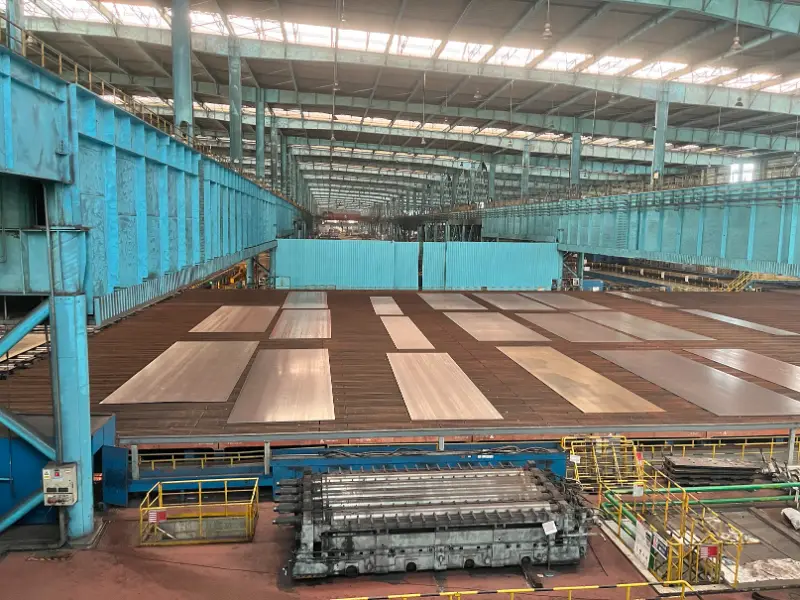
RINA Grade D690 Shipbuilding Steel Plate
RINA Grade D690 Shipbuilding Steel Plate - High Strength Marine & Offshore Steel
Detailed material data for RINA Grade D690 shipbuilding steel: chemical composition, mechanical properties, thermal and electrical characteristics, equivalent grades, and application guidelines.
Hot rolling, quenching, tempering, cutting (flame, plasma, laser), welding, cold forming (limited), machining
- Phone : +8618037372205
- Email : [email protected]
- WhatsApp: Contact via Whtsapp
- WeChat: +8618037372205
RINA Grade D690 Shipbuilding Steel Plate Introduction
RINA Grade D690 is a high-strength, quenched and tempered structural steel plate primarily intended for shipbuilding and offshore applications. It is certified by the Registro Italiano Navale (RINA) and offers a minimum yield strength of 690 MPa, excellent weldability, and reliable low-temperature toughness (impact test at -20°C). The steel is produced as plates with thickness-dependent mechanical properties and is supplied in the quenched and tempered condition. Its combination of high strength and good ductility makes it suitable for weight-critical, highly stressed structures in marine environments, such as deck panels, hull frames, heavy lifting equipment, and offshore platform components. Stringent control of micro-alloying elements and a low carbon equivalent ensure good weldability without preheating in moderate thicknesses, while maintaining superior resistance to brittle fracture.
RINA Grade D690 Shipbuilding Steel Plate Chemical Composition
The composition limits are as specified in RINA Rules for Grade D690 plates. Values reflect the maximum permitted for each element unless a range is given. Aluminum is required as a grain-refining element; total aluminum content is specified. Carbon equivalent (CEV) typically limited to maximum 0.47-0.52 depending on thickness to ensure weldability.
| Chemical Element | Standard Value (max % unless stated) | Remarks |
|---|---|---|
| Carbon (C) | 0.18 | Heat analysis |
| Silicon (Si) | 0.55 | Heat analysis |
| Manganese (Mn) | 1.60 | Heat analysis |
| Phosphorus (P) | 0.020 | Maximum |
| Sulfur (S) | 0.010 | Maximum |
| Chromium (Cr) | 0.80 | Maximum |
| Nickel (Ni) | 1.20 | Maximum |
| Molybdenum (Mo) | 0.50 | Maximum |
| Copper (Cu) | 0.50 | Maximum |
| Vanadium (V) | 0.10 | Maximum |
| Titanium (Ti) | 0.05 | Maximum |
| Niobium (Nb) | 0.05 | Maximum |
| Aluminum (Al, total) | 0.015 – 0.080 | Minimum 0.015 for grain refinement |
| Nitrogen (N) | 0.020 | Maximum, if sufficient Al/Ti present |
RINA Grade D690 Shipbuilding Steel Plate Thermal and Electrical Physical Properties
The data below represent typical values for quenched and tempered high-strength low-alloy steel similar to D690. These are not mandatory in RINA material specifications but are useful for design calculations. Thermal conductivity decreases slightly with increasing temperature. Electrical resistivity is given for direct-current applications.
| Property | Typical Value | Unit | Test Condition / Remark |
|---|---|---|---|
| Density (ρ) | 7850 | kg/m³ | At 20 °C |
| Elastic Modulus (E) | 205 – 210 | GPa | Room temperature |
| Shear Modulus (G) | ~80 | GPa | Calculated from E and ν |
| Poisson's Ratio (ν) | 0.3 | — | Typical for steel |
| Thermal Expansion Coefficient (α) | 12.0 × 10⁻⁶ | K⁻¹ | 20–100 °C range |
| Thermal Conductivity (λ) | ~40 | W/(m·K) | At 20 °C |
| Specific Heat Capacity (cp) | ~480 | J/(kg·K) | At 20 °C |
| Electrical Resistivity (ρₑ) | ~0.25 × 10⁻⁶ | Ω·m | At 20 °C |
RINA Grade D690 Shipbuilding Steel Plate Mechanical Properties
Mechanical properties are guaranteed in the quenched and tempered condition. The values apply to plate thicknesses typically up to 50 mm; for thicker plates, slightly reduced properties may be agreed. Charpy V‑notch impact tests are performed at -20°C for Grade D. The bending test is carried out with a mandrel diameter of 3× plate thickness (3a) and a bending angle of 180°.
| Property | Standard Requirement | Unit | Test Condition |
|---|---|---|---|
| Yield Strength (ReH) | ≥ 690 | MPa | Room temperature, transverse |
| Tensile Strength (Rm) | 770 – 940 | MPa | Room temperature, transverse |
| Elongation (A5) | ≥ 14 | % | Gauge length 5.65√S₀ |
| Charpy Impact Energy (KV2) | ≥ 50 | J | -20 °C, transverse |
| Bend Test | No cracks or flaws | 180°, mandrel dia. 3a |
RINA Grade D690 Shipbuilding Steel Plate Fully Equivalent Material Standards & Substitution Grades
The following grades are recognized as directly equivalent to RINA D690 under the respective classification society rules or international steel standards. Plates certified to these specifications can generally replace RINA D690 in ship and offshore construction, subject to approval.
| Country / Region | Standard / Rules | Equivalent Grade | Remarks |
|---|---|---|---|
| International | RINA Rules | RINA D690 | Original specification |
| International | EN 10025-6 | S690QL / S690QL1 | Identical strength class, quenched and tempered |
| USA | ASTM A514 / A517 | Grade S | Similar strength, often used for offshore |
| Norway/Germany | DNV Rules | E690 | DNV high-strength grade, impact at -40°C (can be agreed at -20°C) |
| USA/UK | ABS Rules | E690 | ABS equivalent |
| UK | Lloyd's Register Rules | E690 | LR equivalent |
| France | Bureau Veritas Rules | E690 | BV equivalent |
| China | CCS Rules | E690 | CCS equivalent |
| Japan | ClassNK Rules | E690 | NK equivalent |
RINA Grade D690 Shipbuilding Steel Plate Application Introduction
RINA D690 is designed for demanding marine and structural applications where high strength-to-weight ratio and guaranteed low-temperature toughness are critical. Welding must follow controlled procedures with low-hydrogen consumables; preheat and interpass temperatures are kept moderate due to the steel's low carbon equivalent. Cold forming is allowed to limited radii; hot forming may degrade the tempered structure and is generally not recommended unless followed by a re-heat treatment. The material can be processed by common cutting methods.
Product Applications: Main deck and bottom plates of large ships, Hull side shells and bulkheads, Crane booms and lifting frames, Jack-up rig legs and spudcans, Heavy welded structural beams and columns, Offshore mooring components, Armoured or blast-resistant structures
Processed into products: Welded tee and angle stiffeners, Flanges and web plates for girders, Cut-to-shape ear plates and padeyes, Transition joints between different strength grades, Machined pins and bushings (if designed accordingly), Base plates and reinforcement pads, Hydraulic cylinder brackets and supports
Application industries: Shipbuilding (naval and commercial vessels), Offshore oil & gas platforms, Renewable energy (wind turbine foundations, jackets), Heavy lifting and transport equipment, Mining and earthmoving machinery, Pressure vessels and boilers (where approved), Bridge construction
RINA Grade D690 Shipbuilding Steel Plate Similar / Alternative High-Strength Steels
These grades are not identical to RINA D690 but offer comparable strength levels and are often considered for similar applications. Modifications in chemistry or delivery condition may exist. Direct substitution requires careful review and, if necessary, approval.
| Country / Region | Standard | Grade | Remarks |
|---|---|---|---|
| Germany | EN 10025-6 | S690Q / S690QL | Very close, used in heavy equipment |
| Japan | JIS G 3128 | SHY 685 / SHY 685N | Similar quenched and tempered HSLA steel |
| USA | ASTM A709 | Grade 100 / 100W | Structural steel, 690 MPa min YS |
| Sweden | SSAB | WELDOX 700 / STRENX 700 | Commercial brand, high-strength plate |
| Germany | DIN EN 10025-6 | S700MC | Thermomechanically rolled (not QT) but similar strength |
| Netherlands | NEN-EN 10025-6 | 1.8928 / S690QL | Same EN standard |
Notes:
Ultrasonic testing: Plates are often ordered with UT inspection per EN 10160 Class S1/E1 or equivalent. Through-thickness properties: When required, Z-quality (Z25/Z35) can be specified according to EN 10164. Weldability: The CEV is typically ≤0.52%; for thicker sections a slightly higher CEV may be allowed if preheat is applied. Thickness tolerance: As per EN 10029 Class A or B. Surface condition: Blasted and primed shop primer can be applied on request. Heat treatment: Re-tempering after hot forming is mandatory to restore properties.
- Share



