
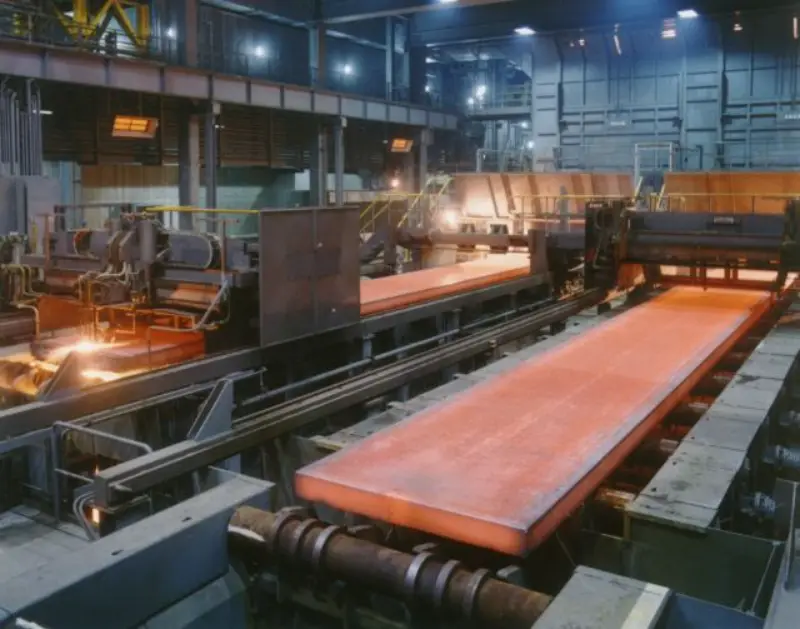
RINA Grade A36 Shipbuilding Steel Plate
RINA Grade A36 Shipbuilding Steel Plate: High-Strength Hull Structural Steel for Marine Engineering
Explore the comprehensive material properties, chemical composition, mechanical and thermal performance of RINA Grade A36 shipbuilding steel plate. Equivalent grades, similar alternatives, and application guidance for ship hulls, offshore structures, and marine components.
Hot rolling, normalizing rolling, thermo-mechanical controlled processing (TMCP), quenching and tempering (Q&T) as per required thickness. Suitable for cold forming, welding (all common arc processes), and straightening.
- Phone : +8618037372205
- Email : [email protected]
- WhatsApp: Contact via Whtsapp
- WeChat: +8618037372205
RINA Grade A36 Shipbuilding Steel Plate Introduction
RINA Grade A36 is a high-strength hull structural steel plate certified by the Italian Register of Shipping (RINA). It belongs to the normalized or thermo-mechanically rolled fine-grain steel category, with a minimum yield strength of 355 MPa (36 ksi). This grade offers an optimal balance of strength, toughness, and weldability, making it suitable for critical structural members in shipbuilding and offshore engineering. Key features:
- Excellent notch toughness at 0 °C, meeting rigorous maritime safety standards.
- Good cold-forming and welding characteristics under controlled heat input.
- Available in thicknesses up to 150 mm with consistent through-thickness properties.
- Complies with RINA Rules Part D, Chapter 3, and is equivalent to IACS UR W11 high-strength steel requirements.
RINA Grade A36 Shipbuilding Steel Plate Chemical Composition
Chemical composition limits as per RINA Rules for Grade A36 high-strength ship steel. The steel is fully killed and fine-grain treated (typically with Al, Nb, V, Ti). Key points:
- Carbon equivalent (CEV) is controlled to ensure good weldability.
- Microalloying elements (Nb, V, Ti) are added singly or in combination to achieve the required strength and toughness.
- Low sulfur and phosphorus levels enhance ductility and resistance to lamellar tearing.
| Element | Content (max, unless range) | Remarks |
|---|---|---|
| C (Carbon) | 0.18 % | For thickness ≤ 25 mm; up to 0.20 % may be permitted for thicker plates with CEV restrictions. |
| Si (Silicon) | 0.10 – 0.50 % | Range in fully killed steel to ensure deoxidation. |
| Mn (Manganese) | 0.90 – 1.60 % | May be increased to 1.70 % for thicknesses > 25.4 mm. |
| P (Phosphorus) | 0.035 % | Maximum; lower limits apply for better toughness and lamellar tearing resistance. |
| S (Sulfur) | 0.035 % | Maximum; low sulfur required for ductility and weld metal quality. |
| Cr (Chromium) | 0.20 % | Residual element; not intentionally added. May be higher if specified. |
| Ni (Nickel) | 0.40 % | Residual element; may be higher if agreed. |
| Mo (Molybdenum) | 0.08 % | Residual element; not a required addition for this grade. |
| Cu (Copper) | 0.35 % | Residual element; higher if specified for atmospheric corrosion resistance. |
| Al (Aluminum, total) | 0.015 – 0.060 % | Required as fine-grain element; acid-soluble Al content. |
| Nb (Niobium) | 0.02 – 0.05 % | Optional microalloy; used for grain refinement. |
| V (Vanadium) | 0.05 – 0.10 % | Optional microalloy; may be used in combination with Nb or Ti. |
| Ti (Titanium) | 0.007 – 0.05 % | Optional microalloy; nitrogen-binding element. |
| N (Nitrogen) | 0.009 % | Maximum; low nitrogen improves toughness in as-rolled condition. |
RINA Grade A36 Shipbuilding Steel Plate Physical Properties
Physical properties listed are typical for normalized/TMCP Grade A36 steel. They are not mandatory in the delivery specification but provide essential data for design and processing. Note:
- Thermal conductivity and specific heat capacity vary slightly with temperature.
- Values are for engineering calculations and are valid up to approximately 400 °C with acceptable accuracy.
| Property | Value | Unit | Condition / Remarks |
|---|---|---|---|
| Density (ρ) | 7.85 | g/cm³ | At 20 °C. |
| Young's Modulus (E) | 205 – 210 | GPa | At 20 °C; slightly decreases with temperature. |
| Shear Modulus (G) | 80 – 82 | GPa | Calculated from E and Poisson's ratio. |
| Poisson's Ratio (ν) | 0.28 – 0.30 | - | Within elastic range. |
| Coefficient of Thermal Expansion (α) | 11.5 – 12.5 | ×10⁻⁶ /K | Between 20 °C and 100 °C; average value approx. 12.0 ×10⁻⁶. Increases up to ~14.5 ×10⁻⁶ at 400 °C. |
| Thermal Conductivity (λ) | 45 – 50 | W/(m·K) | At 20 °C; decreases to ~36 W/(m·K) at 400 °C. |
| Specific Heat Capacity (c_p) | 460 – 500 | J/(kg·K) | At 20 °C; rises to ~600 J/(kg·K) at 400 °C. |
| Electrical Resistivity (ρ_e) | 0.16 – 0.25 | μΩ·m | At 20 °C; typical for carbon-manganese steel. |
RINA Grade A36 Shipbuilding Steel Plate Mechanical Properties
Mechanical properties are based on standard tensile and impact tests according to RINA Rules. Values refer to the as-delivered condition (normalized or TMCP). Important:
- Yield strength is the minimum upper yield (ReH) or 0.2% proof stress (Rp0.2).
- Charpy V-notch impact energy is measured at 0 °C for Grade A36, with longitudinal specimens typically used for certification.
- Bend test is performed at 3× thickness for elongation and flaw detection.
| Property | Requirement | Unit | Test Condition (Thickness t, Orientation) |
|---|---|---|---|
| Yield Strength (ReH) | 355 min | MPa | t ≤ 50 mm; transverse direction. For 50 < t ≤ 70 mm: 345 min; for 70 < t ≤ 100 mm: 335 min; for 100 < t ≤ 150 mm: 325 min. |
| Tensile Strength (Rm) | 490 – 620 | MPa | All thicknesses; transverse direction. |
| Elongation (A, 5.65√So) | 21 min | % | t ≤ 50 mm; transverse. For 50 < t ≤ 70 mm: 20 min; for 70 < t ≤ 100 mm: 19 min; for 100 < t ≤ 150 mm: 18 min. |
| Bend Test (180° bend, diam. = 3×t) | No cracks | - | t ≤ 25 mm; bend diameter 3a (a = specimen thickness); transverse direction. |
| Charpy Impact Energy (KV2) | 34 min (longitudinal) | J | At 0 °C; specimen size 10×10 mm; average of 3 tests, single min 24 J. For transverse tests: 24 J average, 17 J single minimum. |
| Charpy Impact Energy (KV2) | 24 min (transverse) | J | At 0 °C; specimen size 10×10 mm; average of 3 tests, single min 17 J. |
| Through-thickness Reduction of Area (Z) | 35 min (optional Z35) | % | If specified for lamellar tearing resistance, tested per EN 10164. |
RINA Grade A36 Shipbuilding Steel Plate Fully Equivalent Material Standards and Grades Substitution
| Country / Region | Standard / Classification Society | Grade | Remarks |
|---|---|---|---|
| International (IACS) | IACS UR W11 | A36 | All IACS member societies adopt equivalent high-strength ship steel grades. |
| UK / Global | Lloyd's Register (LR) | Grade A36 | Identical requirements; same chemical and mechanical limits. |
| Norway / Global | DNV (now DNV) | VL A36 | Previous designation NV A36; now DNV VL A36 for ships; same properties. |
| USA / Global | American Bureau of Shipping (ABS) | ABS Grade A36 | Equivalent to ASTM A131/A131M Grade AH36 when normalized. |
| France / Global | Bureau Veritas (BV) | A36 | Compliant with BV Rules Pt.4, Ch.1, App.2. |
| Germany / Global | Germanischer Lloyd (GL) – now DNV GL | A36 | Former GL A36; now integrated into DNV. |
| China / Global | China Classification Society (CCS) | A36 | Identical; CCS rules align with IACS UR W11. |
| Japan / Global | Nippon Kaiji Kyokai (ClassNK) | KA36 | Often designated KA36, with same requirements. |
| South Korea / Global | Korean Register (KR) | RA36 | May be designated RA36 or A36; synonymous. |
| India / Global | Indian Register of Shipping (IRS) | A36 | IRS Grade A36 conforms to IACS UR. |
RINA Grade A36 Shipbuilding Steel Plate Application Introduction
RINA Grade A36 steel plate is designed for use in ship hulls, offshore platforms, and other marine structures where high strength and good weldability are required. Its 355 MPa minimum yield strength allows weight reduction compared to ordinary-strength steel (235 MPa class). Key application areas:
Product Applications: Main deck plates and stringer plates, Side shell and bottom shell longitudinally stiffened panels, Transverse and longitudinal bulkheads, Inner bottom plates and floors, Hatch coamings and covers, Structural stiffeners (flat bars, bulb profiles) cut from plate, Offshore module support frames and columns, Jack-up rig leg chords and racks (subject to additional requirements)
Processed into products: Ship hull sections (blocks and sub-assemblies) for all major vessel types, Stiffened panels for decks and bulkheads, Brackets, gussets, and tripping brackets, Crane pedestals and slewing rings, Foundation plates for heavy machinery on board, Protective enclosures and blast walls on platforms, Piles and primary beams of offshore wind substructures, Transition pieces and grouted connections
Application industries: Shipbuilding (commercial vessels, bulk carriers, tankers, container ships, passenger ships), Offshore engineering (oil & gas platforms, FPSO, jack-up rigs, subsea structures), Port and harbor machinery (crane booms, container handling equipment), Renewable energy (offshore wind turbine foundations, transition pieces), Bridge and structural engineering (when certified by RINA for marine environment)
RINA Grade A36 Shipbuilding Steel Plate Similar and Alternative Material Grades
| Country / Region | Standard / Classification Society | Grade | Remarks |
|---|---|---|---|
| All IACS Members | IACS UR W11 | A32 / D32 / E32 | Lower strength level (minimum yield 315 MPa) but similar weldability; used where 36 ksi not required. |
| All IACS Members | IACS UR W11 | D36 | Same strength as A36, but impact test temperature -20 °C; better notch toughness. |
| All IACS Members | IACS UR W11 | E36 | Same strength, impact temperature -40 °C; suitable for critical low-temperature applications. |
| All IACS Members | IACS UR W11 | F36 | Same strength, impact temperature -60 °C; for arctic service steel. |
| USA | ASTM A131/A131M | Grade AH36 | Similar strength and impact at 0 °C; normalized or TMCP. Equivalent to A36. |
| Europe | EN 10025-4 | S355ML / S355N | Structural steel with minimum yield 355 MPa; S355ML (TMCP) with specified low-temperature properties; can substitute in non-marine cert. applications. |
| China | GB/T 712 | AH36 | Direct equivalent; identical to CCS A36. |
Notes:
Certification: Each plate must be stamped with RINA stamp, grade, heat number, and surveyor's mark. Ultrasonic testing to EN 10160 Class S0E1 or higher is often specified. Weldability: Carbon equivalent (CEV) calculated by IIW formula typically ≤ 0.40 % for this grade. Preheat and interpass temperature control may be required for thick sections. Tolerances: Dimensional tolerances as per EN 10029 for plates. Surface protection: Shop primed with zinc-rich or epoxy primer is common to prevent corrosion during construction. Additional tests: CTOD or through-thickness tensile (Z35) can be ordered for critical fatigue-sensitive joints.
- Share



