
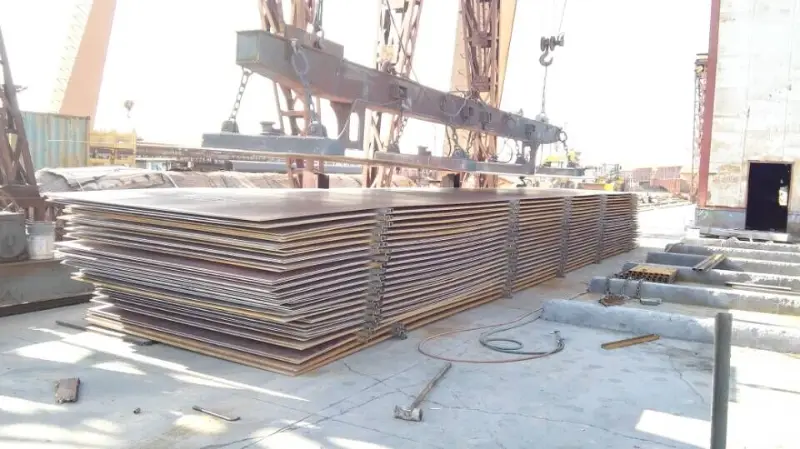
RINA Grade D36 Steel Plate
RINA Grade D36 Shipbuilding Steel Plate: Properties, Equivalents & Applications
Comprehensive technical data for RINA Grade D36 (DH36) shipbuilding steel plate, including chemical composition, mechanical and physical properties, international equivalents, and application guide.
Hot rolling followed by normalising (N) or thermomechanical controlled processing (TMCP); weldable by all common arc methods.
- Phone : +8618037372205
- Email : [email protected]
- WhatsApp: Contact via Whtsapp
- WeChat: +8618037372205
RINA Grade D36 Steel Plate Introduction
RINA Grade D36, often designated as DH36 in the RINA classification, is a high-strength shipbuilding structural steel plate specified by the Registro Italiano Navale (Italian Naval Register). This normalised or thermomechanically controlled processed (TMCP) steel guarantees a minimum yield strength of 355 MPa and offers excellent weldability and low-temperature toughness (impact test at -20°C). Key properties:
- High strength-to-weight ratio for lightweight ship structures.
- Good ductility and notch toughness for operations in cold waters.
- Conforms to IACS UR W11 and RINA Rules Part D, Chapter 3.
- Widely used in hulls, offshore platforms, and marine equipment.
RINA Grade D36 Steel Plate Chemical Composition
The chemical composition of RINA Grade D36 complies with IACS UR W11 (Rev.12) for high-strength hull structural steels with a minimum yield strength of 355 MPa. Grain-refining elements such as aluminium, niobium, vanadium, or titanium may be used individually or in combination. Residual elements like copper, chromium, nickel, and molybdenum are limited to avoid adverse effects on weldability and toughness.
| Element | Standard Value (max, unless range stated) | Remarks |
|---|---|---|
| Carbon (C) | ≤ 0.18% | Ladle analysis |
| Silicon (Si) | ≤ 0.50% | Typically 0.10–0.50% |
| Manganese (Mn) | 0.90–1.60% | Depending on thickness and carbon equivalent |
| Phosphorus (P) | ≤ 0.035% | Lower values typical for better toughness |
| Sulphur (S) | ≤ 0.035% | Low sulphur for improved cleanliness |
| Aluminium (Al, acid sol.) | ≥ 0.015% | When used as grain refiner |
| Niobium (Nb) | 0.02–0.05% | Optional microalloy |
| Vanadium (V) | 0.05–0.10% | Optional microalloy |
| Titanium (Ti) | ≤ 0.02% | Optional microalloy; if combined with Al, Nb, V limitations apply |
| Copper (Cu) | ≤ 0.35% | Residual element |
| Chromium (Cr) | ≤ 0.20% | Residual element |
| Nickel (Ni) | ≤ 0.40% | Residual element |
| Molybdenum (Mo) | ≤ 0.08% | Residual element |
| Nitrogen (N) | ≤ 0.009% | When binding with Al or other elements |
RINA Grade D36 Steel Plate Thermal and Electrical Physical Properties
The following data are typical for carbon‑manganese high‑strength structural steels and can be used for engineering calculations. They are not part of the mandatory classification specification but are representative of RINA D36 grade plates. Temperature‑dependent properties (expansion, conductivity, specific heat) are shown for selected ranges.
| Property | Typical Value | Unit | Test Condition / Remarks |
|---|---|---|---|
| Density (ρ) | 7850 | kg/m³ | At 20°C |
| Elastic modulus (E) | 210 | GPa | At 20°C; decreases with temperature |
| Shear modulus (G) | ≈ 80 | GPa | Calculated from E and Poisson's ratio |
| Poisson's ratio (ν) | 0.3 | — | Within linear‑elastic range |
| Thermal expansion (α) | 11.7 | 10⁻⁶/K | Between 20°C and 100°C |
| Thermal expansion (α) | 12.5 | 10⁻⁶/K | Between 20°C and 200°C |
| Thermal expansion (α) | 13.5 | 10⁻⁶/K | Between 20°C and 400°C |
| Thermal conductivity (λ) | 51 | W/(m·K) | At 20°C |
| Thermal conductivity (λ) | 47 | W/(m·K) | At 200°C |
| Thermal conductivity (λ) | 42 | W/(m·K) | At 400°C |
| Specific heat capacity (c) | 460 | J/(kg·K) | At 20°C; increases with temperature |
| Electrical resistivity (ρ_e) | ≈ 0.20 | 10⁻⁶ Ω·m | At 20°C; typical for carbon‑manganese steel |
RINA Grade D36 Steel Plate Mechanical Properties
The mechanical property requirements for RINA D36 plates are derived from RINA Rules Part D. Test pieces are taken in the transverse direction unless otherwise agreed. Yield strength and tensile strength apply to thicknesses up to 100 mm. Impact energy is specified at -20°C for the D grade; values given are for longitudinal specimens (transverse values are 70% of the longitudinal ones). Bend test mandrel diameter depends on plate thickness.
| Property | Standard Required Value | Unit | Test Condition / Remarks |
|---|---|---|---|
| Yield strength (ReH) | ≥ 355 | MPa | Upper yield, or 0.2% proof stress (Rp0.2); applicable for t ≤ 100 mm |
| Tensile strength (Rm) | 490 – 630 | MPa | For plates t ≤ 100 mm |
| Elongation (A) | ≥ 21 | % | Gauge length 5.65√So (L0=50 mm for a standard flat specimen); t ≤ 50 mm |
| Elongation (A) | ≥ 20 | % | Gauge length 5.65√So; 50 < t ≤ 70 mm |
| Elongation (A) | ≥ 19 | % | Gauge length 5.65√So; 70 < t ≤ 100 mm |
| Bend test (180°) | No cracks | — | Mandrel diameter = 3a (thickness a ≤ 50 mm); 4a (50 < a ≤ 75 mm); 5a (75 < a ≤ 100 mm) |
| Impact energy (KV2) | ≥ 34 (longitudinal) | J | Charpy V-notch at -20°C; average of three tests, individual min. 70% of specified average |
| Impact energy (KV2) | ≥ 24 (transverse) | J | Charpy V-notch at -20°C; for transverse specimen when required |
RINA Grade D36 Steel Plate Full Equivalents – International Classification Society Standards
| Country / Region | Standard / Classification Society | Grade | Remarks |
|---|---|---|---|
| International | IACS UR W11 | AH36, DH36, EH36, FH36 | D36 corresponds to DH36 (impact test -20°C) |
| Italy | RINA | DH36 | Official RINA grade name; D36 is commonly used |
| USA | ABS | DH36 | American Bureau of Shipping – identical requirements |
| United Kingdom | LR | DH36 | Lloyd's Register |
| Norway / Germany | DNV | DH36 | DNV GL (now DNV) rules for ships |
| France | BV | DH36 | Bureau Veritas marine & offshore rules |
| China | CCS | DH36 | China Classification Society |
| Japan | NK (ClassNK) | DH36 | Nippon Kaiji Kyokai |
| South Korea | KR | DH36 | Korean Register |
| India | IRS | DH36 | Indian Register of Shipping |
| Russia | RMRS | DH36 | Russian Maritime Register of Shipping |
| Poland | PRS | DH36 | Polish Register of Shipping |
| Croatia | CRS | DH36 | Croatian Register of Shipping |
RINA Grade D36 Steel Plate Application Introduction
RINA Grade D36 is primarily used in the construction of merchant ships, naval vessels, and offshore structures that require a combination of high strength, excellent weldability, and guaranteed toughness at low temperatures. Typical applications:
- Main hull plates, decks, and bottom shells.
- Longitudinal stiffeners, transverse webs, and frames.
- Offshore platform topside structures and jacket legs.
- Marine crane booms and heavy-lift equipment.
- Structural elements in polar-class vessels operating in icy environments.
Processing via normalising or TMCP allows the steel to be easily cut, formed, and welded using standard shipyard practices.
Product Applications: Container ships, bulk carriers, and tankers, Offshore supply vessels (OSVs) and anchor handlers, Semi‑submersible drilling rigs and jack‑up legs, LNG/LPG carrier hulls, Floating production storage and offloading units (FPSO), Wind turbine transition pieces and monopile foundations
Processed into products: Shell plates and bilge keels, Deck plating and stringer plates, Transverse bulkheads and web frames, Bottom longitudinal stiffeners and floors, Hatch coaming and corner castings, Bow and stern structural modules, Crane pedestals and heavy‑duty mounting plates
Application industries: Shipbuilding (commercial and naval), Offshore oil & gas (platforms, FPSOs), Marine renewable energy (offshore wind foundations), Heavy marine equipment manufacturing, Port and harbour infrastructure (steel piles, sheet piles)
RINA Grade D36 Steel Plate Similar or Alternative Materials
| Country / Region | Standard / Grade | Designation | Remarks |
|---|---|---|---|
| International | IACS UR W11 | EH36 | Higher toughness: impact at -40°C; otherwise same strength as D36 |
| International | IACS UR W11 | AH36 | Lower toughness: impact at 0°C; same strength level |
| Europe | EN 10025-3/4 | S355G9+N / S355G9+M | Normalised or TMCP offshore structural steel, similar strength |
| Europe | EN 10025-6 | S355QL / S355QL1 | Quenched and tempered steel with yield ≈355 MPa, good low‑temperature toughness, used in heavier sections |
| USA | ASTM A131 / A131M | DH36 | Identical chemical and mechanical requirements; often accepted as equivalent |
| Japan | JIS G 3106 | SM490A/B/C, SM490YA/YB | Weldable structural steels with min. yield 325–365 MPa; not specifically for shipbuilding but used in general structures |
| China | GB/T 712 | DH36 | Identical to national marine steel standard; fully equivalent |
Notes:
Delivery conditions and supplementary requirements: RINA D36 plates are typically supplied with a mill test certificate (3.1 or 3.2 according to EN 10204) stating chemical composition, tensile properties, and Charpy impact results. Plates may be ordered with through‑thickness properties (Z‑direction) according to RINA additional requirements. Welding: Preheat and interpass temperature control may be required depending on plate thickness and carbon equivalent (CEV typically ≤ 0.45%). Low‑hydrogen welding consumables are recommended to avoid cold cracking. Any deviations from standard specifications must be agreed upon between the purchaser and the mill.
- Share



