
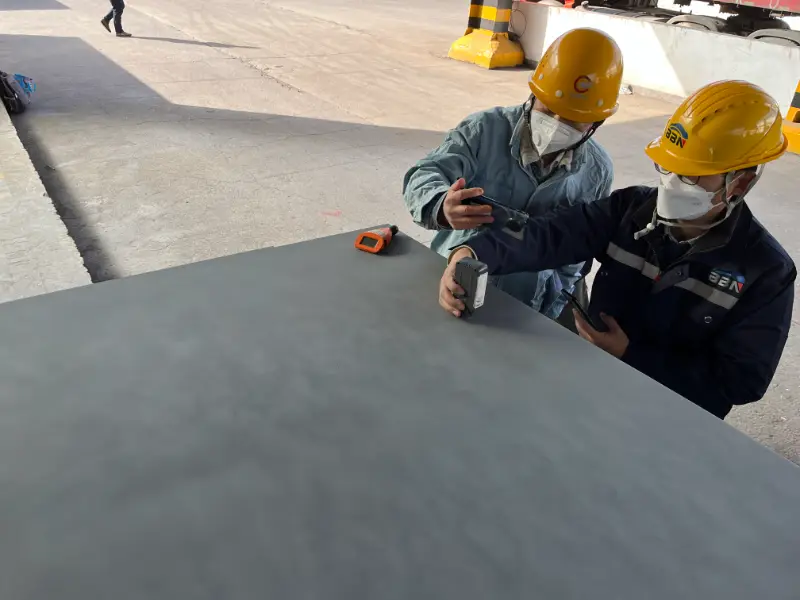
RINA Grade E36 Shipbuilding Steel Plate
RINA Grade E36 Shipbuilding Steel Plate: High-Strength, Low-Temperature Toughness for Marine Structures
Detailed material data for RINA Grade E36 shipbuilding steel plate, including chemical composition, mechanical and physical properties, international equivalents, and application guide. A high-strength, normalized steel with excellent weldability and guaranteed impact toughness at -40°C, certified by the Italian Classification Society.
Suitable for welding (all conventional methods), cutting, cold and hot forming, and machining. TMCP and normalized plates can be cold formed within limits. Preheating may be required depending on thickness and carbon equivalent.
- Phone : +8618037372205
- Email : [email protected]
- WhatsApp: Contact via Whtsapp
- WeChat: +8618037372205
RINA Grade E36 Shipbuilding Steel Plate Introduction
RINA Grade E36 is a high-strength, weldable structural steel plate for shipbuilding and offshore applications, as per the rules of the Italian Classification Society (Registro Italiano Navale). With a minimum yield strength of 355 MPa and good toughness down to -40°C, it is ideal for critical components such as hulls, decks, and offshore structures. This steel is typically supplied in normalized or thermo-mechanically controlled processed (TMCP) condition, offering a fine-grained microstructure, excellent weldability, and resistance to brittle fracture. It belongs to the high-strength hull structural steel family and is closely harmonized with international class society grades like EH36 from ABS, DNV, BV, and LR.
RINA Grade E36 Shipbuilding Steel Plate Chemical Composition
Ladle analysis as per RINA Rules for high-strength shipbuilding steels, thickness ≤ 100 mm. Elements not listed may be present as residuals. Carbon equivalent (CEV) is calculated to ensure good weldability. For larger thickness, microalloying elements (Nb, V, Ti) may be added to refine grain and maintain strength.
- CEV = C + Mn/6 + (Cr+Mo+V)/5 + (Ni+Cu)/15
- Pcm parameter is also often reported for weldability assessment.
| Element | Specified Value (max unless range) | Remarks |
|---|---|---|
| Carbon (C) | ≤ 0.18% | Ladle analysis; product analysis +0.02% tolerance |
| Manganese (Mn) | 0.90 – 1.60% | For thickness ≤ 25 mm, lower Mn may apply; exact range depends on CEV |
| Silicon (Si) | ≤ 0.50% | Killed steel; usually deoxidized with Al |
| Phosphorus (P) | ≤ 0.030% | Max for all thicknesses |
| Sulfur (S) | ≤ 0.030% | Max for all thicknesses |
| Aluminium (Al, acid soluble) | ≥ 0.015% | Indicates sufficient deoxidation for fine grain |
| Niobium (Nb) | ≤ 0.05% | Optional microalloying; may be specified for TMCP products |
| Vanadium (V) | ≤ 0.10% | Optional microalloying |
| Titanium (Ti) | ≤ 0.02% | Optional for grain refinement |
| Copper (Cu) | ≤ 0.35% | Residual element |
| Chromium (Cr) | ≤ 0.20% | Residual element; may be added for specific corrosion resistance |
| Nickel (Ni) | ≤ 0.40% | Residual element; may be higher for improved toughness |
| Molybdenum (Mo) | ≤ 0.08% | Residual element |
RINA Grade E36 Shipbuilding Steel Plate Thermal and Electrical Physical Properties
Representative values for carbon-manganese structural steel at room temperature unless noted. Actual values depend on composition and heat treatment. These data are based on literature for similar steel grades (e.g., EH36/S355) and are useful for design calculations. Thermal properties are important for welding procedure development and fire resistance analysis.
- Density and modulus values are standard for low-alloy steel.
- Thermal conductivity decreases slightly with increasing temperature.
| Property | Typical Value | Unit | Condition / Reference Temperature |
|---|---|---|---|
| Density (ρ) | 7850 | kg/m³ | 20°C |
| Young's Modulus (E) | 205 | GPa | 20°C; dynamic modulus |
| Shear Modulus (G) | 80 | GPa | 20°C (calculated from E and ν) |
| Poisson's Ratio (ν) | 0.3 | - | At room temperature |
| Thermal Expansion Coefficient (α) | 11.7 – 13.0 | 10⁻⁶/K | Between 20°C and 100°C |
| Thermal Conductivity (λ) | 45 – 55 | W/(m·K) | At 20°C; decreases to ~40 at 200°C |
| Specific Heat Capacity (cp) | 460 – 490 | J/(kg·K) | Between 20°C and 100°C |
| Electrical Resistivity (ρe) | 0.25 – 0.30 | ×10⁻⁶ Ω·m | At 20°C |
RINA Grade E36 Shipbuilding Steel Plate Mechanical Properties
Transverse test pieces for plates; longitudinal values are slightly higher. Impact test temperature is -40°C for Grade E36. Yield and tensile requirements depend on thickness range. Bend test is normally required: 180° bend over a mandrel diameter = 3 × thickness for tensile strength up to 530 MPa. For higher strength, a larger mandrel may be used. CVN impact energy is guaranteed on Charpy V-notch specimens.
- All tests as per RINA rules, typically witnessing by surveyor.
- Properties apply to normalized or TMCP condition.
| Property | Specified Value | Unit | Test Condition |
|---|---|---|---|
| Yield Strength (ReH, min) | 355 | MPa | Thickness ≤ 100 mm; for t>100 mm: 345 MPa min |
| Tensile Strength (Rm) | 490 – 630 | MPa | All thicknesses |
| Elongation (A5, min) | 22 | % | Gauge length 5.65√So; transverse test piece |
| Bend Test (180°) | No cracks | - | Mandrel diameter = 3×t (for Rm ≤ 530 MPa); 4×t for Rm >530 MPa |
| Charpy Impact Energy (KV, min) | 50 | J | Longitudinal; -40°C; average of 3 tests; single min 35 J |
| Charpy Impact Energy (KV, min) | 34 | J | Transverse; -40°C; average of 3 tests; single min 24 J |
RINA Grade E36 Shipbuilding Steel Plate Fully Equivalent Material Standard and Substitute Grade Recommendations
These Grade E36 steels from various classification societies are considered equivalent and directly interchangeable, subject to identical mechanical properties and chemical composition constraints. Certificates are mutually recognized under IACS unified requirements.
| Country / Region | Standard / Classification Society | Grade | Remarks |
|---|---|---|---|
| International | IACS UR W11 | EH36 | Unified requirement for high-strength hull structural steel |
| USA / International | ABS Rules | EH36 | American Bureau of Shipping, identical -40°C toughness |
| Norway / Germany | DNV Rules | EH36 | DNV GL (now DNV) standard for shipbuilding |
| France | BV Rules | EH36 | Bureau Veritas specification |
| UK | LR Rules | EH36 | Lloyd's Register, same yield and impact requirements |
| China | CCS Rules | EH36 | China Classification Society |
| Japan | NK Rules | EH36 | Nippon Kaiji Kyokai (ClassNK) |
| Korea | KR Rules | EH36 | Korean Register |
| Russia | RS Rules | E36 | Russian Maritime Register of Shipping |
| Europe | EN 10025-4 | S355M/ML | TMCP steel, but often supplied as S355G10 for offshore; equivalent mechanicals |
RINA Grade E36 Shipbuilding Steel Plate Application Introduction
RINA Grade E36 steel plate is the backbone of modern shipbuilding and offshore engineering where high strength, excellent weldability, and resistance to brittle fracture at low temperatures are mandatory. Its -40°C Charpy guarantee makes it especially suitable for vessels operating in cold climates or ice regions. Typical applications include:
- Hulls and decks of ice-class vessels, tankers, bulk carriers, and container ships.
- Critical structural members of offshore platforms (jackets, decks, legs).
- Marine equipment such as crane pedestals, winch foundations, and hull reinforcements.
- Arctic and subarctic construction: modules, living quarters, flare booms.
The steel is normally delivered with class certificates (3.2) to streamline regulatory approval. Pre-cut shapes, beveling, and primer coatings are available from mills.
Product Applications: Ice-class container ships and tankers, Offshore platform jacket structures, Wind turbine monopile and transition pieces, Ship hull plate kits and modules, Harbor crane booms and gantry structures
Processed into products: Hull shell plates and stiffeners, Decks and bulkheads, Offshore module main girders and columns, Leg chords of jack-up rigs, Bracket plates and web frames, Heavy-lift crane pedestals and rings, Helideck support structures, Padeyes and lifting lugs (with appropriate design)
Application industries: Shipbuilding and ship repair (merchant, navy, icebreakers), Offshore oil and gas (fixed platforms, jack-ups, floating production units), Renewable energy (offshore wind turbine towers and foundations), Heavy civil engineering (bridges, lock gates, port cranes), Marine equipment manufacturing
RINA Grade E36 Shipbuilding Steel Plate Similar / Alternative Material Recommendations
| Country / Region | Standard / Classification Society | Grade | Remarks |
|---|---|---|---|
| International | IACS UR W11 | EH36 MOD or E40 | E40 has higher yield (390 MPa), heavy sections; E36 with extra requirements (Z-quality, CTOD) may be similar |
| Europe | EN 10225 | S355G10+M | Weldable structural steel for offshore structures; similar strength but with additional properties (e.g., CTOD) sometimes specified |
| USA | ASTM A131 / ABS | EH36 | Same grade, but ASTM A131 adds domestic thickness tolerances; chemically similar |
| International | API 2W / 2Y | Grade 50 (355 MPa) | Offshore structural steel, used for fixed platforms; may require through-thickness properties (Z35) |
| Japan | JIS G 3106 / JIS G 3114 | SM490B / SM520B | Similar tensile strength (490 MPa range) but need to verify low-temperature impact; JIS does not directly match -40°C requirement |
Notes:
Welding considerations: Use low-hydrogen processes; preheat and interpass temperatures to be controlled based on plate thickness and carbon equivalent (typical CEV ≤ 0.38). Post-weld heat treatment (PWHT) is not normally required for thicknesses up to 50 mm unless specified by design code. Supplementary requirements: Through-thickness properties (Z15, Z25, Z35) can be ordered per EN 10164 or IACS. CTOD testing may be required for critical joints in offshore applications. Marking: Plates are marked with manufacturer's name, grade, heat number, and RINA stamp. Traceability is fully maintained.
- Share



