
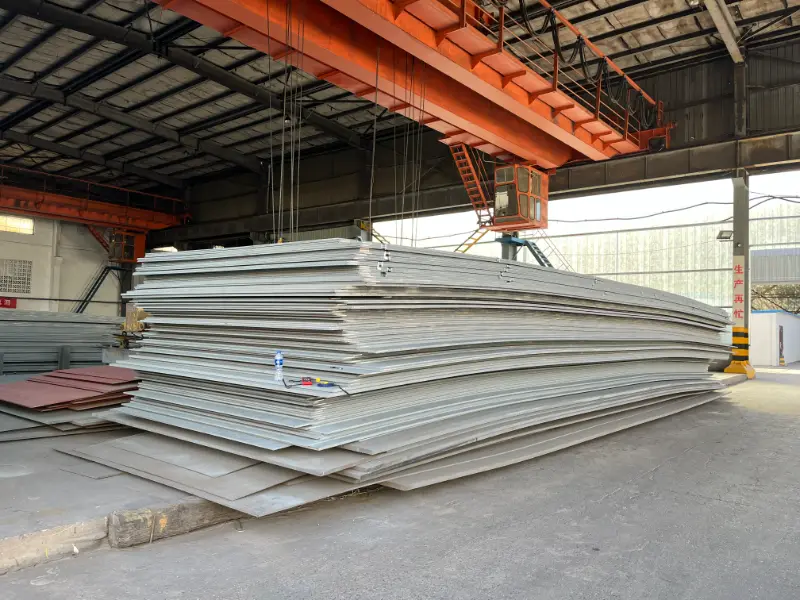
RINA Grade F36 Shipbuilding Steel Plate
RINA Grade F36 Shipbuilding Steel Plate - High-Strength Cryogenic Hull Structural Steel
Explore certified data for RINA Grade F36 shipbuilding steel plate – chemical composition, mechanical properties, thermal/electrical properties, international equivalents, and application guide. Ideal for marine structures requiring excellent notch toughness at -60°C.
Normalised (N), normalised and tempered (N+T), or thermomechanically controlled rolled (TMCP); delivery in as-rolled condition is not permitted for grade F. Suitable for shearing, cold forming, machining, and welding with proper consumables.
- Phone : +8618037372205
- Email : [email protected]
- WhatsApp: Contact via Whtsapp
- WeChat: +8618037372205
RINA Grade F36 Shipbuilding Steel Plate Introduction
RINA Grade F36 is a high-strength hull structural steel certified by the Registro Italiano Navale (Italian Naval Register). It belongs to the higher strength group with a specified minimum yield strength of 355 MPa and guaranteed impact toughness at -60°C. The grade is designed for critical structural components of ships and offshore platforms operating in severe environments, including cryogenic conditions. Main characteristics:
- Fine-grain fully killed steel processed by normalising or thermomechanical controlled rolling (TMCP)
- Excellent weldability and cold-bending properties
- Low-temperature notch toughness meeting the strictest F-grade requirements
- Compliant with IACS Unified Requirement W11 for high-strength steels
- Available in plates and wide flats with thicknesses up to 150 mm
RINA Grade F36 Shipbuilding Steel Plate Chemical Composition
The chemical requirements for RINA Grade F36 are in accordance with IACS UR W11 and RINA Rules Part D, Chapter 3. The steel is fully killed and fine-grain treated. All elements are controlled to ensure high strength, excellent toughness and weldability. Key features:
- Maximum carbon equivalent (CEV) applies for weldability
- Grain-refining elements (Nb, V, Al) are mandatory
- Low phosphorus and sulphur for superior cleanliness
| Element | Standard Value (≤ unless stated) | Remarks |
|---|---|---|
| Carbon (C) | 0.16 | Ladle analysis |
| Manganese (Mn) | 0.90 – 1.60 | For thickness ≤50 mm; higher Mn may be agreed for thicker plates |
| Silicon (Si) | 0.50 | Also minimum 0.10% required for fully killed steel |
| Phosphorus (P) | 0.025 | Low P for toughness |
| Sulphur (S) | 0.025 | Low S for lamellar tearing resistance |
| Aluminium (Al) acid soluble | ≥ 0.015 | Grain refinement |
| Niobium (Nb) | 0.02 – 0.05 | Microalloy for strength and toughness |
| Vanadium (V) | 0.05 – 0.10 | Microalloy, optional |
| Titanium (Ti) | 0.02 | Grain refinement, if added |
| Copper (Cu) | 0.35 | Residual element |
| Chromium (Cr) | 0.20 | Residual element |
| Nickel (Ni) | 0.40 | Residual element; higher may be agreed for thick plates |
| Molybdenum (Mo) | 0.08 | Residual element |
| Nitrogen (N) | 0.009 | Maximum for fine-grain treatment; higher allowed if sufficiently bound by Al/Ti |
| Niobium + Vanadium + Titanium | ≤ 0.12 | Sum of microalloying elements |
| Carbon Equivalent (CEV) | ≤ 0.38 (typical) | Calculated as C + Mn/6 + (Cr+Mo+V)/5 + (Ni+Cu)/15; actual value depends on thickness and delivered condition |
RINA Grade F36 Shipbuilding Steel Plate Thermal and Electrical Physical Properties
The physical properties are typical for hot-rolled high-strength structural steel plates and are not part of the RINA specification. These values are provided for engineering reference and are based on published data for similar grades (e.g., EN 10025-4 S355ML/S355M). Note: Actual properties may slightly vary depending on exact chemistry and delivery condition.
| Property | Standard Value | Unit | Test Conditions / Remarks |
|---|---|---|---|
| Density (ρ) | 7850 | kg/m³ | At room temperature |
| Elastic modulus (E) | 205 | GPa | At 20°C, longitudinal, typical for structural steel |
| Shear modulus (G) | 80 | GPa | Calculated from E and ν |
| Poisson's ratio (ν) | 0.30 | – | Within elastic range |
| Thermal expansion coefficient (α) | 11.7 × 10⁻⁶ | K⁻¹ | Linear expansion, range 20–100°C |
| Thermal expansion coefficient (α) | 12.5 × 10⁻⁶ | K⁻¹ | Range 20–200°C |
| Thermal expansion coefficient (α) | 13.5 × 10⁻⁶ | K⁻¹ | Range 20–400°C |
| Thermal conductivity (λ) | 45 | W/(m·K) | At 20°C |
| Thermal conductivity (λ) | 40 | W/(m·K) | At 200°C |
| Specific heat capacity (cₚ) | 460 | J/(kg·K) | At room temperature, typical |
| Electrical resistivity (ρ_e) | 0.23 | µΩ·m | At 20°C |
RINA Grade F36 Shipbuilding Steel Plate Mechanical Properties
Tensile and impact testing is performed on specimens in accordance with RINA Rules. The values below are minimum requirements unless otherwise indicated. Impact tests are carried out on Charpy V-notch specimens at -60°C in longitudinal direction. Testing standards: Tensile test ISO 6892-1, Impact test ISO 148-1. Bending test is mandatory for plates ≤ 50 mm.
| Property | Standard Requirement | Unit | Test Conditions / Remarks |
|---|---|---|---|
| Yield strength (ReH) | ≥ 355 | MPa | Upper yield strength, for thickness ≤ 50 mm; for thickness 50–70 mm: 355 MPa; 70–100 mm: 355 MPa (agreed); 100–150 mm: 345 MPa |
| Tensile strength (Rm) | 490 – 630 | MPa | Full thickness range |
| Elongation after fracture (A) | ≥ 21 | % | Gauge length 5.65√S₀, longitudinal, for thickness ≤ 50 mm. For 50–70 mm: 21%; 70–100 mm: 21%; 100–150 mm: 21% |
| Charpy impact energy (KV₂) | ≥ 27 (longitudinal) | J | At -60°C, average of 3 tests; single minimum value 70% of average (19 J) |
| Charpy impact energy (KV₂) | ≥ 20 (transverse) | J | At -60°C, if agreed; single minimum 14 J |
| Bend test (180°) | No cracks | – | Mandrel diameter: 3 × thickness (t) for t ≤ 25 mm; 4t for 25 < t ≤ 50 mm. Bend test angle 180°. |
RINA Grade F36 Shipbuilding Steel Plate Exact Equivalent Material Standards and Replaceable Grades
| Country / Region | Classification Society / Standard | Grade | Remarks |
|---|---|---|---|
| International | IACS UR W11 | FH36 | Unified requirement for F-grade (-60°C) high strength steel; identical chemistry and mechanical properties |
| USA | ABS (American Bureau of Shipping) | FH36 | Equivalent grade requiring impact at -60°C |
| Norway / Germany | DNV (Det Norske Veritas) | NV FH36 | FH36 grade, identical toughness requirements |
| United Kingdom | LR (Lloyd's Register) | FH36 | FH36 plates and sections with -60°C Charpy |
| France | BV (Bureau Veritas) | FH36 | High strength F-grade for marine structures |
| China | CCS (China Classification Society) | FH36 | Grade FH36 according to CCS Rules |
| Korea | KR (Korean Register) | FH36 | Identical strength and toughness class |
| Japan | NK (Nippon Kaiji Kyokai) | KH36 | NK designation for cryogenic grade; sometimes KE36 for -40°C, but FH36 equivalents is KE36 with -40°C? Verify: NK uses KE36 for -40°C, KF36 for -60°C would be direct equivalent of FH36. Check: NK high strength grades: KA36, KD36, KE36, KF36; -60°C is KF36 |
| Russia | RS (Russian Maritime Register) | F36 | RS F36 corresponds to FH36 |
RINA Grade F36 Shipbuilding Steel Plate Application Introduction
RINA Grade F36 steel is primarily used in the construction of ships, offshore structures, and special equipment where high strength combined with guaranteed notch toughness at -60°C is mandatory. The grade is selected for critical parts in polar and ice-class vessels, LNG carriers, and cryogenic storage units. Typical end uses:
- Hull envelope, main deck, and bottom plating of icebreakers and Arctic tankers
- Longitudinal stiffeners and web frames subjected to high stress at low temperatures
- LNG/LPG cargo containment tank supports and secondary barriers
- Jack-up rig legs, offshore platform braces, and module support beams
- High-pressure piping and pressure vessel shells when suitable welding procedures are applied
- Components of mobile offshore drilling units (MODUs) designed for cold service
Product Applications: Icebreaker hull plates and stiffeners, Hatch coamings and side shells of bulk carriers and tankers, Crane pedestals and heavy lifting structures on vessels, Pile guides and transition pieces for offshore wind foundations, Pressure vessel supports and cryogenic pipe racks, Topsides module frames and connecting nodes for platforms
Processed into products: Ship shell plates, bilge strakes, and sheer strakes, Transverse and longitudinal bulkheads, Stiffeners (flat bars, angles, bulb profiles), Deck stringer plates and hatch corner plates, Node cans or joint cans for tubular structures, Cold-bent profiles and formed plates for hull curvature
Application industries: Shipbuilding (commercial, naval, and ice-class vessels), Offshore oil & gas (platforms, FPSOs, jack-up rigs), LNG/LPG transportation and storage, Polar engineering and Arctic infrastructure, Heavy civil engineering in cold climates, Bridge and structural steelwork where conformance to marine class is required
RINA Grade F36 Shipbuilding Steel Plate Similar or Closely Related Substitute Materials
| Country / Region | Standard / Classification | Grade | Remarks |
|---|---|---|---|
| Italy / EU | RINA | E36 | RINA E36 – same strength, impact at -40°C; suitable where less severe toughness is required |
| International | IACS UR W11 | DH36 | DH36 – same strength, impact at -20°C; applicable for less demanding environments |
| EU | EN 10025-4 | S355ML / S355MLO | Thermomechanically rolled weldable fine-grain structural steel with 355 MPa yield, impact at -50°C (MLO); approximate but not class approved |
| EU | EN 10225 | S355G15+M / G15+N | Offshore structural steel with similar strength and low-temperature toughness; may require additional certification |
| Russia | GOST R 52927 | 09G2S-15 (09Г2С-15) | Low-alloy steel for shipbuilding, grade F, sometimes used as analogue |
Notes:
Certification: All RINA Grade F36 plates must be issued with inspection certificate type 3.1 or 3.2 according to EN 10204. Factory ultrasonic testing according to EN 10160 class S2E3 is recommended for thicknesses above 40 mm. Welding: Preheating is generally not required for thickness up to 50 mm when using low-hydrogen consumables and adequate heat input (0.8–2.5 kJ/mm). For thicker sections, follow IACS Recommendation No. 47. PWHT is not typically applied. Ordering requirements: When ordering, specify dimensions, quantity, delivery condition (N or TMCP), impact test temperature -60°C, and any supplementary requirements such as Z-quality (through-thickness properties) according to EN 10164, or corrosion protection.
- Share



