
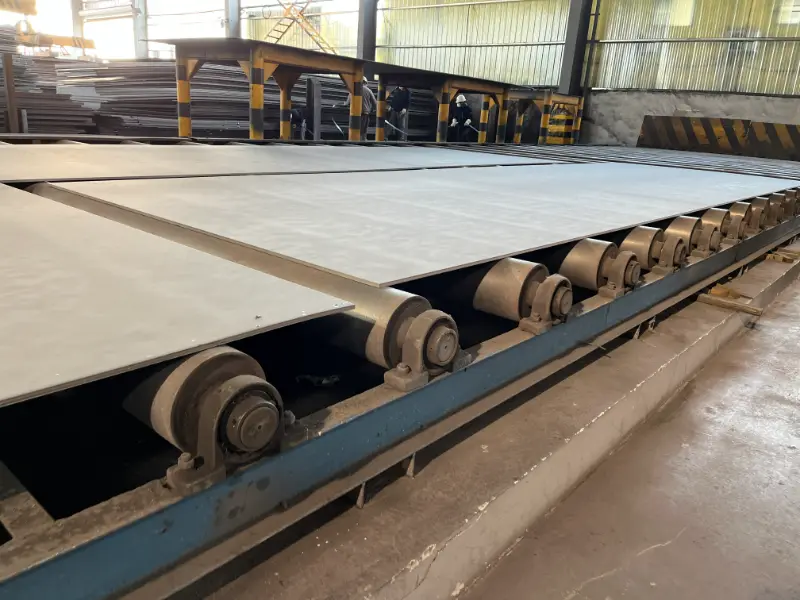
RINA Grade A40 Shipbuilding Steel Plate
RINA Grade A40 Shipbuilding Steel Plate - High-Strength Hull Structural Steel Offer
RINA A40 is a high-strength shipbuilding steel plate with a minimum yield strength of 390 MPa, certified according to Registro Italiano Navale rules for hull structures. Ideal for ship and offshore construction, it provides excellent toughness at 0°C and good weldability.
Cutting, welding, bending, forming, drilling, machining
- Phone : +8618037372205
- Email : [email protected]
- WhatsApp: Contact via Whtsapp
- WeChat: +8618037372205
RINA Grade A40 Shipbuilding Steel Plate Introduction
RINA Grade A40 is a normalised or thermomechanically rolled high-strength steel plate for shipbuilding and offshore structures, certified by Registro Italiano Navale (RINA). It belongs to the A40 strength class, guaranteeing a minimum yield strength of 390 MPa (for thickness ≤ 50 mm). The 'A' designation means the material is impact‑tested at 0 °C. This grade fully complies with IACS UR W11 requirements for high‑strength hull structural steel.
- High yield and tensile strength with excellent toughness
- Good weldability and cold forming properties
- Available in various thicknesses up to 100 mm
- Supplied in normalised (N) or thermomechanically rolled (TMCP) condition
- Widely used in ship hulls, decks, bulkheads, and offshore platforms
RINA Grade A40 Shipbuilding Steel Plate Chemical Composition
The typical chemical composition limits for RINA A40 steel plates comply with RINA Rules and IACS UR W11 for high‑strength hull structural steel. The steel is fully killed and grain‑refined with aluminium and micro‑alloying elements (Nb, V, Ti) to achieve the required strength and toughness. Carbon equivalent (CEV) is typically limited to ≤0.40% (or as agreed) to maintain good weldability.
| Element | Typical Value (max unless range given) | Remarks |
|---|---|---|
| C | ≤0.18 | For thickness ≤50 mm; slight increase possible for thicker plates |
| Mn | 0.90 – 1.60 | High Mn for strength |
| Si | 0.10 – 0.50 | Deoxidiser |
| P | ≤0.035 | Maximum impurity limit |
| S | ≤0.035 | Maximum impurity limit |
| Cu | ≤0.35 | Residual element |
| Ni | ≤0.40 | Residual element |
| Cr | ≤0.20 | Residual element |
| Mo | ≤0.08 | Residual element |
| Nb | 0.02 – 0.05 | Grain refiner |
| V | 0.05 – 0.10 | Precipitation hardening |
| Ti | ≤0.02 | Grain refiner and deoxidiser |
| Al (acid soluble) | ≥0.015 | Minimum for fine grain practice |
RINA Grade A40 Shipbuilding Steel Plate Thermal and Electrical Physical Properties
The following physical property values are typical for low‑alloy high‑strength steel similar to RINA A40. Actual values can vary slightly depending on the exact heat treatment and micro‑alloying content. They are provided for design and calculation purposes at room temperature (20 °C) unless otherwise indicated.
| Physical Property | Typical Value | Unit | Test Condition / Remarks |
|---|---|---|---|
| Density (ρ) | 7.85 | g/cm³ | Room temperature |
| Modulus of Elasticity (E) | 205 | GPa | Tensile test, at 20 °C |
| Shear Modulus (G) | 80 | GPa | Calculated from E and Poisson's ratio |
| Poisson's Ratio (ν) | 0.3 | – | Elastic range |
| Coefficient of Thermal Expansion (α) | 11.5 | 10⁻⁶ /K | 20 – 100 °C average |
| Coefficient of Thermal Expansion (α) | 12.5 | 10⁻⁶ /K | 20 – 200 °C average |
| Thermal Conductivity (λ) | 50 | W/(m·K) | At 20 °C |
| Specific Heat Capacity (c_p) | 460 | J/(kg·K) | At 20 °C |
| Electrical Resistivity (ρ_e) | 0.22 | µΩ·m | At 20 °C; typical for low‑alloy steels |
RINA Grade A40 Shipbuilding Steel Plate Mechanical Properties
Mechanical properties are determined on transverse or longitudinal test pieces according to RINA rules. Yield strength decreases slightly with increasing thickness. Impact toughness (Charpy V‑notch) is measured at 0 °C for longitudinal specimens; lower values apply for transverse ones (typically 2/3 of longitudinal). The tables below represent the specified minimum requirements for different thickness ranges.
| Property | Required Value | Unit | Condition / Remarks |
|---|---|---|---|
| Yield Strength (ReH) | ≥390 | MPa | Plate thickness t ≤ 50 mm |
| Yield Strength (ReH) | ≥380 | MPa | 50 < t ≤ 70 mm |
| Yield Strength (ReH) | ≥370 | MPa | 70 < t ≤ 100 mm |
| Tensile Strength (Rm) | 510 – 650 | MPa | All thicknesses up to 100 mm |
| Elongation (A) | ≥20 | % | Gauge length 5.65√S0; t ≤ 50 mm |
| Elongation (A) | ≥19 | % | 50 < t ≤ 70 mm |
| Elongation (A) | ≥19 | % | 70 < t ≤ 100 mm |
| Charpy V‑notch Impact Energy (KV, longitudinal) | ≥34 | J | At 0 °C; t ≤ 50 mm |
| Charpy V‑notch Impact Energy (KV, longitudinal) | ≥41 | J | At 0 °C; 50 < t ≤ 70 mm |
| Charpy V‑notch Impact Energy (KV, longitudinal) | ≥50 | J | At 0 °C; 70 < t ≤ 100 mm |
| Bending Test (180°) | No cracks | – | Mandrel diameter = 3a (a = plate thickness); t ≤ 50 mm |
| Bending Test (180°) | No cracks | – | Mandrel diameter = 4a; 50 < t ≤ 100 mm |
RINA Grade A40 Shipbuilding Steel Plate Fully Equivalent Material Standards and Substitute Grades
The following classification society grades are considered fully equivalent to RINA A40, based on the IACS UR W11 unified requirement for high‑strength hull structural steel (impact test temperature 0 °C). They can be used interchangeably subject to the individual society's approval.
| Country / Region | Standard / Rule | Grade | Remarks |
|---|---|---|---|
| International (IACS) | UR W11 | AH40 | Unified requirement for high‑strength hull steel at 0 °C |
| USA / International | ABS Steel Vessel Rules | AH40 | American Bureau of Shipping |
| Norway / Germany | DNV Rules for Ships | NV A40 (or AH40) | Det Norske Veritas |
| France | BV Rules | AH40 | Bureau Veritas |
| United Kingdom | LR Rules | AH40 | Lloyd's Register |
| Japan | NK Rules | AH40 | Nippon Kaiji Kyokai (ClassNK) |
| China | CCS Rules | AH40 | China Classification Society |
| South Korea | KR Rules | AH40 | Korean Register of Shipping |
| Italy | RINA Rules | A40 | Registro Italiano Navale (this grade) |
| Russia | RS Rules | AH40 | Russian Maritime Register of Shipping |
RINA Grade A40 Shipbuilding Steel Plate Application Introduction
RINA A40 steel plates are designed for the most heavily loaded parts of ship and offshore platforms. Their high yield strength (≥390 MPa) allows lighter structures and lower fuel consumption. Good toughness at 0 °C and excellent weldability (thanks to controlled carbon equivalent) facilitate efficient fabrication in shipyards. Typical delivery condition is TMCP or normalised, ensuring uniform mechanical properties through the thickness.
Product Applications: Hull shell plates and bottom plates, Main deck and strength deck plates, Bulkheads and watertight doors, Hatch covers and coamings, Frames, stringers, and longitudinal stiffeners, Floating production storage and offloading (FPSO) modules, Offshore platform topside structural parts
Processed into products: Welded stiffened panels, Ship framing sections (flat bar, angle, bulb profiles cut from plate), Bracket plates, Web frames and transverse structures, Rudder horns and rudder plates, Foundation plates for heavy machinery, Crane pedestal rings and lift‑boat legs
Application industries: Shipbuilding and ship repair, Offshore oil & gas platforms and FPSOs, Marine engineering and harbour structures, Naval vessels and military shipbuilding, Barge and floating crane construction, Renewable energy (offshore wind turbine foundations)
RINA Grade A40 Shipbuilding Steel Plate Similar / Alternative Material Grades
The following grades have comparable strength and are often used in marine and structural applications, but they may differ in impact test temperature, delivery condition, or specific certification. Close consultation with the design engineer is recommended when substituting for RINA A40.
| Country / Region | Standard | Grade | Remarks |
|---|---|---|---|
| USA | ASTM A131/A131M | AH40 | High‑strength shipbuilding steel, comparable but may have slight differences in CVN requirements |
| Europe | EN 10025‑4 | S420ML | Thermomechanically rolled structural steel, minimum yield 420 MPa, impact at -50 °C – higher toughness but not certified by IACS for ship classification unless approved |
| Europe | EN 10025‑3 | S420N | Normalised fine‑grain steel, yield 420 MPa, impact at -20 °C – may be used for offshore structures with additional approval |
| International | ISO 630‑4 | E390D | High‑strength structural steel plates, impact at -20 °C, similar mechanical properties but not a direct shipbuilding grade |
| China | GB/T 712 | AH40 | Chinese national standard for shipbuilding steel, equivalent to IACS AH40, can replace RINA A40 |
Notes:
- RINA A40 plates are usually delivered with a mill test certificate (3.1 according to EN 10204) confirming chemical composition, mechanical properties, and impact tests.
- Ultrasonic testing can be carried out according to EN 10160 or ASTM A578 when required (e.g., for critical offshore applications).
- For thicknesses above 50 mm, normalising or TMCP with accelerated cooling is recommended to ensure uniform properties through thickness.
- Welding consumables should match the strength level (E55 or E60 type electrodes depending on strength requirements) and be approved for low‑temperature toughness.
- Pre‑heating may be required for thick sections (>40 mm) depending on ambient conditions; typically a pre‑heat of 50–100 °C is applied.
- Plates can be supplied with coating or shop‑primed to prevent corrosion during fabrication.
- Share



