
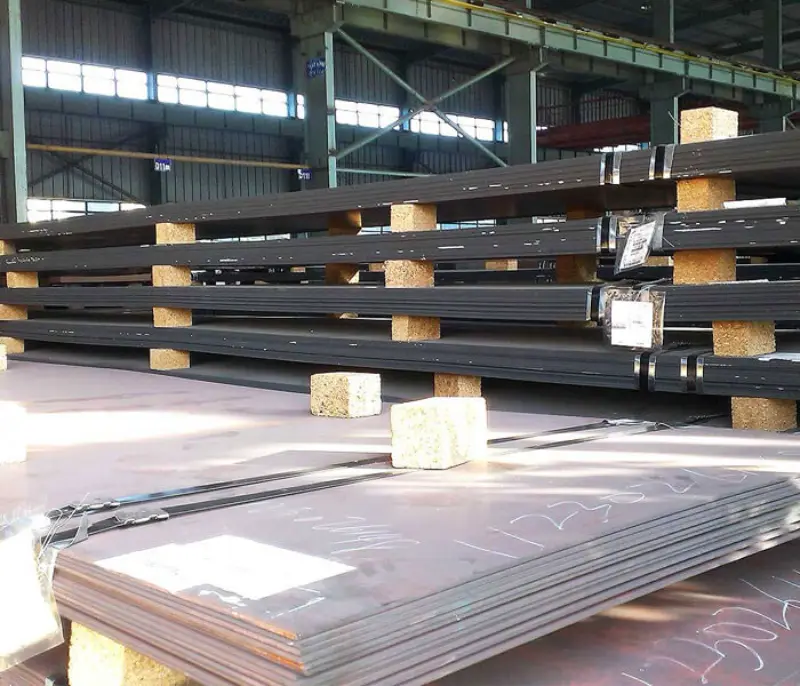
GL Grade E690 Shipbuilding Steel Plate
GL Grade E690 Shipbuilding Steel Plate - High-Strength Quenched & Tempered Marine Steel
Complete technical data for GL Grade E690 shipbuilding steel plate: chemical composition, mechanical properties, thermal and electrical physical properties, full international equivalent grades, and application guidance for offshore and marine structures.
Quenched and Tempered (Q&T), Welding, Cutting, Cold Forming (limited), Hot Forming (followed by re-tempering)
- Phone : +8618037372205
- Email : [email protected]
- WhatsApp: Contact via Whtsapp
- WeChat: +8618037372205
GL Grade E690 Shipbuilding Steel Plate Introduction
GL Grade E690 is a high-strength quenched and tempered structural steel plate designed for shipbuilding and offshore applications under Germanischer Lloyd (now DNV GL) rules. It provides a minimum yield strength of 690 MPa combined with excellent low-temperature toughness, enabling weight reduction in large welded structures. The steel is supplied in the quenched and tempered (Q&T) condition, offering good ductility, weldability, and resistance to brittle fracture. It is widely used for critical parts of ships, offshore platforms, and heavy-lift equipment exposed to dynamic loads and harsh marine environments.
GL Grade E690 Shipbuilding Steel Plate Chemical Composition
The chemical composition of GL Grade E690 is controlled to ensure high strength, good toughness, and sufficient weldability. Carbon equivalent (CEV) is limited to avoid cold cracking. All values are maximum unless a range is shown.
- CEV = C + Mn/6 + (Cr + Mo + V)/5 + (Ni + Cu)/15, typical max 0.47% (thickness ≤ 50 mm).
- Grain refining elements such as Al, Nb, V, and Ti are added to obtain fine austenitic grain size during the quenching process.
| Element | Standard Value (wt%) | Remarks |
|---|---|---|
| Carbon (C) | ≤ 0.20 | |
| Silicon (Si) | 0.10 – 0.55 | |
| Manganese (Mn) | 0.90 – 1.70 | |
| Phosphorus (P) | ≤ 0.025 | |
| Sulfur (S) | ≤ 0.025 | |
| Chromium (Cr) | ≤ 0.30 | |
| Nickel (Ni) | ≤ 0.80 | Higher Ni may be allowed for thickness > 50 mm |
| Molybdenum (Mo) | ≤ 0.30 | |
| Copper (Cu) | ≤ 0.35 | |
| Aluminium (Al) | 0.015 – 0.060 | Total aluminium, acid soluble |
| Niobium (Nb) | 0.02 – 0.05 | |
| Vanadium (V) | 0.05 – 0.10 | |
| Titanium (Ti) | ≤ 0.02 | |
| Nitrogen (N) | ≤ 0.012 | |
| Boron (B) | ≤ 0.0005 | If added |
| CEV | ≤ 0.47 | Carbon equivalent for t ≤ 50 mm; higher thicknesses may have adjusted limits |
GL Grade E690 Shipbuilding Steel Plate Thermal and Electrical Physical Properties
The following properties are typical for quenched and tempered low-alloy structural steels such as E690 and are not specified in the delivery standard. They are provided as approximate values for engineering calculations.
- The properties can vary slightly depending on the actual chemical composition and heat treatment condition.
- Values are valid at room temperature unless stated otherwise.
| Property | Typical Value | Unit | Test Condition |
|---|---|---|---|
| Density (ρ) | 7850 | kg/m³ | at 20 °C |
| Elastic modulus (E) | 205 | GPa | at 20 °C |
| Shear modulus (G) | 80 | GPa | at 20 °C |
| Poisson's ratio (ν) | 0.3 | at 20 °C | |
| Thermal expansion coefficient (α) | 11.1×10⁻⁶ | K⁻¹ | 20 – 100 °C |
| Thermal expansion coefficient (α) | 12.0×10⁻⁶ | K⁻¹ | 20 – 200 °C |
| Thermal conductivity (λ) | 42.6 | W/(m·K) | at 100 °C |
| Thermal conductivity (λ) | 38.5 | W/(m·K) | at 200 °C |
| Specific heat capacity (c) | 475 | J/(kg·K) | at 20 °C |
| Specific heat capacity (c) | 520 | J/(kg·K) | at 200 °C |
| Electrical resistivity (ρₑ) | 0.25×10⁻⁶ | Ω·m | at 20 °C |
GL Grade E690 Shipbuilding Steel Plate Mechanical Properties
Mechanical properties are determined on transverse specimens (tensile) and longitudinal/transverse Charpy V-notch impact specimens. The steel must meet the specified values in the quenched and tempered condition.
- Yield strength decreases with increasing plate thickness; the values below apply to the thickness ranges according to GL rules.
- Impact test temperature is -40 °C for Grade E (E690). Minimum impact energy is given for standard 10×10 mm specimens.
- Bend test: specimen bent 180° without cracking over a former of diameter d = 3a (where a = plate thickness) for t ≤ 50 mm.
| Property | Standard Requirement | Unit | Test Condition / Remarks |
|---|---|---|---|
| Yield strength (ReH) | ≥ 690 | MPa | Plate thickness ≤ 50 mm, transverse |
| Yield strength (ReH) | ≥ 670 | MPa | Plate thickness > 50 mm ≤ 70 mm, transverse |
| Yield strength (ReH) | ≥ 650 | MPa | Plate thickness > 70 mm ≤ 100 mm, transverse |
| Tensile strength (Rm) | 770 – 940 | MPa | All thicknesses up to 100 mm, transverse |
| Elongation after fracture (A) | ≥ 14 | % | Gauge length L₀ = 5.65√S₀, transverse, thickness ≤ 50 mm |
| Elongation after fracture (A) | ≥ 14 | % | Thickness > 50 mm ≤ 70 mm |
| Elongation after fracture (A) | ≥ 14 | % | Thickness > 70 mm ≤ 100 mm |
| Impact energy (KV₂, -40 °C) | ≥ 69 | J | Longitudinal specimen, t ≤ 50 mm |
| Impact energy (KV₂, -40 °C) | ≥ 46 | J | Transverse specimen, t ≤ 50 mm |
| Impact energy (KV₂, -40 °C) | ≥ 50 (long.) / ≥ 34 (trans.) | J | Thickness > 50 mm ≤ 70 mm |
| Impact energy (KV₂, -40 °C) | ≥ 40 (long.) / ≥ 27 (trans.) | J | Thickness > 70 mm ≤ 100 mm |
| Bend test (180°) | No cracks | Former diameter d = 3a, t ≤ 50 mm |
GL Grade E690 Shipbuilding Steel Plate Fully Equivalent International Classification Society Grades
| Country / Region | Standard / Classification Society | Grade | Remarks |
|---|---|---|---|
| USA | ABS (American Bureau of Shipping) | ABS EQ70 | High strength quenched and tempered steel, -40°C impact |
| France | BV (Bureau Veritas) | BV E690 | Equivalent strength and toughness requirements |
| China | CCS (China Classification Society) | CCS E690 | Identical to GL E690 specifications |
| Norway/Germany | DNV (Det Norske Veritas) / DNV GL | DNV E690 | Same base specification, now unified under DNV GL |
| South Korea | KR (Korean Register) | KR E690 | Matching grade for marine structures |
| United Kingdom | LR (Lloyd's Register) | LR E690 | Equivalent chemical and mechanical properties |
| Japan | NK (Nippon Kaiji Kyokai) | NK E690 | Direct equivalent for shipbuilding |
| Italy | RINA (Registro Italiano Navale) | RINA E690 | Interchangeable with GL E690 |
| Russia | RMRS (Russian Maritime Register of Shipping) | RMRS E690 | High-strength grade with -40°C toughness |
GL Grade E690 Shipbuilding Steel Plate Application Introduction
GL Grade E690 is engineered for heavyweight components that demand high strength, low temperature toughness, and excellent weldability. It is predominantly used in the marine and offshore industry, but also finds applications in heavy machinery and infrastructure where weight savings are critical.
Typical end uses include:
Product Applications: Main hull plates and stiffeners for container ships, bulk carriers, and tankers, Deck structures and hatch covers for ice-class vessels, Jack-up rig legs, spudcans, and cantilever beams, Offshore platform topside modules and helideck support structures, Crane jibs, booms, and lattice frameworks for heavy-lift cranes
Processed into products: Longitudinal and transverse frames, Web plates and flanges for built-up girders, Reinforcement pads and insert plates in high-stress zones, Pinion plates and rack chords for jack-up systems, Foundation plates for winches and mooring equipment, Welded tubular nodes and K-joints for offshore jackets
Application industries: Shipbuilding and marine engineering, Offshore oil and gas exploration and production, Renewable energy (offshore wind turbine foundations), Heavy lifting and transport equipment, Pressure vessel and boiler manufacturing
GL Grade E690 Shipbuilding Steel Plate Similar/Alternative Material Grades
| Country / Region | Standard | Grade | Remarks |
|---|---|---|---|
| EU | EN 10025-6 | S690Q / S690QL / S690QL1 | Quenched and tempered structural steel, min. 690 MPa yield; S690QL/QL1 offer improved low-temperature toughness and weldability. |
| USA | ASTM A514 / A517 | Grade Q / Grade Q modified | High-yield-strength quenched and tempered alloy steel plate for structural applications, ~690 MPa yield. |
| Japan | JIS G 3128 | SHY685 / SHY685N | High yield strength steel plate for welded structures, suitable for low temperature service. |
| China | GB/T 16270 | Q690D / Q690E | High strength structural steel plates in quenched and tempered condition; Q690E provides impact at -40°C. |
Notes:
- Delivery condition: quenched and tempered (Q&T). The manufacturer shall guarantee properties after the heat treatment specified in the order.
- Welding: preheating (typically 100–175 °C) and interpass temperature control are recommended, depending on plate thickness and hydrogen potential. Low-hydrogen welding consumables are mandatory. Post-weld heat treatment is generally not required but may be applied for stress relieving.
- Surface condition: plates are delivered with a shop primer or as-rolled/blasted surface as agreed. For critical applications, ultrasonic testing according to EN 10160 or equivalent is often required.
- Forming: cold forming radii must be generous due to the high strength; hot forming requires subsequent re-tempering to restore mechanical properties.
- Certification: material is normally supplied with 3.1 or 3.2 inspection certificates per EN 10204, endorsed by the relevant classification society.
- Share



