
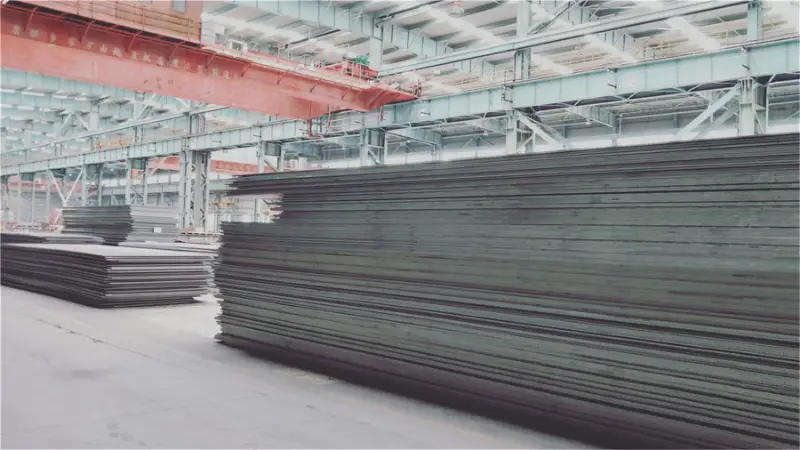
GL Grade F690 Shipbuilding Steel
GL Grade F690 Shipbuilding Steel - High Strength Quenched & Tempered Plate for Offshore & Marine Structures
Comprehensive analysis of GL Grade F690 shipbuilding steel plate: chemical composition, mechanical and physical properties, international equivalents, similar substitutes, and application guidance for marine and offshore engineering.
Welding (with suitable preheating and low-hydrogen procedures), plasma/oxy-fuel/laser cutting, cold forming (with intermediate stress relieving), hot forming (followed by re-tempering)
- Phone : +8618037372205
- Email : [email protected]
- WhatsApp: Contact via Whtsapp
- WeChat: +8618037372205
GL Grade F690 Shipbuilding Steel Introduction
GL Grade F690 is a high-strength quenched and tempered structural steel plate governed by the Germanischer Lloyd (GL) classification society rules, now part of DNV GL. With a minimum yield strength of 690 MPa, it is designed for critical shipbuilding and offshore applications requiring exceptional strength, toughness, and weldability even at low temperatures. The 'F' designation indicates guaranteed impact properties at -60°C, ensuring reliable performance in Arctic and severe environments. Typical delivery condition is quenched and tempered (Q&T). The steel exhibits a fine-grained bainitic/martensitic microstructure, offering an optimum balance between high tensile strength (770–940 MPa) and adequate ductility (≥14% elongation). It is widely used in hull structures, jack-up rig legs, and heavy lifting equipment where weight savings are crucial.
GL Grade F690 Shipbuilding Steel Chemical Composition
The chemical composition of GL F690 steel plate is controlled to achieve high strength and good low-temperature toughness after quenching and tempering. Limits are based on ladle analysis according to GL rules. Microalloying elements such as Nb, V, Ti, and Al are used for grain refinement and precipitation hardening. Note: Carbon equivalent (CEV) is typically ≤ 0.55% for good weldability.
| Element | Standard Value (max unless range) | Remarks |
|---|---|---|
| Carbon (C) | ≤ 0.20 | Controls hardenability and strength |
| Silicon (Si) | ≤ 0.50 | Deoxidizer; excessive Si may impair toughness |
| Manganese (Mn) | ≤ 1.70 | Compensates for strength and improves hardenability |
| Phosphorus (P) | ≤ 0.025 | Harmful impurity, kept low for toughness |
| Sulfur (S) | ≤ 0.020 | Low sulfur for inclusion shape control |
| Chromium (Cr) | ≤ 1.50 | Optional; enhances hardenability and corrosion resistance |
| Nickel (Ni) | ≤ 2.0 | Improves low-temperature toughness |
| Molybdenum (Mo) | ≤ 0.70 | Increases hardenability and suppresses temper embrittlement |
| Copper (Cu) | ≤ 0.50 | Optional; may be present from scrap |
| Vanadium (V) | ≤ 0.12 | Grain refiner and precipitation strengthener |
| Titanium (Ti) | ≤ 0.05 | Forms nitrides for grain refinement |
| Aluminum (Al, total) | ≥ 0.020 | Fine grain practice; min soluble Al agreed upon |
| Niobium (Nb) | ≤ 0.06 | Strong grain refiner and precipitation hardener |
| Nitrogen (N) | ≤ 0.015 | Typically bound as nitrides or carbonitrides |
GL Grade F690 Shipbuilding Steel Physical Properties
Physical properties are typical for quenched and tempered high-strength steel and are not part of GL classification requirements. They should be used as guidance for engineering calculations. Actual values may slightly vary depending on exact chemical composition and heat treatment. Data are based on literature for similar low-alloy structural steels.
| Property | Typical Value | Unit | Test Conditions / Remarks |
|---|---|---|---|
| Density (ρ) | 7.85 | g/cm³ | At room temperature |
| Elastic Modulus (E) | 210 | GPa | At room temperature, tension |
| Shear Modulus (G) | 80 | GPa | Calculated from E and Poisson's ratio |
| Poisson's Ratio (ν) | 0.3 | – | Elastic range |
| Coefficient of Thermal Expansion (α) | 11.5 | 10⁻⁶/K | 20 – 100°C |
| Coefficient of Thermal Expansion (α) | 12.5 | 10⁻⁶/K | 20 – 300°C |
| Thermal Conductivity (λ) | 42 | W/m·K | At 20°C |
| Thermal Conductivity (λ) | 38 | W/m·K | At 200°C |
| Specific Heat Capacity (Cp) | 460 | J/kg·K | At 20°C |
| Electrical Resistivity (ρₑ) | 0.25 | μΩ·m | At 20°C |
GL Grade F690 Shipbuilding Steel Mechanical Properties
Mechanical properties are determined on transverse test pieces according to GL requirements. All values apply to plate thickness ≤ 50 mm unless stated otherwise. For thicknesses 50–100 mm, minimum yield and tensile values may be slightly reduced as per the standard. Impact tests are performed on Charpy V-notch specimens at -60°C for grade F. Note: Requirements may vary for different product thicknesses and test directions.
| Property | Standard Required Value | Unit | Test Conditions |
|---|---|---|---|
| Yield Strength (ReH) | ≥ 690 | MPa | Transverse, t ≤ 50 mm, ambient temperature |
| Tensile Strength (Rm) | 770 – 940 | MPa | Transverse, t ≤ 50 mm |
| Elongation (A5) | ≥ 14 | % | Transverse, gauge length 5.65√So, t ≤ 50 mm |
| Charpy V-notch Impact (KV, longitudinal) | ≥ 27 | J | At -60°C, specimens longitudinal to rolling direction |
| Charpy V-notch Impact (KV, transverse) | ≥ 20 | J | At -60°C, specimens transverse to rolling direction |
| Bend Test (D = mandrel diameter, a = thickness) | No cracks | – | D = 3a, 180° (may be specified as 4a for thicker plates) |
GL Grade F690 Shipbuilding Steel Fully Equivalent Material Standards and Substitute Grades
| Country / Region | Standard / Specification | Grade | Remarks |
|---|---|---|---|
| Germany / International | GL Rules (now DNV GL) | GL F690 | Original specification; directly equivalent to DNV GL F690 |
| Norway / International | DNV GL Rules | DNV GL F690 | Same as GL F690 after merger |
| United Kingdom | LR Rules | LR F690 | Lloyd's Register equivalent with identical minimum properties |
| USA | ABS Rules | ABS F690 | American Bureau of Shipping equivalent for shipbuilding |
| France | BV Rules | BV F690 | Bureau Veritas equivalent |
| Europe | EN 10025-6 | S690QL (1.8928) | Closest European structural steel grade; meets yield & tensile but may have slight differences in impact temperature (Q: -20°C, QL: -40°C / -60°C); often accepted with additional conditions |
GL Grade F690 Shipbuilding Steel Application Introduction
Thanks to its very high strength combined with good low-temperature toughness and weldability, GL F690 steel plate is engineered for weight-critical marine and offshore structures. It enables designers to reduce plate thickness while maintaining structural integrity, leading to lighter vessels and offshore units with higher payload capacities. Use with appropriate welding procedures and inspection to classification society rules.
Product Applications: Hull plating and stiffeners for Arctic tankers and icebreakers, Jack-up rig legs, chords, spudcans, and bracing, Offshore platform deck structures and module support frames, Heavy-lift crane booms, outriggers, and pedestals, Pressure hulls for submarines and deep-sea submersibles, Wind turbine monopile and jacket foundation components
Processed into products: Primary structural members such as girders, frames, and brackets, Highly stressed nodes at deck-to-hull connections, Crane slew rings and slewing bearing supports, Lifting eyes, pad-eyes, and heavy-duty shackle bodies, Reinforced inserts and doubler plates in high fatigue areas, Segmented rings for tunnel boring machines and mining equipment (non-marine use considered on case basis)
Application industries: Shipbuilding (naval, commercial, ice-class vessels), Offshore oil & gas (platforms, jack-ups, FPSOs), Marine crane and heavy lift equipment manufacturing, Port and harbor machinery, Renewable energy (offshore wind turbine foundations, transition pieces), Defense (military hulls and armored structures)
GL Grade F690 Shipbuilding Steel Similar / Alternative Material Recommendations
| Country / Region | Standard / Specification | Grade | Remarks |
|---|---|---|---|
| USA | ASTM A514 / A517 | Grade Q / Type Q | Quenched & tempered plate; yield 690 MPa min; impact properties at -40°C or lower can be specified; requires careful check for marine approval |
| Japan | JIS G 3128 | SHY685 / SHY685N / SHY685NS | High yield strength steel for welded structures; similar strength level; Charpy absorbed energy specified at -40°C or lower |
| China | GB/T 16270 | Q690D / Q690E | High strength structural steel; Q690E has impact test at -40°C; may be accepted as alternative with consideration of ship classification requirements |
| Europe | EN 10025-6 | S690Q / S690QL1 (1.8988 / 1.8928) | Quenched & tempered; S690Q typically for -20°C, QL1 for -40°C; F-grade requires -60°C; special ordering can bring Charpy to -60°C known as S690QL2 or custom |
| International | ISO 4950-2 | S690Q | High yield strength flat steel products; mechanical properties comparable; may require supplementary testing for shipbuilding |
Notes:
- For plates thicker than 50 mm, reduced yield strength and/or additional heat treatment may apply; consult the current GL/DNV GL rules.
- Welders must be qualified for high-strength steels; typical preheat of 75–150°C and low-hydrogen electrodes are recommended to avoid cold cracking.
- When substituting with EN 10025-6 S690QL or equivalent, verify the Charpy impact temperature is at least -60°C for 'F' grade compliance unless otherwise agreed by the classification society.
- All information provided is based on publicly available GL/DNV GL rules and typical steel data; for exact certification and specific project requirements, refer to the latest edition of the classification society rules and the mill test certificates.
- Share



