
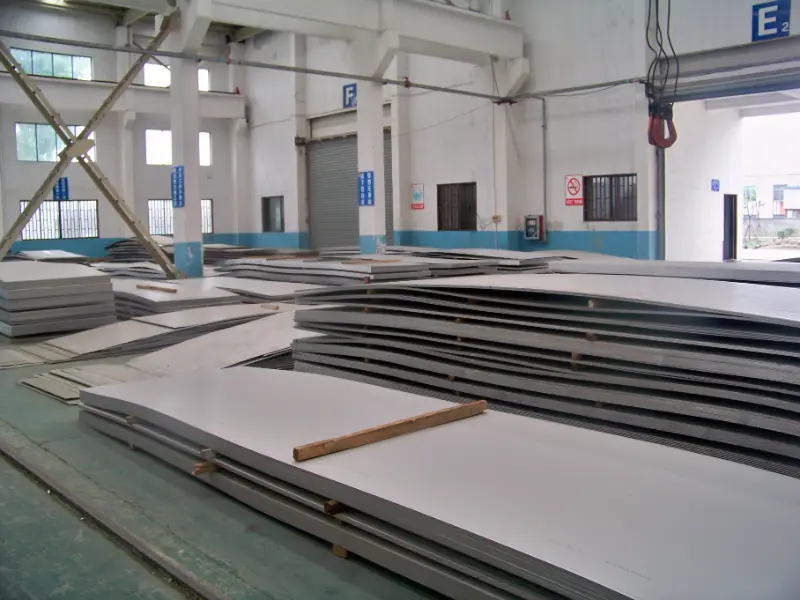
GL Grade F500 High Strength Shipbuilding Steel Plate
GL Grade F500 High Strength Shipbuilding Steel Plate - Expert Data & Equivalents
Complete material datasheet for GL Grade F500 steel plate: chemical composition, tensile and impact properties, thermal & physical data, full international equivalents, similar alternative steels, and detailed application guidance.
Thermo-Mechanical Controlled Process (TMCP); normalizing rolling; welding (all common arc processes); flame and plasma cutting; cold forming and bending
- Phone : +8618037372205
- Email : [email protected]
- WhatsApp: Contact via Whtsapp
- WeChat: +8618037372205
GL Grade F500 High Strength Shipbuilding Steel Plate Introduction
GL Grade F500 is a high-strength controlled-rolled or thermo-mechanically processed (TMCP) hull structural steel certified by Germanischer Lloyd (now part of DNV GL). It is designed for demanding marine and offshore applications requiring a minimum yield strength of 500 MPa and excellent low-temperature toughness down to -60 °C. The grade designation "F" indicates Charpy V-notch impact testing at -60 °C, while "500" refers to the specified minimum yield strength in MPa. This steel combines high strength, good weldability, and superior crack-arrest properties, making it suitable for critical structural components in ice-going vessels, offshore platforms, and large container ships. Typical delivery conditions are TMCP or normalizing rolling, with rigorous testing and certification according to GL rules.
GL Grade F500 High Strength Shipbuilding Steel Plate Chemical Composition
The chemical composition is in accordance with GL Rules (II-3-3) for F500 grade. Maximum limits are indicated for tramp elements; microalloying elements such as niobium, vanadium, titanium, and/or aluminum are added singly or in combination to achieve fine graining and strengthening. Carbon equivalent CEV is controlled to max. 0.53% (t ≤ 50 mm) or 0.55% (50 < t ≤ 100 mm) to ensure good weldability.
| Chemical element | Standard value (wt.%) | Remarks |
|---|---|---|
| Carbon (C) | ≤ 0.18 | Ladle analysis |
| Silicon (Si) | ≤ 0.55 | Ladle analysis |
| Manganese (Mn) | 0.90 – 1.70 | Ladle analysis |
| Phosphorus (P) | ≤ 0.025 | Ladle analysis |
| Sulfur (S) | ≤ 0.025 | Ladle analysis |
| Nitrogen (N) | ≤ 0.020 | Ladle analysis |
| Aluminium (Al) total | ≥ 0.010 | When used as grain refiner |
| Niobium (Nb) | ≤ 0.05 | If added; typical 0.01–0.03 |
| Vanadium (V) | ≤ 0.12 | If added; typical 0.01–0.08 |
| Titanium (Ti) | ≤ 0.05 | If added; typical 0.005–0.02 |
| Copper (Cu) | Typically ≤ 0.30 | Residual, not specified |
| Chromium (Cr) | Typically ≤ 0.25 | Residual, not specified |
| Nickel (Ni) | Typically ≤ 0.25 | Residual, not specified |
| Molybdenum (Mo) | Typically ≤ 0.10 | Residual, not specified |
| Carbon Equivalent (CEV) | ≤ 0.53 (t≤50mm); ≤ 0.55 (50| CEV = C + Mn/6 + (Cr+Mo+V)/5 + (Ni+Cu)/15 | |
GL Grade F500 High Strength Shipbuilding Steel Plate Thermal and Electrical Physical Properties
Physical property data are not mandatory in ship classification standards. The values below are typical for low-alloy high-strength structural steels and are suitable for engineering calculations. Density, moduli of elasticity, and thermal expansion are comparable to grades such as S500ML.
| Property | Standard reference value | Unit | Test condition |
|---|---|---|---|
| Density (ρ) | ~ 7850 | kg/m³ | At 20 °C |
| Modulus of elasticity (E) | ~ 210 | GPa | At 20 °C |
| Shear modulus (G) | ~ 81 | GPa | At 20 °C |
| Poisson's ratio (ν) | ~ 0.3 | — | At 20 °C |
| Thermal expansion coefficient (α) | ~ 12.0 | 10⁻⁶/K | 20–100 °C |
| Thermal expansion coefficient (α) | ~ 13.0 | 10⁻⁶/K | 20–200 °C |
| Thermal conductivity (λ) | ~ 45 | W/m·K | At 20 °C |
| Thermal conductivity (λ) | ~ 42 | W/m·K | At 100 °C |
| Specific heat capacity (cp) | ~ 460 | J/kg·K | At 20 °C |
| Electrical resistivity (ρe) | ~ 0.25 | 10⁻⁶ Ω·m | At 20 °C |
GL Grade F500 High Strength Shipbuilding Steel Plate Mechanical Properties
Mechanical tests are carried out on specimens taken in accordance with GL rules. Tensile and impact properties depend on plate thickness. Charpy V-notch impact energy is tested at -60 °C. Minimum specified values for yield strength (ReH), tensile strength (Rm), and elongation (A5) are given below.
| Property | Standard required value | Unit | Test condition |
|---|---|---|---|
| Upper yield strength (ReH) | ≥ 500 | MPa | Thickness ≤ 50 mm, transverse |
| Upper yield strength (ReH) | ≥ 480 | MPa | Thickness 50 < t ≤ 100 mm, transverse |
| Tensile strength (Rm) | 610 – 770 | MPa | t ≤ 50 mm, transverse |
| Tensile strength (Rm) | 590 – 770 | MPa | 50 < t ≤ 100 mm, transverse |
| Elongation after fracture (A) | ≥ 16 | % | Longitudinal, gauge length 5.65√So |
| Elongation after fracture (A) | ≥ 15 | % | Transverse, gauge length 5.65√So |
| Charpy impact energy (KV) | ≥ 34 (average of 3) | J | Longitudinal, -60 °C, V-notch |
| Charpy impact energy (KV) | ≥ 24 (individual value) | J | Longitudinal, -60 °C, V-notch |
| Bend test (180°) | d = 3a (t ≤ 50 mm) | — | Mandrel diameter d, specimen thickness a |
| Bend test (180°) | d = 4a (50 < t ≤ 100 mm) | — | Mandrel diameter d, specimen thickness a |
GL Grade F500 High Strength Shipbuilding Steel Plate Fully Equivalent Grades – International Substitutes for GL F500
| Country / Region | Standard | Grade | Remarks |
|---|---|---|---|
| International / Norway | DNV GL | VL F500 | Same minimum yield (500 MPa) and impact (-60 °C); recognized as identical grade. |
| USA | ABS (American Bureau of Shipping) | ABS F500 | Equivalent strength and toughness requirements for hull structures. |
| France | BV (Bureau Veritas) | BV F500 | Fully interchangeable in shipbuilding applications. |
| UK | LR (Lloyd's Register) | LR F500 | Same base specification; impact test at -60 °C. |
| Italy | RINA | RINA F500 | Identical mechanical and toughness criteria. |
| South Korea | KR (Korean Register) | KR F500 | Equivalent grade under KR rules. |
| China | CCS (China Classification Society) | CCS F500 | Direct equivalent for shipbuilding steel. |
| Japan | NK (ClassNK) | NK F500 | Same strength level and impact temperature requirement. |
GL Grade F500 High Strength Shipbuilding Steel Plate Application Introduction
GL F500 steel is specifically designed for structural components exposed to high stress and low-temperature conditions in marine environments. Its exceptional combination of high yield strength and superior low-temperature toughness makes it an ideal material for modern shipbuilding and offshore engineering. Below are typical industries, products, and components where F500 is employed.
Product Applications: Ice-class tankers, bulk carriers and LNG carriers, Polar research vessels and icebreakers, Self-elevating drilling units (jack-up rig legs, spudcans), Column-stabilized units (semi-submersibles) – decks and pontoons, Offshore wind turbine transition pieces and monopiles, Very large container ship upper deck and hatch coaming areas
Processed into products: Ship hull plates and stiffeners (especially in high-stress regions), Longitudinal girders and transverse frames, Rudder horns and stern frames, Deck stringers and strength decks, Bulkhead plates in collision zones, Bracket plates and connection nodes in offshore structures, Foundation plates for heavy equipment such as cranes and winches, Bolted and welded connections requiring high load transfer
Application industries: Shipbuilding (commercial, naval, and specialized vessels), Offshore oil & gas exploration and production, Renewable marine energy (offshore wind turbine foundations), Heavy-lift and salvage operations, Port and coastal infrastructure
GL Grade F500 High Strength Shipbuilding Steel Plate Similar or Closely Related Alternative Materials
| Country / Region | Standard | Grade | Remarks |
|---|---|---|---|
| European Union | EN 10025-4 | S500ML | TMCP rolled; min. ReH 500 MPa, but impact temperature only -50 °C (compared to -60 °C for F500). Suitable for less severe low-temperature applications. |
| European Union | EN 10025-6 | S500QL | Quenched and tempered; min. ReH 500 MPa, impact at -40 °C (QL designates -40 °C). High strength but different processing and toughness. |
| International | ASTM A131/A131M | EH500 | Yield strength 500 MPa; impact at -40 °C (E grade). Can be substituted when toughness requirements are less stringent. |
| European Union | EN 10025-4 | S460MLO | ReH ≥460 MPa, impact -50 °C; moderate strength alternative with good cold toughness, sometimes used in place of F500 when strength can be slightly reduced. |
| European Union | EN 10025-6 | S690QL | Higher strength (ReH ≥690 MPa) option for weight reduction; requires careful welding and fracture control. |
Notes:
Welding: Preheating and interpass temperature control should be implemented according to plate thickness and carbon equivalent. Generally, a preheat of 50–100 °C is recommended for thicknesses above 30 mm. Low-hydrogen welding consumables (matching or over-matching in strength) must be used to avoid cold cracking.
Certification: GL F500 steel plates are supplied with inspection certificate 3.1 or 3.2 per EN 10204, including test reports for chemical analysis, mechanical testing, Charpy impacts, and non-destructive testing where specified.
Ultrasonic testing: When required, UT examination according to GL rules or EN 10160 class S2/E2 can be performed.
Corrosion protection: Typical marine coating systems are applicable; pre-treatment and shop primer coatings are common.
- Share



