
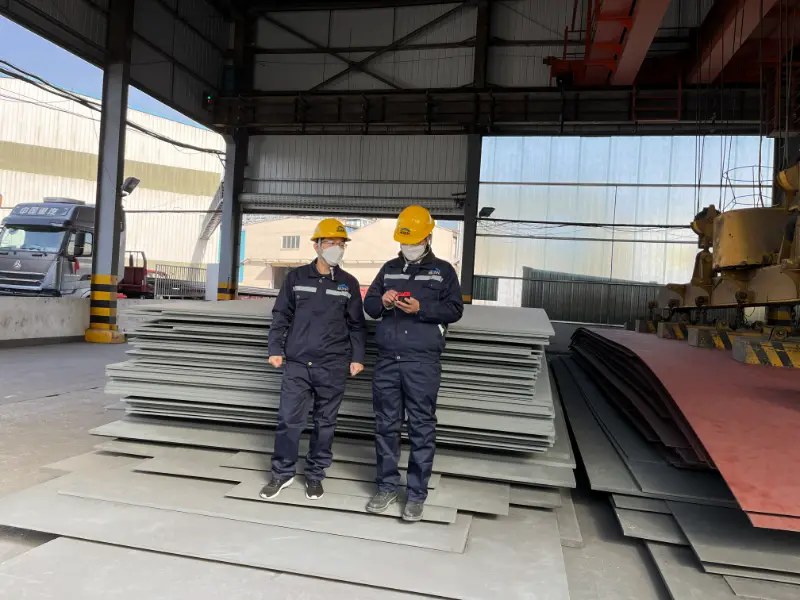
GL Grade E500/EH500 Shipbuilding Steel Plate
GL Grade E500/EH500 Shipbuilding Steel Plate - High Strength & Toughness at Low Temperatures
Detailed technical data for GL Grade E500 (now DNV GL EH500) extra high strength shipbuilding steel plate, covering chemical composition, mechanical and physical properties, international equivalents, and application guidance.
Thermo‑Mechanical Control Process (TMCP); Quenched and Tempered (Q&T) possible by agreement
- Phone : +8618037372205
- Email : [email protected]
- WhatsApp: Contact via Whtsapp
- WeChat: +8618037372205
GL Grade E500/EH500 Shipbuilding Steel Plate Introduction
GL Grade E500 (EH500) is a premium extra high strength structural steel plate specifically designed for hull construction under the GL (Germanischer Lloyd, now DNV GL) classification rules. With a minimum yield strength of 500 MPa and excellent low‑temperature toughness (tested at −40°C), it enables significant weight reduction while maintaining structural integrity in critical shipbuilding applications. This steel is typically supplied in the thermo‑mechanically controlled processed (TMCP) condition, which imparts a fine‑grained microstructure and superior weldability.
- Minimum yield strength: 500 MPa
- Excellent impact toughness at −40°C (min. 50 J)
- Good weldability with appropriate low‑hydrogen procedures
- Available in a wide range of plate thicknesses
- Recognised by all major classification societies (IACS members)
GL Grade E500/EH500 Shipbuilding Steel Plate Chemical Composition
Ladle analysis limits according to DNV GL rules for EH500 extra high strength hull structural steel. The composition is typical of a low‑carbon microalloyed steel, with controlled additions of niobium, vanadium, and titanium to achieve fine grain size and high strength through precipitation hardening. Low phosphorus and sulphur contents ensure excellent notch toughness, while aluminium serves as a deoxidiser. Carbon equivalent (CEV) is limited to ensure good weldability without preheat in moderate thicknesses.
| Chemical Element | Standard Value (max, unless range) | Remarks |
|---|---|---|
| Carbon (C) | ≤ 0.20 | For ladle analysis |
| Silicon (Si) | 0.10 – 0.55 | Deoxidation element |
| Manganese (Mn) | 0.90 – 1.70 | Strength and toughness |
| Phosphorus (P) | ≤ 0.025 | Controlled for low‑temperature toughness |
| Sulfur (S) | ≤ 0.025 | Controlled to avoid hot cracking |
| Aluminium (Al, total) | ≥ 0.020 | Fine grain practice |
| Niobium (Nb) | ≤ 0.05 | Microalloy grain refiner |
| Vanadium (V) | ≤ 0.10 | Precipitation strengthening |
| Titanium (Ti) | ≤ 0.05 | Grain refinement and nitrogen binding |
| Copper (Cu) | ≤ 0.35 | Residual element |
| Chromium (Cr) | ≤ 0.20 | Residual element |
| Nickel (Ni) | ≤ 0.40 | Residual element |
| Molybdenum (Mo) | ≤ 0.08 | Residual element |
| Nitrogen (N) | ≤ 0.012 | Uncombined nitrogen must be low |
| Carbon Equivalent (CEV) | ≤ 0.53 (t ≤ 50 mm) | IIW formula: C+Mn/6+(Cr+Mo+V)/5+(Ni+Cu)/15 |
GL Grade E500/EH500 Shipbuilding Steel Plate Thermal and Electrical Physical Properties
The physical properties listed below are typical for high‑strength low‑alloy steels and are not directly specified in the classification standard. They are provided for reference in design calculations and thermal processing. Values may vary slightly depending on the exact chemical composition and heat treatment condition.
| Property | Typical Value | Unit | Test Condition |
|---|---|---|---|
| Density (ρ) | ~7850 | kg/m³ | 20°C |
| Elastic Modulus (E) | ~210 | GPa | 20°C |
| Shear Modulus (G) | ~80 | GPa | 20°C |
| Poisson's Ratio (ν) | ~0.3 | — | — |
| Thermal Expansion Coefficient (α) | ~12 × 10⁻⁶ | 1/K | 20 – 300°C |
| Thermal Conductivity (λ) | ~50 | W/(m·K) | 20°C |
| Specific Heat Capacity (cp) | ~460 | J/(kg·K) | 20°C |
| Electrical Resistivity (ρe) | ~0.20 | μΩ·m | 20°C |
GL Grade E500/EH500 Shipbuilding Steel Plate Mechanical Properties
Mechanical properties as required by DNV GL rules for EH500 plates in the as‑supplied (TMCP) condition. Tensile testing is performed on transverse specimens at room temperature; impact testing is conducted on longitudinal Charpy V‑notch specimens at −40°C. Elongation is measured over gauge length 5.65√So. Values apply for plate thicknesses up to 100 mm; for thicker products, slightly reduced tensile properties may be agreed.
| Property | Standard Required Value | Unit | Test Condition |
|---|---|---|---|
| Yield Strength (ReH) | ≥ 500 | MPa | Transverse, room temperature |
| Tensile Strength (Rm) | 610 – 770 | MPa | Transverse, room temperature |
| Elongation (A5) | ≥ 17 | % | Gauge length 5.65√So, transverse |
| Impact Energy (KV) | ≥ 50 (average) | J | −40°C, longitudinal, Charpy V‑notch |
| Bend Test | 180°, d = 3a, no cracks | — | Room temperature |
GL Grade E500/EH500 Shipbuilding Steel Plate Completely Equivalent Material Standards and Substitute Grades
| Country/Region | Standard | Grade | Remarks |
|---|---|---|---|
| Germany | GL (now DNV GL) | E500 / EH500 | Original grade; TMCP delivery |
| Norway | DNV GL | EH500 | Unified DNV GL rules, identical requirements |
| United Kingdom | Lloyd's Register (LR) | EH500 | IACS equivalent; same toughness class |
| USA | American Bureau of Shipping (ABS) | EH500 | Recognised for ABS‑classed vessels |
| France | Bureau Veritas (BV) | EH500 | Equivalent extra high strength grade |
| China | China Classification Society (CCS) | EH500 | Identical technical requirements |
| Japan | Nippon Kaiji Kyokai (ClassNK) | EH500 | IACS unified requirement |
| South Korea | Korean Register (KR) | EH500 | Fully compatible with GL E500 |
| Italy | Registro Italiano Navale (RINA) | EH500 | Meets RINA extra high strength rules |
| Russia | Russian Maritime Register of Shipping (RS) | E500 | Equivalent grade; same toughness level |
GL Grade E500/EH500 Shipbuilding Steel Plate Application Introduction
GL Grade E500 / EH500 is specifically engineered for demanding marine and offshore structures where high strength, excellent weldability, and reliable low‑temperature toughness are essential. Its balanced chemistry and TMCP processing allow efficient fabrication with reduced preheat compared to conventional quenched and tempered steels of similar strength.
Typical industry sectors:
Product Applications: Outer hull plates and side shell stiffeners, Weather decks and strength decks, Transverse and longitudinal bulkheads, Jack‑up rig legs, spud cans, and bracings, Crane pedestals and heavy‑duty foundations, Container cell guides and twistlock foundations
Processed into products: Welded hull frames, stringers, and web frames, Deck girders and transverse beams, Cargo hatch coamings and hatch cover stiffeners, Rudder horn structures and stern post elements, Heavy‑lift crane boom segments and slewing ring supports, Articulated loading arm bases and turret structures
Application industries: Shipbuilding (commercial, naval, and specialised vessels), Offshore oil & gas platforms (jack‑ups, semi‑submersibles, FPSOs), Heavy marine construction (harbour cranes, caissons, lock gates), Renewable offshore energy (wind turbine foundations, substation topsides), Ice‑class vessels and Arctic structures
GL Grade E500/EH500 Shipbuilding Steel Plate Similar/Comparable Alternative Materials
| Country/Region | Standard | Grade | Remarks |
|---|---|---|---|
| EU | EN 10025‑6 | S500Q / S500QL / S500QL1 | Quenched and tempered structural steel with minimum yield 500 MPa. Good low‑temperature toughness options; may require additional classification society approval for marine use. |
| EU | EN 10025‑4 | S500M / S500ML | Thermo‑mechanically rolled fine‑grain steel. Similar strength level, but impact test temperatures differ; not specifically developed for shipbuilding. |
| USA | ASTM A514/A514M | Grade Q | Quenched and tempered alloy steel (min. yield 690 MPa). Higher strength may allow thickness reduction; more stringent welding and fabrication procedures needed. |
| USA | ASTM A710/A710M | Grade A, Class 2 | Age‑hardening low‑carbon Cu‑Ni‑Cr‑Mo‑Nb steel with min. yield 550 MPa. Good toughness and weldability; used in naval applications. |
| Japan | JIS G 3128 | SHY 685 | High yield strength steel for welded structures, min. yield 685 MPa. Used in pressure vessels and bridges; fabricability differs from EH500. |
Notes:
Welding Recommendations: Low‑hydrogen welding consumables and controlled heat input are essential to preserve the mechanical properties of the heat‑affected zone (HAZ). Preheating may be required for higher thicknesses or carbon equivalent near the upper limit; follow the steelmaker's and classification society guidelines.
Certification: Plates are delivered with EN 10204 3.1 or 3.2 certificates endorsed by the relevant classification society. Through‑thickness properties (Z‑grade) can be ordered for critical T‑joints.
Heat Treatment: Any post‑weld heat treatment (PWHT) should be evaluated to avoid over‑tempering of the TMCP microstructure; generally not required for most shipbuilding applications.
- Share



