
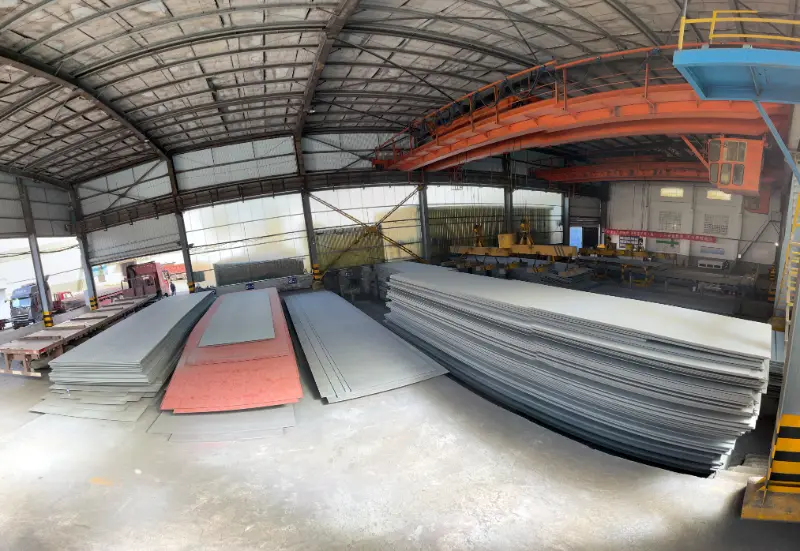
GL Grade D500 Shipbuilding Steel Plate
GL Grade D500 Shipbuilding Steel Plate | High-Strength Marine Steel for Hull & Offshore Structures
Comprehensive material data for GL Grade D500 (DH500) high-strength shipbuilding steel plate: chemical composition, mechanical properties, thermal & electrical characteristics, international equivalents, and application guidance.
Thermo-mechanical controlled processing (TMCP), normalizing, quenching & tempering (subject to agreement); weldable by all conventional methods
- Phone : +8618037372205
- Email : [email protected]
- WhatsApp: Contact via Whtsapp
- WeChat: +8618037372205
GL Grade D500 Shipbuilding Steel Plate Introduction
GL Grade D500 is a high-strength, fine-grain structural steel primarily used in shipbuilding and offshore engineering. It belongs to the 'D' category, indicating guaranteed impact toughness at -20°C, and the numeric designation '500' signifies a minimum yield strength of 500 MPa. Manufactured under the rules of Germanischer Lloyd (now part of DNV GL), this grade complies with the IACS (International Association of Classification Societies) Unified Requirement W11 for extra-high-strength steels. The steel is typically supplied in normalized or thermo-mechanically controlled processed (TMCP) condition, offering an excellent balance of strength, weldability, and low-temperature toughness. Its high yield and tensile strengths permit lighter structural designs without compromising safety, making it ideal for critical hull members, decks, and heavy offshore components.
GL Grade D500 Shipbuilding Steel Plate Chemical Composition
The chemical composition conforms to IACS UR W11 for extra-high-strength DH500 grade. The steel is fully killed and fine-grain treated. Carbon equivalent (CE) is controlled to ensure good weldability: CE = C + Mn/6 + (Cr+Mo+V)/5 + (Ni+Cu)/15. Specific limits may vary with product thickness; the values below are typical for plates up to 50 mm.
- Niobium, vanadium, and titanium are added singly or in combination for grain refinement.
- Aluminium is used for deoxidation and grain size control.
- Maximum residual elements are tightly restricted.
| Element | Standard Value (max, wt%) | Remarks |
|---|---|---|
| Carbon (C) | 0.18 | Typical; for t ≤ 50 mm. For t > 50 mm, may be adjusted |
| Silicon (Si) | 0.10 – 0.55 | Minimum 0.10; max usually 0.55 |
| Manganese (Mn) | 0.90 – 1.60 | Typical range; actual based on thickness and CE |
| Phosphorus (P) | 0.025 | Stringently controlled for toughness |
| Sulfur (S) | 0.025 | Controlled for lamellar tearing resistance (Z-quality optional) |
| Chromium (Cr) | 0.25 | Maximum |
| Nickel (Ni) | 0.50 | Maximum |
| Molybdenum (Mo) | 0.25 | Maximum |
| Copper (Cu) | 0.35 | Maximum |
| Aluminium (Al, acid soluble) | 0.015 – 0.060 | Minimum 0.015; grain refining |
| Niobium (Nb) | 0.02 – 0.05 | Microalloying element |
| Vanadium (V) | 0.05 – 0.10 | Microalloying element |
| Titanium (Ti) | 0.007 – 0.05 | Grain refinement and nitride formation |
| Nitrogen (N) | 0.009 | Maximum |
| Carbon Equivalent (CEV) | 0.40 – 0.45 (typical) | Dependent on thickness and composition; guaranteed by steelmaker |
GL Grade D500 Shipbuilding Steel Plate Thermal and Electrical Physical Properties
Physical properties are typical for low-alloy high-strength steels and are not required by the product standard. They are provided as engineering reference data. Variations may occur with actual chemical composition and heat treatment. All values are at 20°C unless noted.
- Density and elastic modulus are nearly constant for all steel grades.
- Thermal expansion increases with temperature; the coefficient given is for 20–100°C.
| Property | Typical Value | Unit | Test Conditions / Remarks |
|---|---|---|---|
| Density (ρ) | 7850 | kg/m³ | 20°C |
| Elastic modulus (E) | 210 | GPa | 20°C; dynamic modulus |
| Shear modulus (G) | 81 | GPa | 20°C; calculated |
| Poisson's ratio (ν) | 0.30 | – | 20°C |
| Thermal expansion coefficient (α) | 12.0 | 10⁻⁶ /°C | 20–100°C; mean value |
| Thermal conductivity (λ) | 50 | W/(m·K) | 20°C |
| Thermal conductivity at 300°C | 45 | W/(m·K) | Typical, decreasing with temperature |
| Specific heat capacity (cp) | 460 | J/(kg·K) | 20°C |
| Electrical resistivity (ρₑ) | 0.20 | µΩ·m | 20°C; typical for structural carbon-manganese steel |
GL Grade D500 Shipbuilding Steel Plate Mechanical Properties
The specified mechanical properties are tested on transverse specimens and comply with IACS UR W11 and GL rules. The steel must also meet stringent impact toughness requirements at -20°C (D grade). Bend test: 180° bending with diameter = 3 × thickness (t ≤ 25 mm) or 4 × thickness (t > 25 mm) without cracks. Through-thickness properties: available with Z35 designation when specified. Values below are minimum unless a range is given.
- Yield strength is the upper yield point (ReH) or 0.2% proof stress (Rp0.2).
- Impact test uses standard Charpy V-notch specimens; average of three tests.
| Property | Standard Requirement | Unit | Test Conditions |
|---|---|---|---|
| Yield strength (ReH / Rp0.2) | ≥ 500 | MPa | Transverse; room temperature |
| Tensile strength (Rm) | 610 – 770 | MPa | Transverse; room temperature |
| Elongation after fracture (A5) | ≥ 16 | % | Gauge length 5.65√S₀; transverse |
| Bend test (180°) | d = 3t (t ≤ 25 mm), d = 4t (t > 25 mm) | – | No cracks on outside of bend |
| Charpy impact energy (KV₂) | ≥ 34 (average), ≥ 24 (single) | J | Test temperature: -20°C; longitudinal specimens |
| Charpy impact energy (KV₂), transverse | ≥ 24 (average), ≥ 17 (single) | J | Test temperature: -20°C; optional when specified |
| Yield strength at elevated temperature | 110°C: ~470; 200°C: ~430; 300°C: ~390 | MPa | Typical reduction factors; not mandatory |
GL Grade D500 Shipbuilding Steel Plate Fully Equivalent Standards and Designations – Replacements for GL D500
| Country/Region | Standard | Grade/Designation | Remarks |
|---|---|---|---|
| Norway/Germany (DNV GL) | DNV GL Rules Pt.2 Ch.2 | DH500 (NV DH500 / VL DH500) | Direct successor; same technical requirements |
| USA (ABS) | ABS Rules for Materials and Welding | ABS DH500 | Identical per IACS UR W11 |
| UK (LR) | Lloyd's Register Rules | LR DH500 | Identical per IACS UR W11 |
| France (BV) | Bureau Veritas Rules | BV DH500 | Identical per IACS UR W11 |
| China (CCS) | CCS Rules for Materials and Welding | CCS DH500 | Identical per IACS UR W11 |
| South Korea (KR) | Korean Register Rules | KR DH500 | Identical per IACS UR W11 |
| Japan (NK) | ClassNK Rules | NK DH500 | Identical per IACS UR W11 |
| Italy (RINA) | RINA Rules | RINA DH500 | Identical per IACS UR W11 |
GL Grade D500 Shipbuilding Steel Plate Application Introduction
GL Grade D500 (DH500) is engineered for weight-critical, high-stress marine and offshore structures. Its high strength allows thinner plate thicknesses, reducing overall weight while maintaining excellent low-temperature toughness. Below are typical industry sectors, products, and specific components where this grade is employed.
Product Applications: Ultra-large container ships hulls, Ice-class vessels (with additional testing), Semi-submersible and jack-up rig structural elements, FPSO (Floating Production Storage and Offloading) modules, Heavy-lift crane barges, Subsea structural frameworks
Processed into products: Main deck and strength deck plating, Shell and bottom plates, Longitudinal and transverse frames, Bulkhead plates and stiffeners, Hatch coamings and corners, Turret structures for mooring systems, Foundation plates for heavy machinery (e.g., cranes, winches), Column stabilizers for semi-submersibles, Nodes and chords in tubular truss structures
Application industries: Shipbuilding (commercial and naval), Offshore oil & gas platforms, Renewable energy (offshore wind turbine foundations), Heavy lifting and transport equipment, Offshore mining and dredging structures, Bridge construction (when marine environment demands high strength and toughness)
GL Grade D500 Shipbuilding Steel Plate Similar or Alternative High-Strength Steels
| Country/Region | Standard | Grade | Remarks on Similarity |
|---|---|---|---|
| Europe | EN 10025-3 | S460N / S460NL | Normalized, YS 460 MPa, good toughness; lower strength than DH500 |
| Europe | EN 10025-4 | S460M / S460ML | Thermo-mechanically rolled, YS 460 MPa; similar processing but lower YS |
| Europe | EN 10025-6 | S500Q / S500QL | Quenched & tempered, YS 500 MPa; different toughness control, not primarily for shipbuilding |
| Europe | EN 10149-2 | S500MC | High-strength low-alloy for cold forming, YS 500 MPa; limited thickness, no impact guarantee at -20°C typically |
| USA | ASTM A514 / A517 | Grade B (or other) | Q&T plate, YS 690 MPa; limited use in marine due to higher alloying and CE |
| International (offshore) | API 2H | Grade 50 | For offshore structural tubulars, YS 345–414 MPa; lower strength but similar toughness for offshore |
| International | ISO 630-3 | S460N | Structural steel, YS 460 MPa; often used as reference but not for ship classification |
Notes:
Weldability: Due to the micro-alloyed composition, pre-heating may be required for thicker sections or high restraint joints. Consumables matching the strength and toughness class must be used. Corrosion resistance: As a structural carbon-manganese steel, DH500 requires protective coatings or cathodic protection in marine environments. Lamellar tearing: For highly restrained welded joints subject to through-thickness loading, 'Z-grade' (Z25, Z35) option can be specified to achieve minimum reduction of area. Documentation: All plates are supplied with EN 10204 Type 3.1 or 3.2 certification, endorsed by the classification society surveyor.
- Share



