
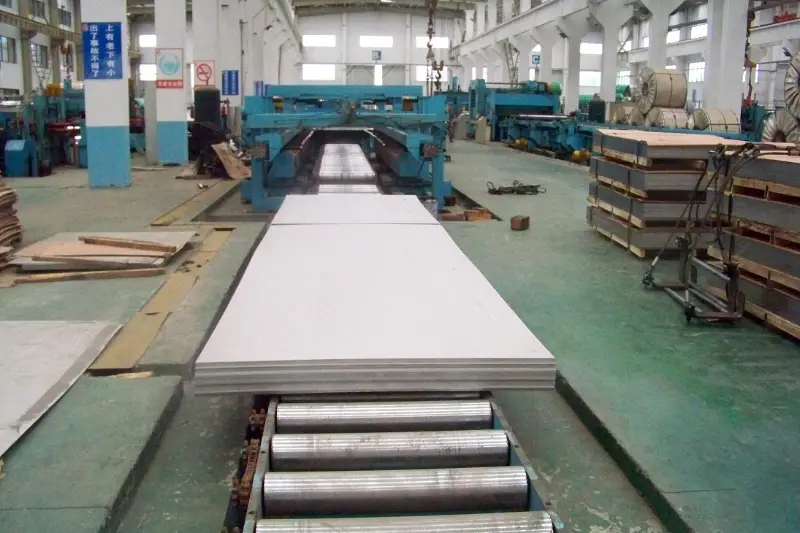
GL Grade A500 Shipbuilding Steel Plate
GL Grade A500 Shipbuilding Steel Plate: High Strength Marine Grade
Comprehensive material data for GL Grade A500 shipbuilding steel plate covering chemical composition, mechanical properties, thermal and electrical physical properties, international equivalents and applications.
Welding, Thermal Cutting, Cold Forming, Hot Forming
- Phone : +8618037372205
- Email : [email protected]
- WhatsApp: Contact via Whtsapp
- WeChat: +8618037372205
GL Grade A500 Shipbuilding Steel Plate Introduction
GL Grade A500 is a high-strength hull structural steel governed by the rules of DNV GL (formerly Germanischer Lloyd). It offers a minimum yield strength of 500 MPa and is designed for welded structures in shipbuilding and offshore engineering. The A designation indicates a Charpy impact test temperature of 0 °C, providing reliable toughness for general marine environments. This grade combines high strength with good weldability and is typically supplied in the thermo-mechanically controlled processed (TMCP) or normalized condition. It is widely used in critical load‑bearing components such as decks, bottom shells and bulkheads of large vessels.
GL Grade A500 Shipbuilding Steel Plate Chemical Composition
Ladle analysis limits according to DNV GL rules. Microalloying elements such as Nb, V, Ti are added singly or in combination to achieve required strength and toughness. Carbon equivalent (CEV) is controlled to ensure weldability, typically ≤ 0.43% for thicknesses up to 50 mm.
| Element | Standard Value | Remarks |
|---|---|---|
| C | ≤ 0.20 | Carbon |
| Si | 0.10 – 0.55 | Silicon |
| Mn | 0.90 – 1.70 | Manganese |
| P | ≤ 0.025 | Phosphorus |
| S | ≤ 0.025 | Sulfur |
| Al (acid soluble) | ≥ 0.015 | Minimum for fine grain practice |
| Nb | ≤ 0.05 | Niobium (optional) |
| V | ≤ 0.10 | Vanadium (optional) |
| Ti | ≤ 0.05 | Titanium (optional) |
| Cu | ≤ 0.35 | Copper (residual) |
| Cr | ≤ 0.20 | Chromium (residual) |
| Ni | ≤ 0.40 | Nickel (residual) |
| Mo | ≤ 0.08 | Molybdenum (residual) |
| CEV | ≤ 0.43 | Carbon equivalent (typical for t ≤ 50 mm) |
GL Grade A500 Shipbuilding Steel Plate Thermal and Electrical Physical Properties
Typical physical properties for a medium‑carbon, microalloyed steel at room temperature. Elevated‑temperature properties may vary and should be verified for design purposes.
| Property | Standard Requirement Value | Unit | Test Condition |
|---|---|---|---|
| Density (ρ) | 7.85 | g/cm³ | Room temperature |
| Modulus of elasticity (E) | 210 | GPa | Room temperature, tensile |
| Shear modulus (G) | ~81 | GPa | Calculated from E and Poisson |
| Poisson ratio (ν) | 0.29 – 0.30 | – | Room temperature |
| Thermal expansion coefficient (α) | 11.5 – 12.5 | 10⁻⁶/K | 20–100 °C range |
| Thermal conductivity (λ) | ~45 | W/(m·K) | Room temperature |
| Specific heat capacity (cp) | ~460 | J/(kg·K) | Room temperature |
| Electrical resistivity (ρₑ) | ~0.20 | 10⁻⁶ Ω·m | Room temperature |
GL Grade A500 Shipbuilding Steel Plate Mechanical Properties
Mechanical properties are valid for plates up to 100 mm thickness in the delivery condition. Tensile testing is performed transverse to the rolling direction. Impact testing is performed on Charpy V‑notch specimens taken in the longitudinal direction at the specified temperature.
| Property | Standard Requirement | Unit | Test Condition |
|---|---|---|---|
| Yield strength (ReH) | ≥ 500 | MPa | t ≤ 100 mm, transverse |
| Tensile strength (Rm) | 610 – 770 | MPa | t ≤ 100 mm, transverse |
| Elongation (A) | ≥ 16 | % | t ≤ 50 mm, gauge length 5.65√S₀, transverse |
| Elongation (A) | ≥ 14 | % | 50 < t ≤ 100 mm, gauge length 5.65√S₀, transverse |
| Charpy impact energy (KV₂) | ≥ 34 | J | at 0 °C, longitudinal, single value |
| Charpy impact energy (KV₂) | ≥ 27 | J | at 0 °C, transverse (if required) |
| Bend test | 180° | – | Diameter = 3a, a = specimen thickness; no cracks |
GL Grade A500 Shipbuilding Steel Plate Equivalent Standards and Alternative Grade Recommendations
| Country/Region | Standard | Grade | Remarks |
|---|---|---|---|
| International | DNV GL | A500 | Original grade |
| USA | ABS Rules | A500 | Same strength and impact temperature (0 °C) |
| Norway | DNV Rules | NV A500 | DNV legacy equivalent |
| France | BV Rules | A500 | Bureau Veritas equivalent |
| UK | LR Rules | A500 | Lloyd's Register equivalent |
| China | CCS Rules | A500 | China Classification Society equivalent |
| Italy | RINA Rules | A500 | RINA equivalent |
| South Korea | KR Rules | RA500 | Korean Register equivalent |
| Japan | NK Rules | KA500 | ClassNK equivalent |
GL Grade A500 Shipbuilding Steel Plate Application Introduction
GL A500 steel plates are primarily used in the construction of welded hulls and offshore structures where high strength and good toughness at 0 °C are required. They are suitable for heavy‑duty structural components subjected to static and dynamic loads.
Product Applications: Ship hulls (deck plating, side shell, bottom shell), Longitudinal and transverse bulkheads, Deckhouses and superstructures of large vessels, Jack‑up rig legs and spudcans, Offshore mooring components
Processed into products: Transverse web frames, Stringer plates, Bilge keels, Bracket plates, Hatch coamings, Crane pedestals
Application industries: Shipbuilding (merchant ships, naval vessels), Offshore oil and gas platforms, Marine cranes and heavy lifting equipment, Wind turbine tower flanges and foundations (offshore), Bridge construction (specialist marine bridges)
GL Grade A500 Shipbuilding Steel Plate Similar / Alternative Materials
| Country/Region | Standard | Grade | Remarks |
|---|---|---|---|
| International | DNV GL | D500 | Impact test at -20 °C, higher toughness |
| International | DNV GL | E500 | Impact test at -40 °C, superior toughness |
| Europe | EN 10025-6 | S500Q / S500QL | Quenched and tempered structural steel, not specifically for shipbuilding |
| Europe | EN 10025-4 | S500M / S500ML | Thermo‑mechanically rolled structural steel, general fabrication |
Notes:
Welding considerations: Low hydrogen welding processes are recommended to avoid cold cracking. Preheat and interpass temperatures should be controlled based on plate thickness and carbon equivalent (CEV). Post-weld heat treatment (PWHT) is normally not required for thicknesses below 50 mm. For thicker sections, PWHT may be considered in accordance with the relevant design rules.
- Share



