
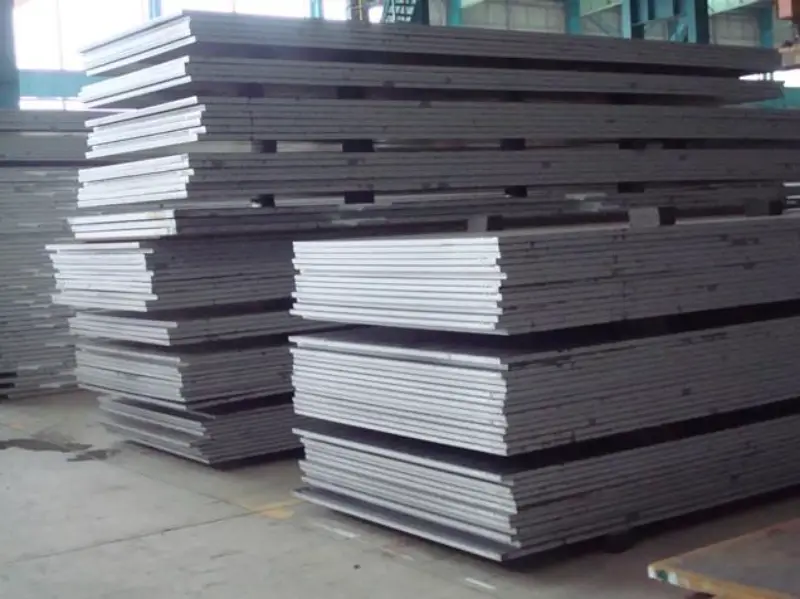
GL Grade F460 Shipbuilding Steel Plate
GL Grade F460 Shipbuilding Steel Plate: Properties, Equivalents & Applications
Detailed material data for GL Grade F460 shipbuilding steel plate covering chemical composition, mechanical and physical properties, equivalent grades, and application guidance.
Hot rolling, normalizing, TMCP, quenching and tempering, welding
- Phone : +8618037372205
- Email : [email protected]
- WhatsApp: Contact via Whtsapp
- WeChat: +8618037372205
GL Grade F460 Shipbuilding Steel Plate Introduction
GL Grade F460 is a high-strength shipbuilding structural steel plate classified under the rules of Germanischer Lloyd (now DNV GL). It belongs to the extra-high-strength category with a minimum yield strength of 460 MPa. The 'F' designation indicates fine-grain practice and guaranteed impact toughness at -60 °C, making it suitable for critical low-temperature applications in ship and offshore structures. The steel is typically supplied in normalized, thermomechanically rolled (TMCP), or quenched and tempered condition. It offers excellent weldability, high strength-to-weight ratio, and good resistance to brittle fracture. GL F460 is widely used in the construction of hulls, decks, and structural members of large vessels and offshore platforms operating in cold environments.
GL Grade F460 Shipbuilding Steel Plate Chemical Composition
The chemical composition conforms to the limits for GL Grade F460 as specified in IACS UR W11 and GL classification rules. Elements like Nb, V, Ti, Al may be added for grain refinement and strengthening. The carbon equivalent (CEV) is controlled to ensure good weldability.
| Element | Standard Value | Remarks |
|---|---|---|
| Carbon (C) | ≤ 0.18 | Ladle analysis |
| Manganese (Mn) | 1.00 – 1.60 | Higher Mn improves strength |
| Silicon (Si) | ≤ 0.50 | Deoxidizer |
| Phosphorus (P) | ≤ 0.025 | |
| Sulfur (S) | ≤ 0.025 | |
| Nickel (Ni) | ≤ 0.80 | Enhances toughness |
| Chromium (Cr) | ≤ 0.20 | Residual element |
| Molybdenum (Mo) | ≤ 0.08 | Residual element |
| Copper (Cu) | ≤ 0.35 | Residual element |
| Niobium (Nb) | 0.02 – 0.05 | Grain refiner |
| Vanadium (V) | 0.05 – 0.10 | Microalloying |
| Titanium (Ti) | ≤ 0.02 | Grain refiner |
| Aluminum (Al) | 0.015 – 0.05 | Total Al, deoxidizer |
| Nitrogen (N) | ≤ 0.009 | If combined with Al or V |
| Carbon Equivalent (CEV) | ≤ 0.45 – 0.46 | Depends on thickness |
GL Grade F460 Shipbuilding Steel Plate Thermal and Electrical Physical Properties
Physical properties are based on typical values for high-strength low-alloy structural steels. Actual values may vary slightly with exact composition and heat treatment. Density, thermal expansion, and thermal conductivity are important for design and welding distortion calculations.
| Property | Standard Value | Unit | Test Condition |
|---|---|---|---|
| Density (ρ) | 7.85 | g/cm³ | 20 °C |
| Modulus of Elasticity (E) | 205 | GPa | 20 °C |
| Shear Modulus (G) | 80 | GPa | 20 °C |
| Poisson's Ratio (ν) | 0.3 | – | 20 °C |
| Thermal Expansion (α) | 11.5 | 10⁻⁶/K | 20 – 100 °C |
| Thermal Conductivity (λ) | 50 | W/(m·K) | 20 °C |
| Specific Heat Capacity (c) | 460 | J/(kg·K) | 20 °C |
| Electrical Resistivity (ρₑ) | 0.25 | 10⁻⁶ Ω·m | 20 °C |
GL Grade F460 Shipbuilding Steel Plate Mechanical Properties
Mechanical properties are determined on transverse test pieces in accordance with GL rules. Tensile and impact tests are required. Minimum values are guaranteed; actual values usually exceed the minimum. Impact energy values are for standard 10x10 mm Charpy-V specimens.
| Property | Standard Value | Unit | Test Condition |
|---|---|---|---|
| Yield Strength (ReH) | ≥ 460 | MPa | t ≤ 50 mm, transverse |
| Tensile Strength (Rm) | 570 – 720 | MPa | t ≤ 50 mm, transverse |
| Elongation (A) | ≥ 17 | % | L₀ = 5.65√S₀, t ≤ 50 mm, transverse |
| Bend Test | d = 3a | – | 180° bend, t ≤ 50 mm |
| Impact Energy (KV₂) | ≥ 46 (longitudinal) | J | -60 °C, average of 3 specimens |
| Impact Energy (KV₂) | ≥ 27 (transverse) | J | -60 °C, average of 3 specimens |
| Yield Strength (ReH) | ≥ 440 | MPa | t > 50 – 100 mm, transverse |
| Tensile Strength (Rm) | 570 – 720 | MPa | t > 50 – 100 mm, transverse |
| Elongation (A) | ≥ 17 | % | t > 50 – 100 mm, transverse |
GL Grade F460 Shipbuilding Steel Plate Fully Equivalent Material Standards and Replaceable Designations
| Country / Region | Standard | Grade | Remarks |
|---|---|---|---|
| International (IACS) | IACS UR W11 | F460 | Unified requirement for all IACS members |
| Norway / Germany (DNV) | DNV Rules | NV F460 | Equivalent to GL F460 |
| France (BV) | BV Rules | F460 | |
| United Kingdom (LR) | LR Rules | F460 | |
| USA (ABS) | ABS Rules | F460 | |
| China (CCS) | CCS Rules | F460 | Identical chemical and mechanical limits |
| Korea (KR) | KR Rules | F460 | |
| Japan (NK) | NK Rules | KF460 | Same minimum yield strength and toughness |
GL Grade F460 Shipbuilding Steel Plate Application Introduction
GL F460 steel plates are specifically engineered for ship and offshore structures requiring high strength at sub-zero temperatures. The material can be formed, welded, and machined using standard practices, but preheating and low-hydrogen welding processes are recommended to avoid cold cracking. Typical applications include:
Product Applications: Hull side shells and bottoms, Deck plates and stringers, Bulkheads and web frames, High-stress structural members of ice-going vessels, Offshore platform decks and legs
Processed into products: Welded panels and sections, Bending-formed structural profiles, Reinforced stiffeners and brackets, Bolt-connected nodes, Corner fittings and inserts for high-stress areas
Application industries: Shipbuilding (merchant vessels, naval ships, icebreakers), Offshore oil & gas (jack-up rig legs, platform structures), Marine engineering, Heavy construction in cold climates
GL Grade F460 Shipbuilding Steel Plate Similar / Alternative Material Recommendations
| Country / Region | Standard | Grade | Remarks |
|---|---|---|---|
| International (IACS) | IACS UR W11 | E460 | Lower low-temperature toughness (-40 °C) than F460 |
| International (IACS) | IACS UR W11 | D460 | Toughness guaranteed at -20 °C |
| International (IACS) | IACS UR W11 | A460 | Toughness at 0 °C |
| International (IACS) | IACS UR W11 | F500 / F550 | Higher yield strength, similar toughness level |
| EU (EN) | EN 10025-6 | S460QL / S460QL1 | Quenched & tempered structural steel, not specifically shipbuilding but comparable strength |
Notes:
- All chemical and mechanical properties are based on GL/DNV classification society rules and IACS UR W11. Slight variations may exist between individual class societies; consult specific rules for precise limits.
- For thicknesses >100 mm, property values shall be subject to agreement.
- Weldability: Low carbon equivalent (CEV) ensures good weldability. Preheating and post-weld heat treatment may be required based on thickness and hydrogen level.
- Formability: Suitable for cold bending with bending radii <5t; hot forming should be followed by normalizing or TMCP confirmation.
- Share



