
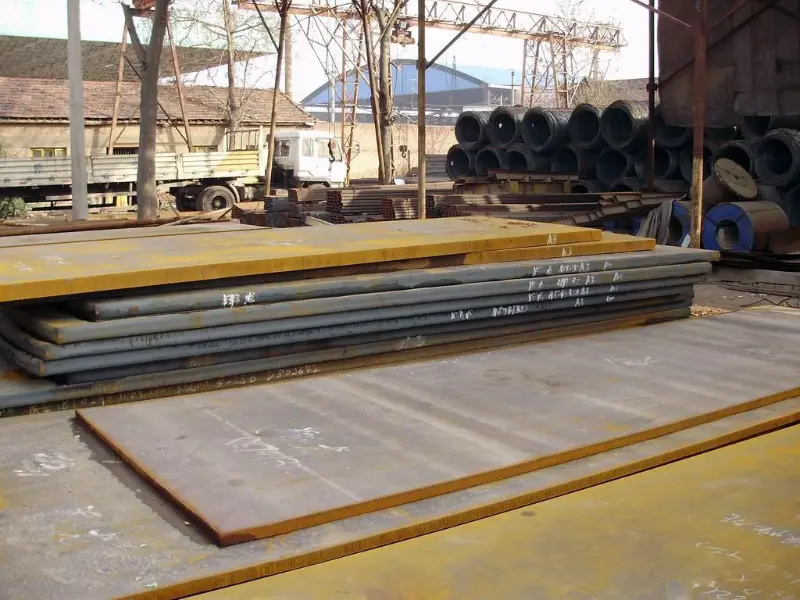
GL Grade E460 Shipbuilding Steel Plate
GL Grade E460 Shipbuilding Steel Plate - Data Sheet & Equivalents
Comprehensive data for GL Grade E460 shipbuilding steel plate: chemical composition, mechanical and thermal properties, international equivalents, and application guide.
Hot rolling, normalizing, TMCP, cold forming, welding, machining
- Phone : +8618037372205
- Email : [email protected]
- WhatsApp: Contact via Whtsapp
- WeChat: +8618037372205
GL Grade E460 Shipbuilding Steel Plate Introduction
GL Grade E460 is a high-strength shipbuilding structural steel plate specified by Germanischer Lloyd (now DNV GL) with a minimum yield strength of 460 MPa. It belongs to the EH460 category, indicating guaranteed impact toughness at -40°C. The steel is typically supplied in normalized or thermo-mechanically controlled processed (TMCP) condition. It offers excellent weldability, good cold-forming properties, and high resistance to brittle fracture, making it suitable for critical structural components in ships and offshore platforms. The chemical composition is microalloyed with niobium, vanadium, or titanium to achieve fine grain structure and high strength. The steel meets the requirements of IACS UR W11 for shipbuilding and is recognized by all major classification societies.
GL Grade E460 Shipbuilding Steel Plate Chemical Composition
The chemical composition of GL Grade E460 is designed to provide high strength, good weldability, and low-temperature toughness. It is characterized by low carbon content and microalloying with elements like niobium, vanadium, or titanium. Maximum limits are given unless a range is indicated. Ceq (Carbon Equivalent) is typically controlled to <0.45% for thicknesses up to 50 mm and may be adjusted for thicker plates.
| Element | Typical Value (max %) | Remarks |
|---|---|---|
| C | 0.18 | Max |
| Si | 0.10 - 0.55 | If applicable |
| Mn | 1.00 - 1.70 | - |
| P | 0.025 | Max |
| S | 0.025 | Max |
| N | 0.012 | Max |
| Al (acid soluble) | 0.020 min | Usually present for grain refining |
| Nb | 0.02 - 0.05 | Can be used singly or in combination |
| V | 0.05 - 0.10 | Can be used singly or in combination |
| Ti | 0.02 max | If added |
| Cu | 0.35 max | - |
| Cr | 0.20 max | - |
| Ni | 0.40 max | - |
| Mo | 0.08 max | - |
GL Grade E460 Shipbuilding Steel Plate Thermal and Electrical Physical Properties
The following physical properties are typical for GL Grade E460 type steels (low-carbon microalloyed steel). They may vary slightly depending on actual chemical composition and heat treatment condition. These values are not directly specified in the classification rules but are useful for engineering calculations. Density is ~7850 kg/m³. Thermal expansion coefficient is about 11.5 x 10⁻⁶ /K in the range 20-100°C. Thermal conductivity decreases with temperature; the value at 100°C is around 45 W/(m·K). Specific heat capacity is ~460 J/(kg·K). Electrical resistivity is about 0.25 x 10⁻⁶ Ω·m.
| Property | Typical Value | Unit | Test Condition |
|---|---|---|---|
| Density (ρ) | 7850 | kg/m³ | Room temperature |
| Elastic Modulus (E) | 205 | GPa | Room temperature |
| Shear Modulus (G) | 80 | GPa | Room temperature |
| Poisson's Ratio (ν) | 0.3 | - | Room temperature |
| Thermal Expansion Coefficient (α) | 11.5 | 10&supminus;⁶ /K | 20 to 100°C |
| Thermal Expansion Coefficient (α) | 12.5 | 10&supminus;⁶ /K | 20 to 200°C |
| Thermal Conductivity (λ) | 45 | W/(m·K) | At 100°C |
| Specific Heat Capacity (c) | 460 | J/(kg·K) | At 20°C |
| Electrical Resistivity (ρₑ) | 0.25 | 10&supminus;⁶ Ω·m | At 20°C |
GL Grade E460 Shipbuilding Steel Plate Mechanical Properties
Mechanical properties are determined on standard test specimens taken in transverse direction. Impact test temperature is -40°C for Grade E. Values may vary depending on thickness range. Yield strength (ReH) decreases with increasing plate thickness. Tensile strength (Rm) remains within 570-720 MPa for all thickness up to 100 mm. Elongation is minimum 15-17% proportional to thickness. Impact energy (KV) minimum average is 41 J at -40°C (longitudinal or transverse as specified).
| Property | Standard Requirement | Unit | Test Condition / Thickness (mm) |
|---|---|---|---|
| Yield Strength (ReH) | 460 | MPa | t ≤ 50 |
| Yield Strength (ReH) | 440 | MPa | 50 < t ≤ 70 |
| Yield Strength (ReH) | 420 | MPa | 70 < t ≤ 100 |
| Tensile Strength (Rm) | 570 - 720 | MPa | t ≤ 100 |
| Elongation (A) | 17 min | % | t ≤ 50 |
| Elongation (A) | 16 min | % | 50 < t ≤ 70 |
| Elongation (A) | 15 min | % | 70 < t ≤ 100 |
| Impact Energy (KV), longitudinal | 41 average / 28 min | J | -40°C, t ≤ 100 |
| Impact Energy (KV), transverse | 31 average / 22 min | J | -40°C, t ≤ 100 (if agreed) |
| Bend Test (Dia. = d) | d = 3t | - | 180° bending, t ≤ 50 |
| Bend Test (Dia. = d) | d = 4t | - | 180° bending, 50 < t ≤ 70 |
| Bend Test (Dia. = d) | d = 5t | - | 180° bending, 70 < t ≤ 100 |
GL Grade E460 Shipbuilding Steel Plate Fully Equivalent Standards and Replaceable Grades
| Region / Society | Standard / Rule | Grade | Remarks |
|---|---|---|---|
| International (IACS) | IACS UR W11 | EH460 | Base specification; identical requirements |
| DNV (Norway/Germany) | DNV Rules Pt.2 Ch.1 | EH460 | Formerly DNV E460, fully compatible |
| Lloyd's Register (UK) | LR Rules | EH460 | Same strength and toughness category |
| American Bureau of Shipping | ABS Rules | EH460 | Identical material group |
| Bureau Veritas (France) | BV Rules | EH460 | Same designation |
| China Classification Society | CCS Rules | EH460 | Same designation |
| ClassNK (Japan) | NK Rules | KE460 | K grade corresponds to E (toughness at -40°C) |
| Korean Register | KR Rules | EH460 | Fully equivalent |
| RINA (Italy) | RINA Rules | EH460 | Fully equivalent |
| RS (Russia) | RS Rules | E460 | Or A460 with specific toughness |
| Germanischer Lloyd | GL Rules | E460 | Original specification |
GL Grade E460 Shipbuilding Steel Plate Application Introduction
GL Grade E460 steel is intended for highly stressed welded structures in shipbuilding and offshore engineering where weight savings and high load-bearing capacity are critical. It can be processed by cutting (flame, plasma, laser), cold or hot forming, and welding using low-hydrogen procedures. Preheating may be required for thick sections or when CEV is high. The steel is typically delivered with inspection certificates (e.g., EN 10204 3.1 or 3.2).
Product Applications: Hull plates and stiffeners, Longitudinal and transverse bulkheads, Weather decks and main deck stringers, Bottom and side shell plating in high bending moment regions, Offshore platform columns and bracings, Crane pedestals and heavy load-bearing flanges, Welded tee and angle sections
Processed into products: Shell expansion plates (bilge strake, sheer strake), Bracket plates and floors, Deck girders and deck transverse webs, Hatch coaming plates, Rudder horn plates and skeg frames, Crane king posts and jib rests, Pad eyes and lifting lugs (heavy duty)
Application industries: Commercial shipbuilding (container ships, bulk carriers, tankers, cruise ships), Naval shipbuilding (frigates, destroyers, support vessels), Offshore oil and gas (jackets, topsides, decks, FPSOs), Offshore wind energy (transition pieces, monopile foundations, substructures), Heavy lifting equipment (cranes, pedestals), Bridge construction (when approved as structural steel with toughness)
GL Grade E460 Shipbuilding Steel Plate Similar or Comparable Alternative Materials
| Region / Society | Standard | Grade | Remarks |
|---|---|---|---|
| European Union | EN 10025-4 | S460ML / S460MLO | Thermomechanical rolled, comparable strength, minimum impact -50°C (ML) or -40°C (MLO). Not specifically for shipbuilding, may need additional approval. |
| European Union | EN 10025-3 | S460NL | Normalized, similar strength, -50°C impact. May substitute with additional welding certification for ship structures. |
| USA | ASTM A572 / A709 | Grade 65 (450 MPa) | Slightly lower minimum YS (450 MPa). Not a direct substitute; thicker sections may need evaluation. |
| USA | ASTM A131 | EH40 | Lower strength (min YS 390 MPa). Not equivalent in strength but same toughness category; can be considered for less stressed areas. |
| International | ISO 4950-2 | S460QL | Quenched and tempered, higher strength, -40°C; may replace E460 if QT delivery accepted. |
| Japan | JIS G 3106 | SM570 | Tensile strength 570-720 MPa, YS >=460 MPa. Not ship class approved inherently; additional classification society approval needed. |
Notes:
Additional requirements may apply depending on the specific project:
- Through-thickness properties (Z-quality) per EN 10164: Z25 or Z35 for highly restrained joints.
- Offshore structural applications may require supplementary toughness (CTOD) testing.
- Welding procedure qualification must be performed in accordance with the classification society's rules and manufacturer's approbation.
- Corrosion protection usually includes shop primer and painting systems; for splash zones, additional corrosion allowance is designed.
- Share



