
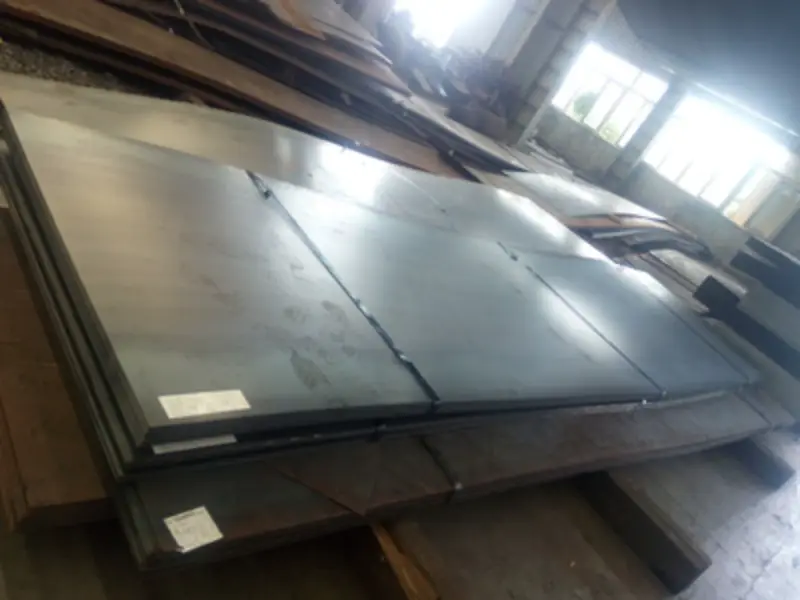
GL Grade D460 Shipbuilding Steel Plate
GL Grade D460 Shipbuilding Steel Plate: High-Strength Marine Steel Data
Detailed technical data for GL Grade D460 shipbuilding steel plate: chemical composition, mechanical properties, physical properties, international equivalents, and typical applications in ship and offshore structures.
Thermo-mechanical controlled rolling (TMCP), normalizing, quenching and tempering (if specified), welding, flame cutting, cold forming
- Phone : +8618037372205
- Email : [email protected]
- WhatsApp: Contact via Whtsapp
- WeChat: +8618037372205
GL Grade D460 Shipbuilding Steel Plate Introduction
GL Grade D460 is a high-strength shipbuilding steel plate specified by Germanischer Lloyd (now DNV GL) for hull and offshore structures. It belongs to the group of fine-grain structural steels with a minimum yield strength of 460 MPa, offering excellent strength-to-weight ratio, good weldability, and reliable low-temperature toughness (D-grade, impact tested at -20 °C). The steel is typically supplied in a thermo-mechanically controlled rolled (TMCP) or normalized condition, ensuring consistent mechanical properties across plate thicknesses up to 100 mm. Key characteristics include:
- High yield and tensile strength for weight reduction in large vessels
- Outstanding notch toughness at sub-zero temperatures, essential for hull integrity in cold waters
- Good formability and weldability, compatible with standard shipyard fabrication processes
- Compliance with GL Rules for Classification and Construction, Part 1, Chapter 2, Section 3
GL Grade D460 Shipbuilding Steel Plate Chemical Composition
The following chemical composition limits apply to GL D460 steel plates as per GL Rules. All elements are controlled to ensure fine grain size, high strength, and good weldability. Additional microalloying elements such as Nb, V, Ti are used singly or in combination. The carbon equivalent (CEV) is typically restricted to maintain weldability.
| Element | Standard Value (%) | Remarks |
|---|---|---|
| Carbon (C) | ≤ 0.20 | |
| Silicon (Si) | 0.10 – 0.55 | |
| Manganese (Mn) | 1.00 – 1.70 | Higher Mn may be allowed for increased strength |
| Phosphorus (P) | ≤ 0.025 | |
| Sulfur (S) | ≤ 0.025 | |
| Aluminium (Al) acid soluble | ≥ 0.015 | Grain refining element |
| Niobium (Nb) | ≤ 0.05 | Optional microalloy |
| Vanadium (V) | ≤ 0.10 | Optional microalloy |
| Titanium (Ti) | ≤ 0.02 | Optional microalloy |
| Nitrogen (N) | ≤ 0.012 | Elevated N may be compensated by Al fixation |
| Chromium (Cr) | ≤ 0.30 | Residual element (not intentionally added without agreement) |
| Nickel (Ni) | ≤ 0.40 | Residual element |
| Molybdenum (Mo) | ≤ 0.08 | Residual element |
| Copper (Cu) | ≤ 0.35 | Residual element |
| Total microalloys (Nb+V+Ti) | ≤ 0.12 | Combined addition limit |
GL Grade D460 Shipbuilding Steel Plate Physical Properties
Typical physical properties for D460 steel at room temperature and over a range of service temperatures. These values are indicative and may vary slightly with exact composition and processing route. They are suitable for design calculations involving thermal loads, stiffness, and electrical resistivity.
| Property | Typical Value | Unit | Conditions / Temperature |
|---|---|---|---|
| Density (ρ) | 7850 | kg/m³ | 20 °C |
| Elastic modulus (E) | 205 | GPa | 20 °C |
| Shear modulus (G) | 79 | GPa | 20 °C, calculated from E and ν |
| Poisson's ratio (ν) | 0.30 | — | Room temperature |
| Thermal expansion coefficient (α) | 11.5 × 10⁻⁶ | 1/K | 20 – 100 °C |
| Thermal expansion coefficient (α) | 12.3 × 10⁻⁶ | 1/K | 20 – 200 °C |
| Thermal expansion coefficient (α) | 13.2 × 10⁻⁶ | 1/K | 20 – 400 °C |
| Thermal conductivity (λ) | 47 | W/(m·K) | 20 °C |
| Thermal conductivity (λ) | 43 | W/(m·K) | 200 °C |
| Specific heat capacity (cₚ) | 460 | J/(kg·K) | 20 °C |
| Electrical resistivity (ρₑ) | 0.22 | Ω·mm²/m | 20 °C |
GL Grade D460 Shipbuilding Steel Plate Mechanical Properties
Mechanical properties are determined on test pieces taken in the transverse direction (unless otherwise agreed) after final heat treatment. Values apply to plate thicknesses ≤ 100 mm. Impact tests are performed on Charpy V-notch specimens at -20 °C (D-grade). For thicker plates, properties may be slightly adjusted per the standard.
| Property | Required Value | Unit | Test Conditions / Notes |
|---|---|---|---|
| Yield strength (ReH) | ≥ 460 | MPa | Thickness ≤ 100 mm, transverse |
| Tensile strength (Rm) | 570 – 720 | MPa | Transverse, all thickness |
| Elongation after fracture (A) | ≥ 17 | % | Thickness ≤ 50 mm, gauge length 5.65√S0 |
| Elongation after fracture (A) | ≥ 16 | % | Thickness > 50 mm ≤ 70 mm |
| Elongation after fracture (A) | ≥ 15 | % | Thickness > 70 mm ≤ 100 mm |
| Charpy impact energy (KV) – longitudinal | ≥ 31 | J | -20 °C, average of 3 specimens (single min. 22 J) |
| Charpy impact energy (KV) – transverse | ≥ 21 | J | -20 °C, average of 3 specimens (single min. 15 J) |
| Bend test (180° bend) | No cracks | — | Mandrel diameter: 3 × thickness (t ≤ 25 mm); 4 × thickness (t > 25 mm) |
GL Grade D460 Shipbuilding Steel Plate Fully Equivalent Material Standards & Substitute Grades
| Country / Region | Standard / Classification Society | Grade | Remarks |
|---|---|---|---|
| Norway / Germany | DNV GL | D460 | Identical; DNV GL unified rules |
| USA | American Bureau of Shipping (ABS) | D460 | Equivalent strength and toughness level |
| UK | Lloyd's Register (LR) | D460 | Same requirements as GL |
| France | Bureau Veritas (BV) | D460 | Fully interchangeable |
| China | China Classification Society (CCS) | D460 | Harmonized with IACS UR W11 |
| Japan | Nippon Kaiji Kyokai (ClassNK) | D460 | Equivalent grade |
| Italy | Registro Italiano Navale (RINA) | D460 | Equivalent grade |
| South Korea | Korean Register (KR) | D460 | Equivalent grade |
| International | IACS (International Association of Classification Societies) | D460 | Common structural rules reference |
GL Grade D460 Shipbuilding Steel Plate Application Introduction
GL D460 steel plate is extensively used in the construction of seagoing vessels and offshore units where high strength and reliable toughness are required. The combination of yield strength ≥ 460 MPa and good weldability allows designers to reduce scantlings and structural weight while maintaining safety factors. Typical application areas and components include:
Product Applications: Hull shell plates and bottom plating, Main deck and strength deck plates, Longitudinal and transverse bulkheads, Web frames and stiffener systems, Foundation plates for heavy machinery
Processed into products: Shell plates in high-stress zones (midship section, sheer strake), Longitudinal stiffeners and girders, Transverse frames and floors, Hatch coamings and container cell guides, Crane pedestal plates and king post supports, Offshore module structural members
Application industries: Shipbuilding (container ships, bulk carriers, tankers, LNG carriers), Offshore oil & gas (jackets, topsides, floating production units), Marine construction (tugboats, barges, pontoon systems), Heavy engineering (crane pedestals, heavy-lift equipment)
GL Grade D460 Shipbuilding Steel Plate Similar / Alternative Materials with Comparable Properties
| Country / Region | Standard | Grade | Remarks |
|---|---|---|---|
| Norway / Germany | DNV GL | E460 | Higher toughness grade (-40°C), otherwise equivalent strength |
| European Union | EN 10025-4:2019 | S460ML (1.8838) | Fine-grain structural steel for offshore; TMCP, similar YS/TS but not dedicated for ship classification, requires additional certifications for marine use |
| USA | ASTM A131 / A131M | EH46 | Equivalent offshore structural steel with similar strength and impact test temperature -40°C, can replace D460 with charpy margin |
| International | API 2H | Grade 50 | For tubular joints in offshore platforms, comparable strength but different product forms |
Notes:
Delivery condition is usually TMCP, which provides optimum balance of strength and toughness. For thick plates or special applications, normalizing or quenching and tempering may be specified. Weldability is assured by controlled carbon equivalent (typically CEV ≤ 0.38–0.40). Full traceability and classification society certification are provided with each batch. Surface condition: as-rolled, descaled, or blast-cleaned and primer-coated as per client requirements.
- Share



