
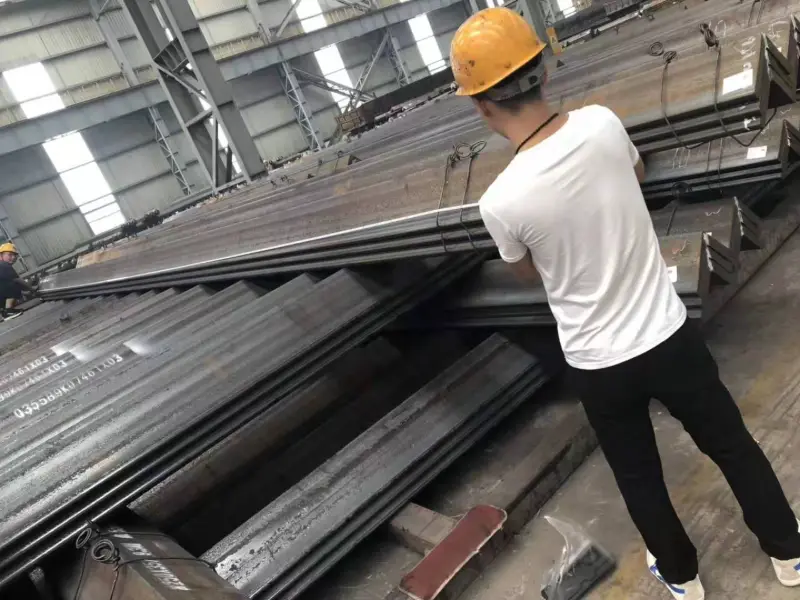
GL Grade A460 Shipbuilding Steel Plate
GL Grade A460 Shipbuilding Steel Plate | High-Strength Marine Steel with Min Yield 460 MPa
Complete material data for GL Grade A460 shipbuilding steel plate per Germanischer Lloyd rules: chemical composition, mechanical properties, physical properties, equivalent grades, and application guide.
Hot rolling, normalizing rolling, thermo-mechanical controlled process (TMCP), quenching and tempering (by agreement)
- Phone : +8618037372205
- Email : [email protected]
- WhatsApp: Contact via Whtsapp
- WeChat: +8618037372205
GL Grade A460 Shipbuilding Steel Plate Introduction
GL Grade A460 is a high-strength hull structural steel specified by Germanischer Lloyd (now DNV GL) for the construction of seagoing ships and offshore structures. It belongs to the normalized or thermo-mechanically rolled fine-grain steel category with a minimum yield strength of 460 MPa. The steel is designed to provide excellent weldability, good toughness at 0 °C, and high resistance to brittle fracture, making it suitable for critical structural components in harsh marine environments. It is typically supplied in the thermo-mechanical controlled processing (TMCP) condition, which refines the grain structure and improves strength-toughness balance without excessive alloying. This grade is fully compliant with IACS UR W28 and is equivalent to AH46 grades of all major classification societies.
GL Grade A460 Shipbuilding Steel Plate Chemical Composition
The chemical composition of GL A460 steel is defined in IACS UR W28, Table 1, for high-strength hull structural steels. The steel is microalloyed with Nb, V, Ti to achieve grain refinement and precipitation strengthening while maintaining weldability. Residual elements are controlled to avoid hot shortness and ensure toughness. Carbon equivalent (Ceq) is limited to guarantee good weldability.
| Element | Standard Value | Remarks |
|---|---|---|
| Carbon (C) | ≤0.18 | |
| Manganese (Mn) | 0.90 – 1.60 | |
| Silicon (Si) | 0.10 – 0.50 | |
| Phosphorus (P) | ≤0.025 | |
| Sulfur (S) | ≤0.025 | |
| Aluminum (Al, total) | ≥0.020 | Acid soluble Al ≥0.015% acceptable |
| Niobium (Nb) | ≤0.05 | |
| Vanadium (V) | ≤0.10 | |
| Titanium (Ti) | ≤0.02 | |
| Copper (Cu) | ≤0.35 | |
| Chromium (Cr) | ≤0.20 | |
| Nickel (Ni) | ≤0.40 | |
| Molybdenum (Mo) | ≤0.08 | |
| Nitrogen (N) | ≤0.009 | If applicable, required for certain microalloy designs |
| Carbon Equivalent (Ceq) | ≤0.40 (t≤50mm) / ≤0.41 (50| Ceq = C + Mn/6 + (Cr+Mo+V)/5 + (Ni+Cu)/15 | |
GL Grade A460 Shipbuilding Steel Plate Thermal and Electrical Physical Properties
The following physical properties are representative for high-strength low-alloy carbon-manganese shipbuilding steels like GL A460. They are not specified by GL rules but are provided for engineering calculations, such as thermal expansion analysis, heat transfer modeling, and electrical design. Actual values may vary slightly depending on exact composition and processing history.
| Property | Typical Value | Unit | Conditions |
|---|---|---|---|
| Density (ρ) | 7850 | kg/m³ | Room temperature |
| Modulus of Elasticity (E) | ~205 | GPa | Room temperature, static |
| Shear Modulus (G) | ~80 | GPa | Room temperature |
| Poisson's Ratio (ν) | ~0.3 | — | Room temperature |
| Thermal Expansion Coefficient (α) | ~11.5 | 10⁻⁶/K | 20–100 °C (mean value) |
| Thermal Conductivity (λ) | ~50 | W/(m·K) | At 20 °C |
| Specific Heat Capacity (cp) | ~460 | J/(kg·K) | At 20 °C |
| Electrical Resistivity (ρe) | ~0.2 | 10⁻⁶ Ω·m | At 20 °C |
GL Grade A460 Shipbuilding Steel Plate Mechanical Properties
Mechanical properties are specified in IACS UR W28, Table 2 and Table 3 for Grade A460 (impact test at 0 °C). Tensile testing is performed on transverse specimens. Bend tests require that the specimen is capable of being bent through 180° without cracking. Charpy V-notch impact tests are carried out on longitudinal specimens at 0 °C. Values represent minimum requirements and may vary depending on actual thickness and agreed supplementary conditions.
| Property | Required Value | Unit | Test Conditions |
|---|---|---|---|
| Yield Strength (ReH) | ≥460 | MPa | Transverse tensile test, t ≤ 100 mm |
| Tensile Strength (Rm) | 570 – 720 | MPa | Transverse tensile test, t ≤ 100 mm |
| Elongation (A) | ≥17 | % | Proportional gauge length 5.65√So, transverse, t ≤ 100 mm |
| Bend Test (Bend Diameter) | 3t | — | t ≤ 50 mm, bending angle 180° |
| Bend Test (Bend Diameter) | 4t | — | 50 < t ≤ 100 mm, bending angle 180° |
| Charpy Impact Energy (KV) at 0 °C | ≥31 (average) / ≥22 (individual) | J | Longitudinal, t ≤ 50 mm |
| Charpy Impact Energy (KV) at 0 °C | ≥27 (average) / ≥19 (individual) | J | Longitudinal, 50 < t ≤ 70 mm |
| Charpy Impact Energy (KV) at 0 °C | ≥27 (average) / ≥19 (individual) | J | Longitudinal, 70 < t ≤ 100 mm |
GL Grade A460 Shipbuilding Steel Plate Fully Equivalent Standards and Grades for Direct Substitution
| Country / Region | Standard / Rules | Grade | Remarks |
|---|---|---|---|
| International | IACS UR W28 | A460 | Common IACS high-strength grade, yield 460 MPa, impact 0 °C |
| Germany | DNV GL Rules | GL A460 / DNV NV A460 | Consolidated class rules, identical properties |
| USA | ABS Rules | ABS AH46 | Equivalent to GL A460, Charpy at 0 °C |
| France | BV Rules | BV AH46 | Equivalent to GL A460 |
| United Kingdom | LR Rules | LR AH46 | Equivalent to GL A460 |
| Italy | RINA Rules | RINA AH46 | Equivalent to GL A460 |
| Japan | NK Rules | NK KA46 | K designation indicates 0 °C impact test |
| China | CCS Rules | CCS AH46 | Equivalent to GL A460 |
| South Korea | KR Rules | KR AH46 | Equivalent to GL A460 |
| Russia | RMRS Rules | RMRS A460 | Equivalent strength and toughness |
| Norway | DNV Rules (historical) | DNV NV A460 | Identical to current DNV GL grade |
GL Grade A460 Shipbuilding Steel Plate Application Introduction
GL Grade A460 is widely utilized in the marine and offshore industry due to its high strength-to-weight ratio, good weldability and guaranteed impact toughness at 0 °C. It is suitable for both longitudinal and transverse structural elements. The TMCP delivery condition provides a fine microstructure that allows reduced preheat during welding and better resistance to brittle fracture. When used in critical applications, supplementary requirements like Z-quality (through-thickness properties) or ultrasonic testing are often specified. Designers must comply with DNV GL rules for material selection and welding.
Product Applications: Container ships and bulk carriers, Crude oil and product tankers, Floating production, storage and offloading (FPSO) units, Fixed and floating offshore platforms (jackets, decks), Icebreakers and arctic vessels, Naval and coast guard vessels
Processed into products: Main hull shell plates and side plates, Deck and bottom plates, Longitudinal stiffeners and girders, Transverse frames and webframes, Bulkhead plates and structural bulkheads, Bilge keels and rudder horns, High-stress brackets and foundations
Application industries: Shipbuilding, Offshore Oil & Gas, Marine & Coastal Engineering, Port & Harbor Construction
GL Grade A460 Shipbuilding Steel Plate Similar/Comparable Materials That May Be Considered
| Country / Region | Standard | Grade | Remarks |
|---|---|---|---|
| Europe | EN 10025-6 | S460Q / S460QL / S460QL1 | Quenched and tempered structural steel, min yield 460 MPa; impact temperature down to -20/-40/-60 °C; may be used for non-class marine structures if welding and toughness are verified |
| Europe | EN 10025-4 | S460ML | Thermomechanical rolled fine-grain structural steel, min yield 460 MPa, excellent toughness at -50 °C; suitable as alternative with class society approval |
| USA | ASTM A572/A572M | Grade 65 (450 MPa) | High-strength low-alloy columbium-vanadium structural steel; lower yield strength than A460; requires qualification for shipbuilding |
| International | IACS UR W28 | AH40 | Shipbuilding steel with min yield 390 MPa; lower strength but similar Charpy at 0 °C; may be used for less stressed members |
| International | API 2W | Grade 60 (415 MPa) | Steel for offshore structures with through-thickness properties; different specification, potential substitution with engineering analysis |
| Japan | JIS G 3106 | SM570 | High-strength welded structural steel, min yield 460 MPa for t≤16 mm (lower for thicker); toughness and chemistry must be aligned with class requirements |
Notes:
Material must be certified by DNV GL or another recognized classification society. Re-testing and documentation according to class rules are mandatory. Welding: Approved welding consumables matching the strength level should be used; preheating and interpass temperature control depend on plate thickness and carbon equivalent. Forming: Cold and hot forming are possible, but attention must be paid to strain ageing and reduction of toughness. Corrosion: As a carbon-manganese steel, it requires corrosion protection (coatings, cathodic protection) in seawater service. Thickness limitations: The specified properties are valid for thicknesses up to 100 mm; for thicker plates, special agreement with the classification society is required.
- Share



