
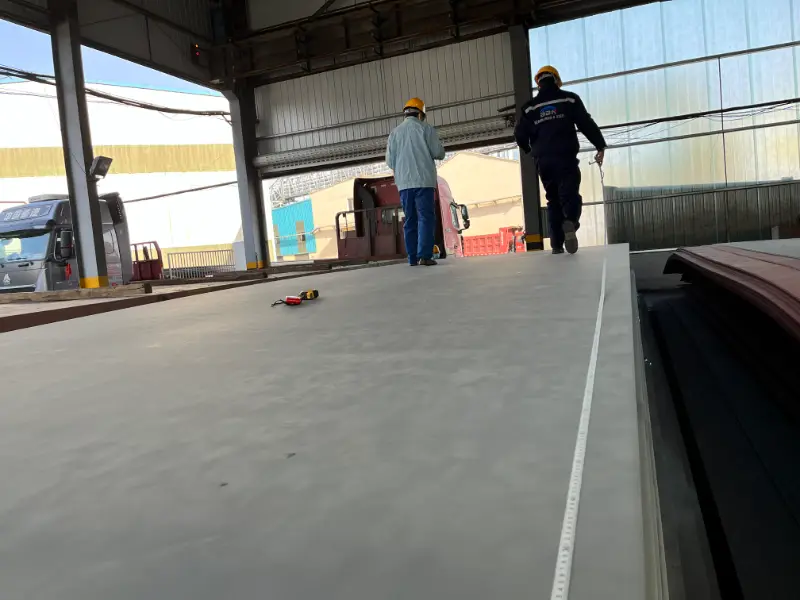
GL Grade F420 Shipbuilding Steel Plate
GL Grade F420 Shipbuilding Steel Plate: High-Strength Normalized Fine-Grain Steel for Offshore & Marine Structures
Comprehensive technical data for GL Grade F420 shipbuilding plate under Germanischer Lloyd standards, including chemical composition, mechanical properties, physical properties, international equivalents, and application guidance for marine and offshore engineering.
Hot rolling, normalizing (N) or thermo-mechanical rolling (M), welding, cold forming (limited), machining
- Phone : +8618037372205
- Email : [email protected]
- WhatsApp: Contact via Whtsapp
- WeChat: +8618037372205
GL Grade F420 Shipbuilding Steel Plate Introduction
GL Grade F420 is a high-strength, normalized fine-grain structural steel plate certified by Germanischer Lloyd (now DNV) for shipbuilding and offshore applications. Designed with a minimum yield strength of 420 MPa, it offers excellent weldability, low-temperature toughness (F-grade for service at -60°C), and resistance to brittle fracture. The steel is typically supplied in normalized or thermo-mechanically rolled condition, ensuring uniform mechanical properties through thicknesses up to approximately 100 mm. Its controlled chemistry with microalloying elements (Nb, V, Ti) provides fine grain refinement and enhanced mechanical performance without compromising formability. F420 is widely utilized in critical structural members of ships, offshore platforms, and marine equipment subjected to high static and dynamic loads in severe environments.
GL Grade F420 Shipbuilding Steel Plate Chemical Composition
Chemical composition according to GL Rules / IACS UR W13 for grade F420. Requirements are based on ladle analysis. Nb, V and Ti may be added singly or in combination. The carbon equivalent value (CEV) is controlled to ensure good weldability, typically CEV = C + Mn/6 + (Cr+Mo+V)/5 + (Ni+Cu)/15 ≤ 0.45–0.48 for thicknesses ≤50 mm; slightly higher for thicker products.
| Chemical element | Nominal content | Remarks |
|---|---|---|
| Carbon (C) | ≤ 0.20% | Depending on thickness and CEV; typical aim 0.10–0.18% |
| Silicon (Si) | ≤ 0.55% | Often 0.25–0.55% for deoxidation |
| Manganese (Mn) | 0.90–1.70% | For strength and toughness; higher Mn may be used with lower C |
| Phosphorus (P) | ≤ 0.025% | Maximum for shipbuilding quality |
| Sulfur (S) | ≤ 0.025% | Maximum for shipbuilding quality; typical <0.010% |
| Chromium (Cr) | ≤ 0.25% | Residual or intentional; not a required addition |
| Molybdenum (Mo) | ≤ 0.08% | Residual; not intentionally added |
| Nickel (Ni) | ≤ 0.40% | Residual; may be used for toughness up to 0.65% for grades ≥ F420 |
| Copper (Cu) | ≤ 0.35% | Residual; may be present from scrap |
| Aluminium (Al) total | ≥ 0.020% | Grain refining, usually as acid-soluble Al |
| Niobium (Nb) | ≤ 0.05% | Microalloying for grain refinement |
| Vanadium (V) | ≤ 0.10% | Microalloying; typical addition 0.02–0.08% |
| Titanium (Ti) | ≤ 0.05% | Optional microalloying; often used with Nb for improved toughness |
| Nitrogen (N) | ≤ 0.012% | Maximum unless bound by Ti/Al |
| Carbon Equivalent (CEV) | ≤ 0.48 (typically) | For plates ≤ 50 mm; ≤ 0.50 for 50–100 mm; adjusted per standard |
GL Grade F420 Shipbuilding Steel Plate Physical Properties
Physical properties are not formally required by GL classification rules; the values provided are typical for normalized low-alloy structural steels of this strength class and can be used for design calculations. Properties slightly vary with composition and heat treatment condition.
| Property | Typical value | Unit | Test conditions / remarks |
|---|---|---|---|
| Density (ρ) | 7850 | kg/m³ | At room temperature (20°C) |
| Elastic modulus (E) | 210 | GPa | At 20°C; temperature dependence: approx. 205 GPa at 100°C, 195 GPa at 200°C |
| Shear modulus (G) | 81 | GPa | Calculated from E and ν |
| Poisson's ratio (ν) | 0.3 | — | In elastic range |
| Thermal expansion coefficient (α) | 11.5 – 12.5 | 10⁻⁶/K | Mean value between 20°C and 100°C; increases with temperature (e.g., ~13.5 at 200°C, ~14.5 at 400°C) |
| Thermal conductivity (λ) | 45 – 55 | W/(m·K) | At 20°C; decreases with increasing temperature (approx. 40 W/(m·K) at 200°C) |
| Specific heat capacity (c) | 460 – 480 | J/(kg·K) | At 20°C; increases with temperature (approx. 550 J/(kg·K) at 300°C) |
| Electrical resistivity (ρ_e) | 0.20 – 0.25 | µΩ·m | At 20°C; varies with alloy content |
GL Grade F420 Shipbuilding Steel Plate Mechanical Properties
Mechanical properties for GL F420 normalized or TMCP rolled plates as required by GL Rules. Transverse tensile properties are normally specified for plates. Impact energy requirements apply to longitudinal or transverse specimens at -60°C (F-grade). For thickness ranges not explicitly covered, proportional strength reductions may apply; consult the full standard.
| Property | Required value | Unit | Test conditions and remarks |
|---|---|---|---|
| Yield strength (ReH) | ≥ 420 | MPa | For plate thickness t ≤ 100 mm; t ≤ 16 mm may have min. 430 MPa according to some specifications |
| Yield strength (ReH) | ≥ 400 | MPa | For thickness 100 < t ≤ 150 mm (typical; verify with GL rules) |
| Tensile strength (Rm) | 520 – 680 | MPa | Transverse test specimens; thickness range t ≤ 100 mm |
| Tensile strength (Rm) | 500 – 660 | MPa | For thickness 100 < t ≤ 150 mm |
| Elongation (A5) | ≥ 19 | % | Based on gauge length L0 = 5.65√S0; typically transverse |
| Elongation (A50 mm) | ≥ 19 | % | Alternatively expressed; depends on specimen thickness |
| Charpy impact energy (KV, longitudinal) | ≥ 50 (average of 3) | J | Test temperature -60°C; minimum single value 70% of average (35 J) |
| Charpy impact energy (KV, transverse) | ≥ 34 (average of 3) | J | Test temperature -60°C; minimum single value 24 J |
| Bend test (mandrel diameter) | No cracking | — | Bend angle 180°; mandrel diameter = 3t (t ≤ 35 mm) or 4t (t > 35 mm) for tensile strength > 620 MPa |
GL Grade F420 Shipbuilding Steel Plate Equivalent Material Standards and Replaceable Grades
| Country/Region | Standard | Grade | Remarks |
|---|---|---|---|
| IACS | IACS UR W13 | F420 | Unified requirement for high-strength hull structural steel; direct equivalent |
| Europe | EN 10225-3 | S420G2+M / S420G1+M | Comparison depends on CEV and impact condition; S420G1 is normalized, G2 is TMCP; F420 corresponds roughly to S420G2+M |
| DNV (Norway) | DNVGL-OS-B101 | F420 | Identical grade definition under DNV rules |
| ABS (USA) | ABS Rules | F420 | ABS grade F420; equivalent mechanical and impact properties |
| LR (UK) | LR Rules | F420 | Lloyd's Register F420 |
| BV (France) | BV Rules | F420 | Bureau Veritas F420 |
| CCS (China) | CCS Rules | F420 | China Classification Society F420 |
| KR (Korea) | KR Rules | F420 | Korean Register F420 |
| NK (Japan) | NK Rules | F420 | Nippon Kaiji Kyokai F420 |
| RINA (Italy) | RINA Rules | F420 | Registro Italiano Navale F420 |
GL Grade F420 Shipbuilding Steel Plate Application Introduction
GL F420 is a premium high-strength shipbuilding and offshore structural steel designed for demanding applications where lightweight design, high load-bearing capacity, and excellent toughness at low ambient temperatures are crucial. It is predominantly used in ship and offshore structures operating in harsh environments. The steel can be processed by flame cutting, cold forming (with controlled radius-to-thickness ratios), welding by all common methods (SMAW, SAW, GMAW), and machining. Preheating and interpass temperature control are recommended depending on plate thickness and hydrogen control requirements.
Product Applications: Hull shell plates for ice-strengthened LNG carriers, Le legs and leg wells of self-elevating platforms, Columns, pontoons, and bracings of semi-submersible drilling units, Transition pieces and monopile connecting flanges for offshore wind turbines, Deck and bottom plates for heavy-load RO-RO ships, Crane pedestals and slewing rings on offshore installation vessels
Processed into products: Flanged beams and stiffeners for main deck and bottom structures, Skids and load distribution plates under heavy equipment, Shackle eyes and padeyes for mooring and towing systems, Anchor rack modules and pull-in winch foundations, Hinge and bearing supports for retractable thrusters, Door and hatch coamings in watertight bulkheads, Jacking frame adapters and rack chocks on jack-up rigs
Application industries: Shipbuilding (naval and commercial vessels: container ships, bulk carriers, tankers, ice-class vessels), Offshore oil & gas (jack-up rigs, semi-submersibles, SPARs, TLPs, FPSO hulls and modules), Offshore renewable energy (wind turbine foundations, transition pieces, substructures), Marine engineering (heavy lift vessels, dredgers, crane barges), Arctic engineering (ice-resistant structures with toughness at -60°C), Port and harbor equipment (container cranes, ship-to-shore crane structures)
GL Grade F420 Shipbuilding Steel Plate Similar/Comparable Materials
| Country/Region | Standard | Grade | Remarks / Analysis |
|---|---|---|---|
| Europe | EN 10025-6 | S460QL / S460QL1 | Quenched and tempered structural steel with min. yield 460 MPa; higher strength, different toughening mechanism; may replace F420 if welding and design adapted, excellent low-temperature toughness (down to -60°C) |
| Europe | EN 10225 | S355G10+M / S355G15+N | Lower strength grade (355 MPa) for fixed offshore structures; higher toughness and strict chemistry; can be used in less demanding zones |
| Europe | EN 10225-3 | S460G2+M | TMCP off shore steel with 460 MPa yield; often used as upgraded alternative where weight reduction is critical; requires careful welding procedures |
| Japan | JIS G 3106 | SM490YB / SM520C | Weldable structural steels; SM520C has 365 MPa min yield but better toughness. With F420 grade meeting equivalent thickness and impact requirements, not a direct replacement but can be considered if design recalculation allows |
| USA | ASTM A572 / ASTM A871 | Grade 65 / Grade 65 | ASTM A572 Gr. 65 (450 MPa yield) used in structural applications but lacks ship-classification stamp; may be accepted for ancillary structures with engineering approval |
| Russia | GOST 52927 | RS F420 | Russian Maritime Register of Shipping equivalent; similar requirements |
Notes:
Welding Guidelines: Low hydrogen practices are mandatory to avoid cold cracking. Preheating (100–150°C) for thicknesses above 30 mm is typical. Heat input shall be controlled to avoid grain coarsening in the HAZ. CEV and PCM values should be checked against the welding procedure specification.
Corrosion Protection: As a carbon‑manganese steel, F420 requires protective coatings (paint, anodes or cladding) for marine environments. Utilization in as‑welded condition with sacrificial anodes is common.
Certification: All deliveries must be accompanied by a classification society certificate (e.g., GL, DNV, BV) confirming compliance with the specified grade and test requirements.
Thickness Tolerances: Usually acc. to EN 10029 or equivalent, with Class A or B depending on ordering.
- Share



