
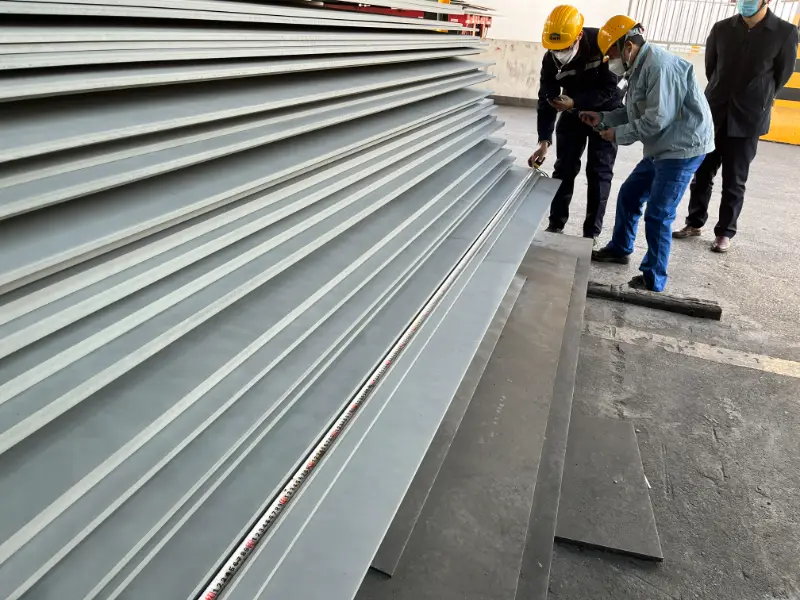
GL Grade A550 Shipbuilding Steel Plate
GL Grade A550 Shipbuilding Steel Plate | High Strength Hull Structural Steel
GL Grade A550 is a high-strength shipbuilding steel plate with a minimum yield strength of 550 MPa, certified by Germanischer Lloyd. It is used for offshore and marine structures requiring excellent toughness and weldability.
Hot rolling, controlled rolling (TMCP), normalising rolling, or quenching and tempering (QT)
- Phone : +8618037372205
- Email : [email protected]
- WhatsApp: Contact via Whtsapp
- WeChat: +8618037372205
GL Grade A550 Shipbuilding Steel Plate Introduction
GL Grade A550 is a high-strength structural steel plate intended for ship and offshore construction, classified under the rules of Germanischer Lloyd (now DNV GL). With a minimum yield strength of 550 MPa, this quenched and tempered (or TMCP) steel offers an exceptional combination of high strength, good weldability, and adequate low-temperature toughness. It is suitable for critical hull members, deck plating, and structural components in large vessels and offshore platforms. The standard guarantees consistent mechanical properties across thicknesses up to 100 mm.
- High yield strength reduces structural weight
- Good notch toughness at 0°C (A-grade impact test)
- Excellent formability and weldability with proper preheating
GL Grade A550 Shipbuilding Steel Plate Chemical Composition
Ladle analysis according to GL rules for Grade A550. Values are maximum unless a range is given. Microalloying elements such as niobium, vanadium, and titanium may be added singly or in combination to achieve the required strength. For thicknesses > 25 mm, the carbon equivalent (CEV) is typically specified to ensure weldability.
| Element | Percentage (%) | Remarks |
|---|---|---|
| C | ≤ 0.20 | For thickness ≤ 50 mm |
| C | ≤ 0.22 | For thickness > 50 mm |
| Si | ≤ 0.55 | - |
| Mn | ≤ 1.60 | Combined with microalloying |
| P | ≤ 0.025 | - |
| S | ≤ 0.025 | - |
| Al (acid soluble) | ≥ 0.015 | Total aluminium |
| Nb | ≤ 0.05 | Optional microalloying |
| V | ≤ 0.10 | Optional microalloying |
| Ti | ≤ 0.03 | Optional microalloying |
| Cr | ≤ 0.25 | Residual |
| Ni | ≤ 0.40 | Residual |
| Mo | ≤ 0.08 | Residual |
| Cu | ≤ 0.30 | Residual |
GL Grade A550 Shipbuilding Steel Plate Physical Properties
Representative physical and thermal properties for a quenched and tempered high-strength steel of this strength class. These values are for general guidance at room temperature unless otherwise indicated. Properties may vary slightly with exact composition and heat treatment condition. Electrical resistivity and thermal conductivity are typical for low-alloy structural steels.
| Property | Typical Value | Unit | Test Condition |
|---|---|---|---|
| Density (ρ) | 7850 | kg/m³ | Room temperature |
| Elastic modulus (E) | 205 – 210 | GPa | Room temperature |
| Shear modulus (G) | 80 | GPa | Calculated from E and ν |
| Poisson's ratio (ν) | 0.3 | - | Elastic range |
| Thermal expansion (α) | 12.0 × 10⁻⁶ | 1/K | 20°C to 100°C |
| Thermal expansion (α) | 12.5 × 10⁻⁶ | 1/K | 20°C to 200°C |
| Thermal expansion (α) | 13.1 × 10⁻⁶ | 1/K | 20°C to 400°C |
| Thermal conductivity (λ) | 36 – 40 | W/(m·K) | Room temperature |
| Specific heat capacity (cₚ) | 460 – 500 | J/(kg·K) | Room temperature |
| Electrical resistivity (ρₑ) | 0.25 – 0.30 | Ω·mm²/m | Room temperature |
GL Grade A550 Shipbuilding Steel Plate Mechanical Properties
Mechanical properties at room temperature for GL Grade A550 plates in quenched and tempered or TMCP condition. The impact test temperature for grade A is 0°C. Elongation requirements are for proportionally machined test pieces with gauge length L₀ = 5.65√S₀. Please refer to the specific GL standard for detailed testing conditions.
| Property | Specified Value | Unit | Test Condition / Remarks |
|---|---|---|---|
| Yield strength (ReH) | ≥ 550 | MPa | Thickness ≤ 50 mm |
| Yield strength (ReH) | ≥ 530 | MPa | 50 mm < Thickness ≤ 70 mm |
| Yield strength (ReH) | ≥ 510 | MPa | 70 mm < Thickness ≤ 100 mm |
| Tensile strength (Rm) | 670 – 830 | MPa | Thickness ≤ 50 mm |
| Tensile strength (Rm) | 650 – 830 | MPa | 50 mm < Thickness ≤ 70 mm |
| Tensile strength (Rm) | 630 – 800 | MPa | 70 mm < Thickness ≤ 100 mm |
| Elongation (A) | ≥ 16 | % | L₀ = 5.65√S₀, t ≤ 50 mm |
| Elongation (A) | ≥ 15 | % | L₀ = 5.65√S₀, 50 < t ≤ 70 mm |
| Elongation (A) | ≥ 14 | % | L₀ = 5.65√S₀, 70 < t ≤ 100 mm |
| Charpy impact (KV, longitudinal) | ≥ 27 | J | at 0°C (Grade A) |
| Charpy impact (KV, transverse) | ≥ 20 | J | at 0°C (when specified) |
| Bend test (180°) | d = 3a | - | Mandrel diameter, no cracks |
GL Grade A550 Shipbuilding Steel Plate Identical Material Standards and Substitutable Grades
| Country/Region | Standard | Grade/Designation | Remarks |
|---|---|---|---|
| Germany / International | GL (Germanischer Lloyd) | A550 | Original grade, minimum yield 550 MPa, 0°C impact |
| Norway / International | DNV (Det Norske Veritas) | NV A550 | Equivalent high-strength shipbuilding steel |
| USA / International | ABS (American Bureau of Shipping) | AH550 | Same strength and toughness level |
| UK / International | LR (Lloyd's Register) | AH550 | Identical requirements |
| France / International | BV (Bureau Veritas) | AH550 | Equivalent grade |
| China / International | CCS (China Classification Society) | AH550 | Same mechanical properties |
| South Korea / International | KR (Korean Register) | AH550 | Fully interchangeable |
| Japan / International | NK (ClassNK) | KA550 | Matching high-strength grade |
| Italy / International | RINA | AH550 | Equivalent for marine structures |
GL Grade A550 Shipbuilding Steel Plate Application Introduction
GL Grade A550 is designed for welded structures that demand high strength-to-weight ratios, good fatigue resistance, and reliable low-temperature toughness. A550 plates are extensively used in ship and offshore sectors. The steel is typically fabricated by welding, cutting, forming, and machining. Preheating and post-weld heat treatment may be required depending on the thickness and welding procedure to avoid hydrogen cracking. Common applications and suitable products and components are listed below.
Product Applications: Hull plating for container ships, bulk carriers, tankers, Deck and bottom structural members, Jack-up rig legs and spudcan components, Offshore platform topside modules, Ship crane pedestals and heavy-duty booms
Processed into products: Longitudinal stiffeners and web frames, Upper deck stringers and sheer strakes, Bottom girders and floor plates, Bulkhead plating and stiffened panels, Hatch coamings and heavy reinforcement pads, Welded tubular joints for offshore structures
Application industries: Commercial and naval shipbuilding, Offshore oil & gas platforms and FPSOs, Renewable energy offshore structures (wind turbine foundations), Heavy-lift and crane construction, Marine pressure vessels and tanks
GL Grade A550 Shipbuilding Steel Plate Similar or Alternative Material Recommendations
| Country/Region | Standard | Grade/Designation | Remarks |
|---|---|---|---|
| Europe | EN 10025-6 | S550QL / S550Q | Quenched and tempered structural steel, min yield 550 MPa; not class-specific, but often accepted for offshore with additional testing |
| USA | ASTM A514 / A517 | Grade Q / B | High-strength quenched and tempered plate, min yield 690 MPa; similar weldability, higher strength. For applications with higher demands |
| International | API 2Y / 2W | Grade 60 | Offshore structural steel plates, min yield 415–550 MPa depending on grade, used in fixed offshore structures |
| Japan | JIS G 3106 | SM570 | Weldable high-strength steel for structures, min yield 460 MPa; lower strength but often used for less critical parts |
Notes:
Ultrasonic testing is normally required for thicknesses above 20 mm according to GL rules. The steel may be supplied with through-thickness (Z-grade) properties, e.g., Z25 or Z35, to improve lamellar tearing resistance when specified. Carbon Equivalent (CEV) values are guaranteed for weldability; typical CEV ≤ 0.50 for thickness up to 50 mm. Delivery documents include inspection certificate 3.1 or 3.2 per EN 10204. Various surface finishes (shop primer, blasted, uncoated) are available upon agreement.
- Share



