
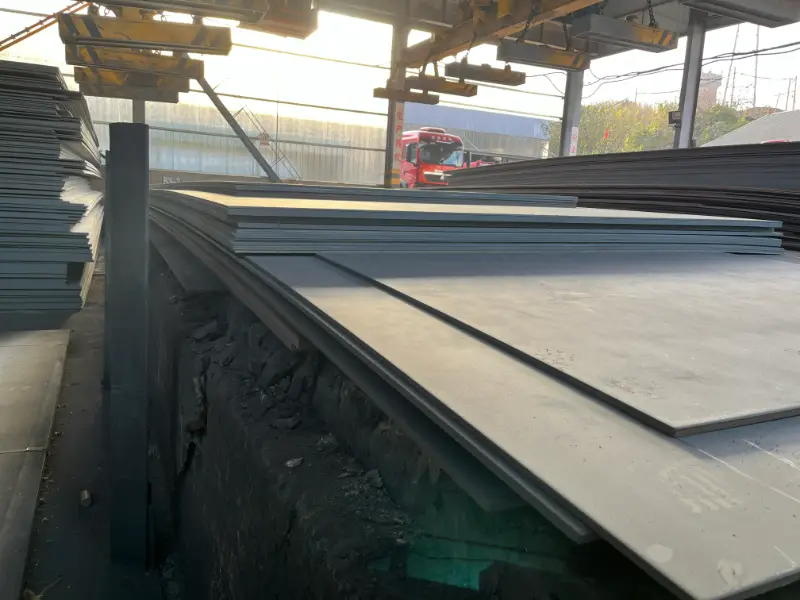
RINA Grade A Shipbuilding Steel Plate
RINA Grade A Shipbuilding Steel Plate - Properties, Equivalents & Applications
Explore the chemical composition, mechanical and physical properties of RINA Grade A shipbuilding steel plate, along with international equivalents, similar materials, and detailed application guide.
Hot rolling, normalizing (optional), controlled rolling, welding, bending, cutting, and forming
- Phone : +8618037372205
- Email : [email protected]
- WhatsApp: Contact via Whtsapp
- WeChat: +8618037372205
RINA Grade A Shipbuilding Steel Plate Introduction
RINA Grade A is a normal strength hull structural steel governed by the rules of Registro Italiano Navale (RINA). It is widely used in the construction of ship hulls, offshore structures, and marine equipment. This steel grade is characterized by good weldability, moderate tensile strength, and sufficient toughness for general shipbuilding applications. The material is typically supplied in the as-rolled condition, and when required, normalized or controlled-rolled processes are applied. It meets the basic requirements for ordinary strength ship plates, offering reliable performance in ambient and moderate temperature environments. Design professionals often select Grade A for secondary structural members, decks, and shell plating where low-temperature toughness demands are not critical. Its chemical composition is tightly controlled to ensure consistent mechanical properties and fabricability.
RINA Grade A Shipbuilding Steel Plate Chemical Composition
The chemical composition requirements for RINA Grade A are defined in accordance with RINA Rules Part D, Chapter 2. These limits ensure good weldability and consistent mechanical performance. Note: The manganese content shall be at least 2.5 times the carbon content. Residual element limits (Cu, Cr, Ni, Mo) are maximum values to avoid adverse effects on toughness and hot ductility. Fully killed steel practice with sufficient aluminum content is standard for modern production.
| Chemical Element | Standard Value (max, unless indicated otherwise) | Remarks |
|---|---|---|
| C (Carbon) | ≤ 0.21% | - |
| Mn (Manganese) | ≥ 2.5 × C (typical range 0.60–1.00%) | Minimum 2.5 × C; maximum often limited to 1.00% for thickness ≤ 50 mm |
| Si (Silicon) | ≤ 0.50% | - |
| P (Phosphorus) | ≤ 0.035% | - |
| S (Sulfur) | ≤ 0.035% | - |
| Al (Aluminium, acid soluble) | ≥ 0.015% | Required for fully killed steel |
| Cu (Copper) | ≤ 0.35% | Residual element |
| Cr (Chromium) | ≤ 0.20% | Residual element |
| Ni (Nickel) | ≤ 0.40% | Residual element |
| Mo (Molybdenum) | ≤ 0.08% | Residual element |
| N (Nitrogen) | ≤ 0.009% | If not bound by aluminium or other grain refiners, usually limited |
| Others (total) | ≤ 0.70% (total of Cu+Cr+Ni+Mo) | Residual summery |
RINA Grade A Shipbuilding Steel Plate Thermal and Electrical Physical Properties
The physical properties shown are typical for carbon‑manganese structural steel at ambient temperature and are based on published data for similar grades. They are provided for design calculations and do not replace specific mill certificates. Density is the standard value for steel. Elastic modulus, shear modulus, and Poisson's ratio are derived from dynamic tests. Thermal expansion applies to the range 20–100 °C. Thermal conductivity and specific heat capacity are at room temperature unless otherwise noted. Electrical resistivity is the typical value at 20 °C.
| Property | Typical Value | Unit | Test Conditions / Remarks |
|---|---|---|---|
| Density (ρ) | 7.85 | g/cm³ | At 20 °C |
| Elastic Modulus (E) | 200 – 210 | GPa | At 20 °C, longitudinal |
| Shear Modulus (G) | ≈ 79 | GPa | Calculated from E and ν |
| Poisson's Ratio (ν) | 0.3 | - | In elastic range |
| Thermal Expansion Coefficient (α) | 11.5 – 12.5 × 10⁻⁶ | K⁻¹ | For 20–100 °C range |
| Thermal Conductivity (λ) | ≈ 50 | W/(m·K) | At 20 °C; decreases slightly with increasing temperature |
| Specific Heat Capacity (cₚ) | ≈ 460 | J/(kg·K) | At 20 °C; increases with temperature |
| Electrical Resistivity (ρₑ) | ≈ 0.15 – 0.20 | µΩ·m | At 20 °C |
RINA Grade A Shipbuilding Steel Plate Mechanical Properties
The tensile and impact properties apply to plates in the as-rolled or normalized condition, tested at room temperature in the transverse direction (or as specified). Yield strength (ReH) is the upper yield or 0.2% proof stress. Tensile strength (Rm) applies to full thickness range. Elongation is measured on a proportional gauge length of 5.65√S₀ (or 50 mm). Bend test is performed with a mandrel diameter of 3 times the thickness (3a) through 180° without cracking. Charpy V-notch impact test is not mandatory for Grade A in many rules when thickness ≤ 50 mm; however, when required (e.g., for certain application or regional supplement), the minimum average absorbed energy is 27 J at 0°C for longitudinal specimens.
| Property | Required Value | Unit | Test Conditions |
|---|---|---|---|
| Yield Strength (ReH) | ≥ 235 | MPa | Room temperature, transverse test piece; for thickness > 50 mm, minimum 235 MPa maintained |
| Tensile Strength (Rm) | 400 – 520 | MPa | Room temperature, transverse; applicable for all thicknesses |
| Elongation (A) | ≥ 22 (for t ≤ 40 mm), ≥ 20 (40 < t ≤ 100) | % | Gauge length 5.65√S₀ or 50 mm; value depends on thickness |
| Bend Test | Mandrel diameter 3a, 180° bending | - | No cracking or defects; a = specimen thickness |
| Charpy V-notch Impact (KV₂) | ≥ 27 (when required) | J | Longitudinal specimen, 0 °C; not mandatory for Grade A with thickness ≤ 50 mm per standard IACS UR W11 |
RINA Grade A Shipbuilding Steel Plate Completely Equivalent Material Standards and Substitutable Grades
| Country / Region | Standard / Regulation | Grade / Designation | Remarks |
|---|---|---|---|
| International (IACS Member) | IACS UR W11 | Normal strength – Class A | Basis for all major classification society grades |
| USA | ABS Rules for Materials and Welding | ABS Grade A | Fully interchangeable with RINA Grade A |
| UK | Lloyd's Register Rules | LR Grade A | Same chemical and mechanical requirements |
| Norway/Germany | DNV Ship Rules / DNVGL-RU-SHIP Pt.2 | NV A (DNV Grade A) | Identical performance criteria |
| France | Bureau Veritas Rules | BV Grade A | Recognised as equivalent |
| China | CCS Rules for Materials & Welding | CCS A | Corresponds to RINA Grade A |
| Japan | Nippon Kaiji Kyokai (ClassNK) | NK Grade A | Meets same specification |
| South Korea | Korean Register Rules | KR Grade A | Equivalent in all respects |
| Russia | Russian Maritime Register of Shipping | RS Grade A | Interchangeable designation |
RINA Grade A Shipbuilding Steel Plate Application Introduction
RINA Grade A shipbuilding steel serves as the backbone for numerous marine and offshore construction projects. It is selected primarily for moderate strength applications where low‑temperature toughness is not the dominant design criterion. The steel's good ductility and weldability simplify fabrication procedures. Below are typical industries, products, and components.
Product Applications: Hull shell plating (side and bottom plates), Decks and superstructure panels, Bulkheads and tank walls, Offshore platform structural members (non‑critical), Barge decks and bottom plates, Transition pieces for wind turbine foundations
Processed into products: Ship hull plates, bilge keels, and sheer strakes, Stiffeners, brackets, and gusset plates, Hatch coamings and deck girders, Watertight doors and manhole covers, Secondary structural beams and columns, Offshore walkways, handrails, and grating supports
Application industries: Shipbuilding and repair, Offshore oil and gas, Marine renewable energy (offshore wind foundations), Port and harbor engineering, Barge and inland waterway vessel construction, Structural engineering in coastal environments
RINA Grade A Shipbuilding Steel Plate Similar / Near-Equivalent Alternative Materials
| Country / Region | Standard | Grade | Analysis and Remarks |
|---|---|---|---|
| Europe | EN 10025-2 | S235JR | Similar yield strength (≥ 235 MPa) and tensile range (360–510 MPa). However, S235JR is not certified for shipbuilding; impact requirements and sulfur/phosphorus limits may differ. Can be used in non-classed marine structures after qualification. |
| USA | ASTM A36 / A36M | A36 | Common structural steel with yield ≥ 250 MPa (thin gauges) and tensile 400–550 MPa. Slightly higher strength but lacks guaranteed Charpy toughness at 0 °C. Not directly substitutable for classed ship components. |
| China | GB/T 700 | Q235A / Q235B | Q235B offers 0 °C impact option and yield ≥ 235 MPa. Carbon and manganese limits are comparable, but full conformance to IACS UR W11 requires additional testing. Suitable for non-class marine applications. |
| India | IS 2062 | E250 Grade A / BR | Tensile properties and chemistry similar; E250 BR with controlled S/P and impact may approach Grade A requirements. For marine use, class society certification would be needed. |
Notes:
Supply conditions: Plates are usually delivered with inspection certificates in accordance with EN 10204 type 3.1 or 3.2 upon request. Weldability: Grade A steel has a low carbon equivalent (CEV typically ≤ 0.38%) and can be welded with standard shipyard procedures; preheat is generally unnecessary for thicknesses below 30 mm. Tolerances and dimensions: Dimensional tolerances comply with RINA Rules or the agreed standard (e.g., EN 10029 for plates). Corrosion protection: While no specific alloying for corrosion resistance is included, typical paint and cathodic protection systems are applied. Marking: Each plate is stamped with the RINA brand, grade, heat number, and additional marks as required by the classification society.
- Share



