
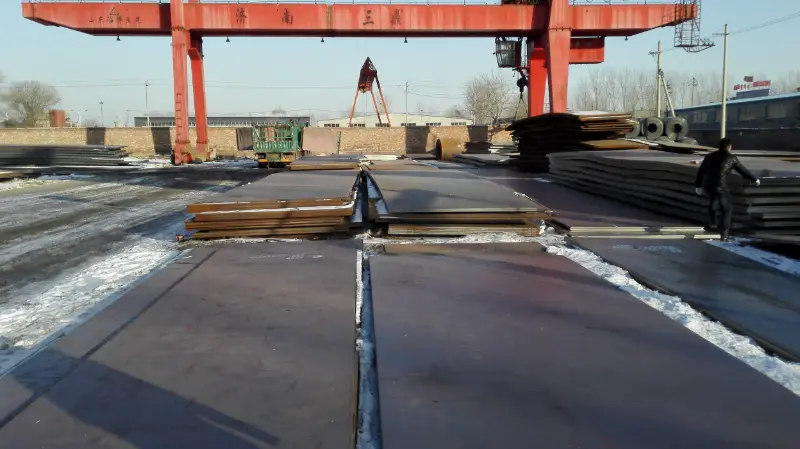
RINA Grade B Shipbuilding Steel Plate
RINA Grade B Shipbuilding Steel: Properties, Equivalents & Applications
Comprehensive material data for RINA Grade B shipbuilding steel plate: chemical composition, mechanical and thermal properties, full international equivalents, and application guidelines.
Hot rolling, normalizing (if required), cold forming, gas/plasma/laser cutting, arc welding (SMAW, SAW, GMAW), bending, and straightening
- Phone : +8618037372205
- Email : [email protected]
- WhatsApp: Contact via Whtsapp
- WeChat: +8618037372205
RINA Grade B Shipbuilding Steel Plate Introduction
RINA Grade B is a normal-strength hull structural steel specified by the Registro Italiano Navale (RINA) under its Rules for the Classification of Ships. It conforms to IACS UR W11 requirements for ordinary shipbuilding steels. This grade is characterised by a minimum yield strength of 235 MPa, excellent weldability, and reliable impact toughness at 0°C. It is predominantly supplied as hot-rolled plates, frequently used in the construction of hulls, decks, bulkheads, and other critical marine structures. The steel is fully killed and often fine-grain treated with aluminium to achieve the required toughness. It can be delivered in hot-rolled or normalized condition, and is accepted by all major classification societies under equivalent grades.
RINA Grade B Shipbuilding Steel Plate Chemical Composition , Heat Analysis
Chemical composition for RINA Grade B follows IACS UR W11 Table 1. The steel is fully killed and fine-grain treated (usually with aluminium). Residual elements are strictly limited to ensure weldability and toughness. All values are maximum unless otherwise indicated.
| Element | Required Value (wt%) | Remarks |
|---|---|---|
| Carbon (C) | ≤ 0.21 | Max limit |
| Manganese (Mn) | 0.80 – 1.20 | Min 0.80% if C ≤ 0.18%; min 1.00% if C > 0.18% |
| Silicon (Si) | ≤ 0.35 | Deoxidiser |
| Phosphorus (P) | ≤ 0.035 | |
| Sulfur (S) | ≤ 0.035 | |
| Aluminium (acid-soluble) | ≥ 0.015 | Fine-grain practice; not required if other grain-refining elements are used |
| Chromium (Cr) | ≤ 0.20 | Residual element |
| Nickel (Ni) | ≤ 0.40 | Residual element |
| Copper (Cu) | ≤ 0.35 | Residual element |
| Molybdenum (Mo) | ≤ 0.08 | Residual element |
| Vanadium (V) | ≤ 0.05 | Residual element |
| Nitrogen (N) | ≤ 0.009 | If not Al-treated |
RINA Grade B Shipbuilding Steel Plate Thermal & Electrical Physical Properties
Physical properties are typical for hot-rolled carbon steel of this composition. Actual values may vary slightly with specific heat analysis and processing. Used for design calculations unless project-specific testing is required.
| Property | Typical Value | Unit | Test Condition |
|---|---|---|---|
| Density (ρ) | 7850 | kg/m³ | Room temperature |
| Modulus of Elasticity (E) | 200 – 210 | GPa | Room temperature |
| Shear Modulus (G) | 77 – 81 | GPa | Room temperature |
| Poisson's Ratio (ν) | 0.3 | Elastic range | |
| Thermal Expansion Coefficient (α) | 10.5 – 12.5 | 10⁻⁶/K | 20°C to 100°C |
| Thermal Expansion Coefficient (α) | 11.5 – 13.5 | 10⁻⁶/K | 20°C to 200°C |
| Thermal Expansion Coefficient (α) | 12.5 – 14.5 | 10⁻⁶/K | 20°C to 400°C |
| Thermal Conductivity (λ) | 48 – 52 | W/(m·K) | Room temperature |
| Specific Heat Capacity (cp) | 450 – 470 | J/(kg·K) | Room temperature |
| Electrical Resistivity (ρe) | 0.15 – 0.25 | μΩ·m | Room temperature |
| Melting Range | 1490 – 1530 | °C | Approximate |
RINA Grade B Shipbuilding Steel Plate Mechanical Properties
Tensile and impact properties according to RINA Rules / IACS UR W11. Values apply to transverse specimens unless longitudinal is specified for impact. Yield strength varies with thickness. Bending test (180°) uses the indicated former diameter.
| Property | Required Value | Unit | Test Condition / Remarks |
|---|---|---|---|
| Yield Strength (ReH) | ≥ 235 | MPa | Thickness t ≤ 16 mm |
| Yield Strength (ReH) | ≥ 225 | MPa | 16 < t ≤ 40 mm |
| Yield Strength (ReH) | ≥ 215 | MPa | 40 < t ≤ 100 mm |
| Tensile Strength (Rm) | 400 – 520 | MPa | All thicknesses |
| Elongation (A5, L0 = 5.65√So) | ≥ 22 | % | t ≤ 50 mm |
| Elongation (A5, L0 = 5.65√So) | ≥ 21 | % | 50 < t ≤ 70 mm |
| Elongation (A5, L0 = 5.65√So) | ≥ 20 | % | 70 < t ≤ 100 mm |
| Bend Test (180°) | Former diameter = 2t | t ≤ 25 mm | |
| Bend Test (180°) | Former diameter = 3t | 25 < t ≤ 50 mm | |
| Bend Test (180°) | Former diameter = 4t | 50 < t ≤ 75 mm | |
| Bend Test (180°) | Former diameter = 5t | 75 < t ≤ 100 mm | |
| Charpy V-notch Impact Energy (KV) | ≥ 27 (longitudinal) | J | Test temperature 0°C, average of 3 specimens |
| Charpy V-notch Impact Energy (KV) | ≥ 20 (transverse) | J | Test temperature 0°C, optional for thinner sections |
RINA Grade B Shipbuilding Steel Plate Fully Equivalent Materials – Same Grade from Other Classification Societies
| Country / Region | Standard / Rule | Grade | Remarks |
|---|---|---|---|
| International (USA) | ABS Rules | ABS Grade B | Identical requirements per IACS UR W11 |
| France | BV Rules | BV Grade B | Identical |
| China | CCS Rules | CCS Grade B | Identical |
| Norway / Germany | DNV Rules | DNV Grade B | Identical (formerly NV B) |
| South Korea | KR Rules | KR Grade B | Identical |
| United Kingdom | LR Rules | LR Grade B | Identical |
| Japan | NK Rules | NK Grade B | Identical |
| Russia | RS Rules | RS Grade B | Identical |
| Poland | PRS Rules | PRS Grade B | Identical |
| India | IRS Rules | IRS Grade B | Identical |
| Croatia | CRS Rules | CRS Grade B | Identical |
RINA Grade B Shipbuilding Steel Plate Application Introduction
RINA Grade B is a versatile shipbuilding steel approved for use in primary and secondary structures of seagoing vessels and offshore installations. It combines adequate strength, good ductility and reliable toughness at 0°C, meeting the demands of general shipbuilding applications. The steel is readily weldable with all common shipyard processes and does not normally require preheating for thicknesses below 40 mm. It is typically supplied in the hot-rolled condition, with optional normalising for thicker sections or when improved toughness is specified. The following examples illustrate its typical use:
Product Applications: Hull shell plating (bottom, side, and deck plates), Longitudinal and transverse bulkheads, Web frames and girder webs, Stiffeners (flat bars, bulb flats, angles, T-sections), Double-bottom floors and girders, Hatch coamings and side stringers, Deckhouses and superstructures (primary members), Caissons and temporary steel structures for marine use
Processed into products: Large welded hull plates (flame-cut, beveled, and rolled to curvature), Cut and welded panels for modular block construction, Flanged and stiffened bracket plates, Deck and bulkhead stiffeners fitted by profile cutting and straightening, Padeyes, lugs, and lifting points fabricated from plate offcuts, Collision bulkhead plates and strengthening inserts, Foundation plates for machinery and deck equipment
Application industries: Shipbuilding (merchant ships, bulk carriers, tankers, container vessels, ferries, Ro-Ro ships), Offshore engineering (jack-up rigs, semi-submersibles, floating production units), Marine construction (barges, pontoons, floating docks, harbour structures), Pressure hulls for submersibles (limited to non-ice class applications), Steel construction (port equipment, crane booms, bridges, heavy structural frames when corrosion protection is adequate)
RINA Grade B Shipbuilding Steel Plate Similar or Neighbouring Grades
| Country / Region | Standard / Rule | Grade | Remarks / Differences |
|---|---|---|---|
| All IACS Members | IACS UR W11 | Grade A | Lower toughness requirement (no mandatory impact test or test at +20°C); weldable but less suitable for critical low-temperature applications. |
| All IACS Members | IACS UR W11 | Grade D | Tougher than Grade B – impact test at -20°C; otherwise similar strength and chemistry; can replace B when higher toughness is needed. |
| All IACS Members | IACS UR W11 | Grade E | Highest toughness among normal strength grades – impact test at -40°C; used for arctic or critical structural applications; fully killed and fine grained. |
| All IACS Members | IACS UR W11 | AH36 | Higher strength hull structural steel (min yield 355 MPa); impact test at 0°C as Grade B; can be used to reduce plate thickness where strength governs, but subject to stricter welding procedure. |
Notes:
Weldability: RINA Grade B possesses excellent weldability with carbon equivalent values typically below 0.40. All common arc welding processes can be used, including manual metal arc (SMAW), submerged arc (SAW), and gas metal arc (GMAW). Preheating is generally unnecessary for thicknesses up to about 40 mm. Formability: The steel can be cold-formed with inner bending radii following class rules (typically not less than 2t for plate bending). Hot forming should be followed by re-normalising if mechanical properties are affected. Corrosion Protection: As a carbon steel, it requires appropriate protection in marine environments, such as coating systems (epoxy, anti-corrosive paints) and cathodic protection. Certification: Plates must be delivered with RINA surveyor's inspection and stamping unless the purchaser accepts EN 10204 3.1 certificates countersigned by a recognised independent body.
- Share



