
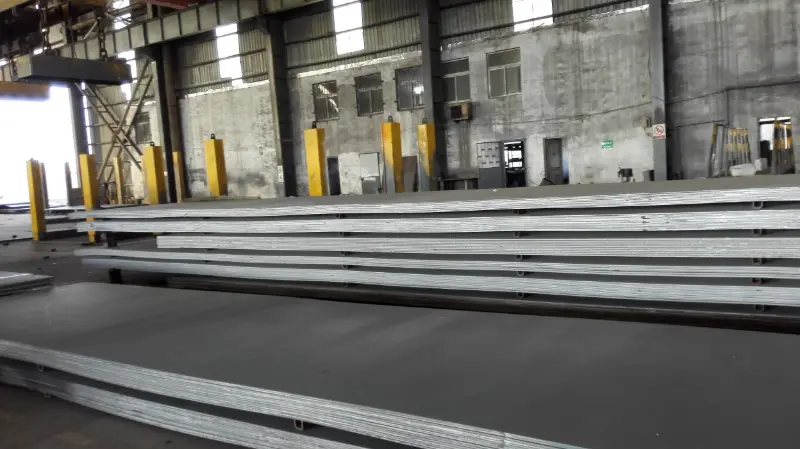
GL Grade D690 Shipbuilding Steel Plate
GL Grade D690 Shipbuilding Steel Plate: High-Strength Quenched & Tempered Offshore Structural Material
Comprehensive data sheet for GL Grade D690 steel plate including chemical composition, mechanical properties, thermal and electrical characteristics, equivalent standards, and application guidance for ship and offshore construction.
Cutting, forming, welding, stress relieving (post-weld heat treatment not normally required)
- Phone : +8618037372205
- Email : [email protected]
- WhatsApp: Contact via Whtsapp
- WeChat: +8618037372205
GL Grade D690 Shipbuilding Steel Plate Introduction
GL Grade D690 is a high-strength, quenched and tempered weldable fine-grain structural steel primarily used for shipbuilding and offshore structures. It is certified by Germanischer Lloyd (GL) according to their Rules for Classification and Construction. The designation 'D690' indicates a minimum yield strength of 690 MPa and a toughness class 'D' with impact testing at -20°C. This grade offers an excellent combination of high strength, good low-temperature toughness, and weldability, enabling weight reduction in critical structural members. Typical applications include hull girders, deck plating, and jack-up rig components. The material is usually supplied in the quenched and tempered (Q&T) or thermo-mechanically controlled rolled (TMCP) condition, meeting strict requirements for through-thickness properties and low-temperature impact energy.
GL Grade D690 Shipbuilding Steel Plate Chemical Composition
Chemical composition according to IACS UR W31 and typical GL specification for grade D690. All elements are controlled to ensure good weldability and toughness. Carbon equivalent (CEV) is usually limited to ≤0.52% for thicknesses ≤50 mm. Fine-grained practice with sufficient aluminum content is mandatory.
| Chemical Element | Standard Value (%) | Remarks |
|---|---|---|
| Carbon (C) | ≤ 0.20 | Typical max. as per IACS UR W31 |
| Silicon (Si) | ≤ 0.55 | |
| Manganese (Mn) | ≤ 1.70 | |
| Phosphorus (P) | ≤ 0.025 | |
| Sulfur (S) | ≤ 0.025 | |
| Aluminum (Al_soluble) | ≥ 0.015 | Total or acid-soluble aluminum |
| Niobium (Nb) | ≤ 0.06 | |
| Vanadium (V) | ≤ 0.10 | |
| Titanium (Ti) | ≤ 0.05 | |
| Copper (Cu) | ≤ 0.35 | |
| Chromium (Cr) | ≤ 0.25 | |
| Nickel (Ni) | ≤ 0.40 | |
| Molybdenum (Mo) | ≤ 0.30 | |
| Nitrogen (N) | ≤ 0.012 | |
| Boron (B) | ≤ 0.0005 | Optional micro-alloying |
| Carbon Equivalent (CEV) | ≤ 0.52 (typical) | For thickness ≤ 50 mm |
GL Grade D690 Shipbuilding Steel Plate Thermal and Electrical Physical Properties
Physical properties are indicative and based on data for similar high-strength structural steels. They are not part of the material certification but serve as guidance for design calculations.
| Property | Typical Value | Unit | Reference Condition |
|---|---|---|---|
| Density (ρ) | 7850 | kg/m³ | At 20 °C |
| Modulus of Elasticity (E) | 210 | GPa | At 20 °C |
| Shear Modulus (G) | 80 | GPa | At 20 °C |
| Poisson's Ratio (ν) | 0.3 | – | Elastic range |
| Thermal Expansion Coefficient (α) | 12.0 × 10⁻⁶ | 1/K | 20–100 °C |
| Thermal Expansion Coefficient (α) | 13.0 × 10⁻⁶ | 1/K | 20–200 °C |
| Thermal Expansion Coefficient (α) | 14.0 × 10⁻⁶ | 1/K | 20–400 °C |
| Thermal Conductivity (λ) | 45 | W/(m·K) | At 20 °C |
| Specific Heat Capacity (cp) | 460 | J/(kg·K) | At 20 °C |
| Electrical Resistivity (ρe) | 0.20 × 10⁻⁶ | Ω·m | At 20 °C |
GL Grade D690 Shipbuilding Steel Plate Mechanical Properties
Mechanical properties required by GL Rules and IACS UR W31 for D690 grade plates. Testing is performed on transverse or longitudinal specimens as per agreement. Bending test mandrel diameter depends on plate thickness. Impact energy values are for standard Charpy V-notch specimens.
| Property | Standard Requirement | Unit | Test Condition |
|---|---|---|---|
| Yield Strength (ReH) | ≥ 690 | MPa | Room temperature, t ≤ 100 mm |
| Tensile Strength (Rm) | 770 – 940 | MPa | Room temperature, t ≤ 100 mm |
| Elongation (A5) | ≥ 14 | % | Gauge length 5.65√So, t ≤ 100 mm |
| Minimum Bend Diameter | 3t (t ≤ 50 mm) | – | 180° bend, no cracks |
| Impact Energy (KV, Longitudinal) | ≥ 34 | J | -20°C, D-grade |
| Impact Energy (KV, Transverse) | ≥ 24 | J | -20°C, D-grade |
| Through-thickness Reduction of Area (Z) | Requirements upon request | % | Option Z25/Z35 per EN 10164 |
GL Grade D690 Shipbuilding Steel Plate Fully Equivalent Material Standards & Substitute Grades
| Country/Region | Standard | Grade | Remarks |
|---|---|---|---|
| International (IACS) | IACS UR W31 | DH690 | Equivalent toughness level D (-20°C) |
| Norway / DNV | DNV Rules | DH690 | Same specification |
| USA / ABS | ABS Rules | DH690 | Same yield and toughness |
| UK / LR | Lloyd's Register Rules | DH690 | Identical requirements |
| France / BV | Bureau Veritas Rules | DH690 | Identical requirements |
| China / CCS | CCS Rules | DH690 | Identical requirements |
| Japan / NK (ClassNK) | NK Rules | KD690 | NK uses K for -20°C toughness |
| Italy / RINA | RINA Rules | DH690 | Identical |
| Russia / RS | RS Rules | DH690 | Grade D690 |
| Poland / PRS | Polish Register Rules | DH690 | Identical |
| Croatia / CRS | Croatian Register Rules | DH690 | Identical |
GL Grade D690 Shipbuilding Steel Plate Application Introduction
GL Grade D690 is primarily designed for weight-critical welded structures in marine and offshore environments. Its high strength permits reduced scantlings compared to conventional steels, while maintaining excellent fatigue and fracture toughness properties. Proper welding procedures with low-hydrogen consumables and controlled heat input are essential.
Product Applications: Hull shell and strength deck plates, Longitudinal stiffeners and girders, Leg chords and rack plates of jack-up platforms, Offshore crane pedestals and A-frames, Subsea structural components
Processed into products: Cut and formed plate parts for ship hulls, Welded box girders and T-beams, Flanges and webs of heavy plate girders, Brackets and node plates, Machined pins and connectors (when additional processing is acceptable)
Application industries: Shipbuilding (naval vessels, container ships, LNG carriers), Offshore oil & gas (jack-up rigs, semi-submersibles, topside modules), Marine engineering (lock gates, piling, harbor structures), Renewable energy (offshore wind turbine substructures, transition pieces), Heavy construction (crane booms, bridges, pressure vessels)
GL Grade D690 Shipbuilding Steel Plate Materials with Similar Properties
| Country/Region | Standard | Grade | Remarks |
|---|---|---|---|
| Europe | EN 10025-6 | S690QL / S690QL1 | Quenched & tempered; similar strength, not automatically ship-certified. CEV and impact properties may differ. |
| USA | ASTM A514 / A517 | Grade E, F, H, etc. | High-strength steel with min. 690 MPa yield; different chemical ranges and testing regime; requires additional approval for marine use. |
| International | ISO 4950-2 / ISO 4951 | S690QL | Similar to EN 10025-6; suitable for general structural applications. |
| Japan | JIS G 3128 | SHY 685 | High yield strength steel for welded structures; yield ≥ 685 MPa, similar strength class. |
Notes:
Note: The supplied data are based on IACS UR W31 and typical interpretations of GL rules. For exact requirements, the latest edition of the GL Rules for Materials and Welding or the relevant IACS UR must be consulted. Welding: Low hydrogen electrodes/processes and appropriate preheat/interpass temperatures are essential. NDT: Ultrasonic testing is normally required in accordance with EN 10160 or class rules. For through-thickness properties, it is recommended to order with option Z25 or Z35 per EN 10164.
- Share



