
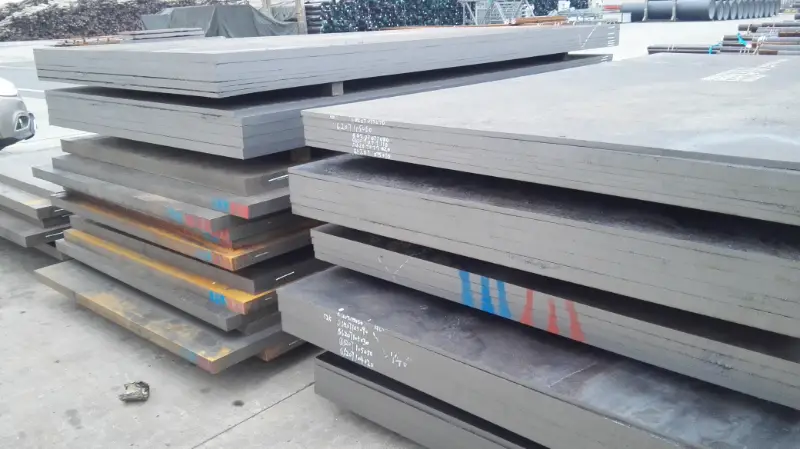
GL Grade A690 Shipbuilding Steel Plate
GL Grade A690 Shipbuilding Steel Plate - High-Strength Quenched & Tempered Marine Steel
Comprehensive data sheet for GL Grade A690 shipbuilding steel: chemical composition, mechanical properties, thermal and electrical constants, equivalent grades from DNV, ABS, LR, and similar materials.
Hot rolling followed by quenching and tempering; capable of subsequent cold forming, flame cutting, and welding with adequate preheat and interpass control.
- Phone : +8618037372205
- Email : [email protected]
- WhatsApp: Contact via Whtsapp
- WeChat: +8618037372205
GL Grade A690 Shipbuilding Steel Plate Introduction
GL A690 is a high-strength low-alloy (HSLA) steel grade defined by the Germanischer Lloyd (GL) rules for ship and offshore structures. It is supplied in the quenched and tempered (Q&T) condition, achieving a minimum yield strength of 690 MPa and excellent toughness at temperatures down to -60°C depending on the toughness class (A, D, E, F). The steel offers exceptional strength-to-weight ratio, good weldability when proper procedures are followed, and high resistance to brittle fracture in harsh marine environments.
- Typical applications include heavy lift crane pedestals, jacket legs, deck plates, and critical structural members in offshore platforms and naval vessels.
- Thickness range normally spans from 3 mm to 150 mm, with specific properties guaranteed for each thickness bracket.
- The alloying philosophy balances Mn, Cr, Ni, Mo, and micro-alloying elements to ensure deep hardenability and consistent mechanical properties across large sections.
GL Grade A690 Shipbuilding Steel Plate Chemical composition
The chemical composition of GL A690 is designed to provide high strength through low-carbon martensite/bainite structure obtained by quenching and tempering. Micro-alloying elements like Nb, V, and Ti are added for grain refinement and precipitation strengthening.
- Maximum carbon equivalent (CEV) is usually limited to <0.52 to ensure good weldability.
- Values apply to ladle analysis; product analysis tolerances follow GL rules.
| Element | Specified Value (wt%) | Remarks |
|---|---|---|
| Carbon (C) | ≤ 0.18 | Max allowed |
| Manganese (Mn) | 0.90 – 1.60 | |
| Silicon (Si) | ≤ 0.55 | |
| Phosphorus (P) | ≤ 0.025 | Lower is required for some toughness classes |
| Sulfur (S) | ≤ 0.025 | Lower is required for some toughness classes |
| Copper (Cu) | ≤ 0.35 | |
| Chromium (Cr) | ≤ 0.25 | |
| Nickel (Ni) | ≤ 0.30 | Higher Ni may be used for thicker plates or F-class toughness |
| Molybdenum (Mo) | ≤ 0.15 | |
| Niobium (Nb) | ≤ 0.06 | V+Nb+Ti ≤ 0.12 |
| Vanadium (V) | ≤ 0.10 | V+Nb+Ti ≤ 0.12 |
| Titanium (Ti) | ≤ 0.02 | V+Nb+Ti ≤ 0.12 |
| Aluminum (Al) total | ≥ 0.015 | Fully killed fine grain practice |
| Nitrogen (N) | ≤ 0.012 |
GL Grade A690 Shipbuilding Steel Plate Thermal and electrical physical properties
The physical properties are typical for low-alloy quenched and tempered steels and serve as design guidelines. Temperature-dependent variations must be considered for structural fire engineering and thermal processing. Actual values can vary slightly depending on the exact heat chemistry.
| Property | Typical Value | Unit | Test Condition / Remarks |
|---|---|---|---|
| Density (ρ) | 7.85 | g/cm³ | 20 °C |
| Young's modulus (E) | 210 | GPa | 20 °C, tension |
| Shear modulus (G) | 81 | GPa | 20 °C, calculated from E and ν |
| Poisson's ratio (ν) | 0.3 | - | 20 °C, elastic range |
| Thermal expansion coefficient (α) | 12.0 × 10⁻⁶ | K⁻¹ | 20 – 100 °C |
| Thermal expansion coefficient (α) | 13.0 × 10⁻⁶ | K⁻¹ | 20 – 200 °C |
| Thermal expansion coefficient (α) | 13.8 × 10⁻⁶ | K⁻¹ | 20 – 400 °C |
| Thermal conductivity (λ) | 48 | W/(m·K) | 20 °C |
| Thermal conductivity (λ) | 45 | W/(m·K) | 100 °C |
| Thermal conductivity (λ) | 40 | W/(m·K) | 200 °C |
| Specific heat capacity (cp) | 460 | J/(kg·K) | 20 – 100 °C |
| Electrical resistivity (ρ_e) | 0.20 | Ω·mm²/m | 20 °C |
GL Grade A690 Shipbuilding Steel Plate Mechanical properties
These values represent the minimum guaranteed levels according to GL rules for plates in the quenched and tempered condition. Actual properties may be higher and depend on thickness and rolling direction.
- Impact test temperature depends on the toughness suffix (A: 0°C, D: -20°C, E: -40°C, F: -60°C).
- Bend test with a mandrel diameter of 3t (t = plate thickness) up to 180° must be free of cracks.
| Property | Required Value | Unit | Test Condition |
|---|---|---|---|
| Yield strength (ReH) | ≥ 690 | MPa | Ambient, thickness ≤ 50 mm |
| Yield strength (ReH) | ≥ 650 | MPa | Thickness > 50 mm ≤ 100 mm |
| Yield strength (ReH) | ≥ 620 | MPa | Thickness > 100 mm ≤ 150 mm |
| Tensile strength (Rm) | 770 – 940 | MPa | Thickness ≤ 50 mm |
| Tensile strength (Rm) | 720 – 900 | MPa | Thickness > 50 mm ≤ 100 mm |
| Tensile strength (Rm) | 700 – 880 | MPa | Thickness > 100 mm ≤ 150 mm |
| Elongation (A5) | ≥ 14 | % | Gauge length 5.65√S0, transverse |
| Bend test (mandrel diameter) | d = 3t, 180° | - | No cracks; t = specimen thickness |
| Charpy V-notch impact (KV2) | ≥ 69 | J | At 0 °C (Grade A), longitudinal |
| Charpy V-notch impact (KV2) | ≥ 69 | J | At -20 °C (Grade D), longitudinal |
| Charpy V-notch impact (KV2) | ≥ 69 | J | At -40 °C (Grade E), longitudinal |
| Charpy V-notch impact (KV2) | ≥ 69 | J | At -60 °C (Grade F), longitudinal |
GL Grade A690 Shipbuilding Steel Plate Exact equivalent materials
| Country / Region | Standard / Classification Society | Grade / Designation | Remarks |
|---|---|---|---|
| Norway / DNV | DNV Rules for Classification – Ships | DNV A690 (NV A690) | Same chemistry and mechanical requirements as GL A690 |
| USA / ABS | American Bureau of Shipping Rules | ABS AH690, DH690, EH690, FH690 | Toughness suffix matches GL A, D, E, F classes |
| UK / LR | Lloyd's Register Rules | LR AH690, DH690, EH690, FH690 | Identical strength and impact levels |
| France / BV | Bureau Veritas Marine & Offshore Rules | BV A690 | Equivalent to GL A690 in all thickness ranges |
| Japan / NK | Nippon Kaiji Kyokai (ClassNK) Rules | NK KA690 | Equivalent grade for ships and marine structures |
| Italy / RINA | RINA Rules | RINA A690 | Same specification as GL A690 |
| Russia / RMRS | Russian Maritime Register of Shipping | RMRS A690 | Corresponding high-strength steel for shipbuilding |
GL Grade A690 Shipbuilding Steel Plate Application Introduction
GL A690 is intended for demanding marine and offshore applications where high static and dynamic loads combine with low-temperature service. It is best suited for welded structures requiring post-weld toughness without stress relief.
- Welding: Low-hydrogen processes mandatory; preheat and interpass temperature typically 150–250°C based on thickness; post-weld heat treatment generally avoided to preserve the quenched and tempered structure.
- Forming: Cold forming possible for thin plates (t < 25 mm) with a minimum bending radius of 3t; warm forming at 600°C followed by retempering is an option for thicker sections.
Product Applications: Deck plates and sheer strakes, Longitudinal and transverse bulkheads, Crane pedestals and boom structures, Jacket legs and bracing members, Davit bases and towing beams, Reinforcing doublers and insert plates
Processed into products: Flanges for offshore mooring systems, Base plates for drilling derricks, Gusset plates and lifting pad eyes, Turret structures for FPSO, Ice contact zones in hull, Transition pieces and anchor shackles
Application industries: Shipbuilding and repair (naval and merchant vessels), Offshore oil & gas (fixed platforms, FPSO modules), Offshore renewable energy (wind turbine foundations, substations), Marine heavy-lift crane and equipment manufacturing, Ice-class vessel hulls and ice-breaking structures, Submarine pressure hulls and deep-sea applications
GL Grade A690 Shipbuilding Steel Plate Similar alternative materials
| Country / Region | Standard | Grade | Remarks |
|---|---|---|---|
| Europe | EN 10025-6 | S690Q / S690QL / S690QL1 | Hot-rolled structural steel Q+T; similar strength, lower targeted CEV; often used in heavy machinery and crane construction; requires careful review for marine approval. |
| USA | ASTM A514 / A514M | Grade S (Type B/C/E) | Quenched and tempered alloy steel plate with min YS 690 MPa and tensile 760–895 MPa; used in structural applications but not specifically certified for shipbuilding without class approval. |
| USA | ASTM A709 / A709M | Grade 690 (HPS 690W) | High-performance steel for bridges with similar strength; offers excellent corrosion resistance and toughness. Not a direct substitute for marine service without additional tests. |
| International | ISO 4950-2 | S690Q | Hot-rolled structural steel with yield 690 MPa; comparable chemical limits but the standard is not automatically accepted by classification societies. |
| USA | API Specification 2H | Grade 50 (yield 345 MPa) | Only a lower strength grade; no 690 MPa grade exists. API 2W or 2Y provides higher strength but not exactly 690 MPa. Consider if strength reduction is acceptable. |
Notes:
- All data complies with the Germanischer Lloyd rules as per the latest edition of the "Rules for Classification and Construction – Ship Technology, 1 – Seagoing Ships, Part 2 – Materials and Welding".
- For plates thicker than 150 mm, special agreement with the classification society is required to define mechanical properties and testing frequencies.
- Ultrasonic testing according to GL specifications is often mandatory for critical applications; class acceptance marks are stamped on the plate.
- The purchaser should specify toughness class (A, D, E, or F) at the inquiry stage to ensure proper impact test temperature is ordered.
- Share



