
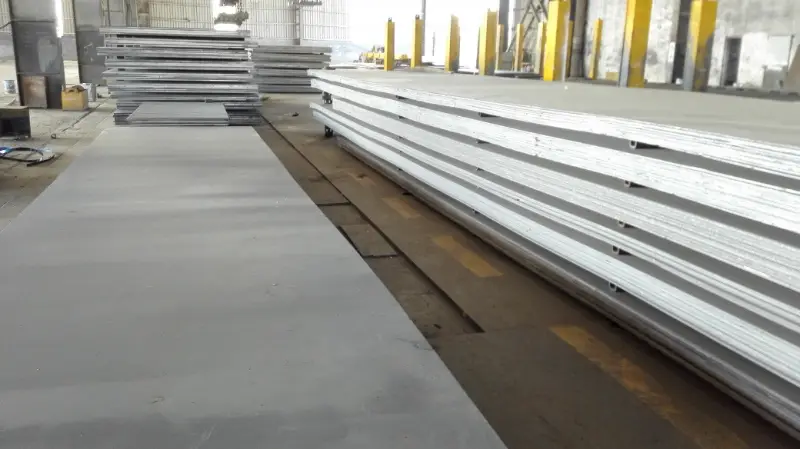
GL Grade F620 Shipbuilding Steel Plate
GL Grade F620 Shipbuilding Steel Plate: High-Strength Quenched and Tempered Steel for Marine and Offshore Applications
Comprehensive data sheet for GL Grade F620 shipbuilding steel plate, covering chemical composition, mechanical and physical properties, international equivalents, and typical applications.
Hot rolled followed by quenching and tempering (Q&T); can be processed by cutting, cold forming (with restrictions), welding (with appropriate preheat and consumables), and machining.
- Phone : +8618037372205
- Email : [email protected]
- WhatsApp: Contact via Whtsapp
- WeChat: +8618037372205
GL Grade F620 Shipbuilding Steel Plate Introduction
GL Grade F620 is a high-strength, quenched and tempered structural steel primarily intended for shipbuilding and offshore applications. It is governed by the rules of Germanischer Lloyd (now DNV) and is characterised by a minimum yield strength of 620 MPa in the quenched and tempered condition. The 'F' designation indicates a requirement for impact testing at -60°C, ensuring excellent low-temperature toughness. GL F620 offers a favourable combination of high strength, good weldability, and ductility, making it suitable for critical load-bearing structures in harsh marine environments. Its chemistry is carefully controlled, typically with low carbon equivalent, and microalloying elements such as niobium, vanadium, and titanium to achieve the desired mechanical properties. This grade is comparable to EN 10225 S620Q and similar high-strength grades from other classification societies, such as DNV E620 or BV E620, with the key differentiator being the specified impact test temperature.
GL Grade F620 Shipbuilding Steel Plate Chemical Composition
The chemical composition of GL Grade F620 is carefully balanced to achieve high strength and excellent low-temperature toughness after quenching and tempering. Carbon content is kept low (≤0.20%) to ensure good weldability, while manganese, chromium, nickel, and molybdenum contribute to hardenability and strength. Microalloying elements such as niobium, vanadium, and titanium provide grain refinement and precipitation hardening. Phosphorus and sulfur are stringently controlled to minimise embrittlement. The carbon equivalent (Ceq) is usually specified to guarantee weldability, with typical limits depending on plate thickness. The table below shows the maximum (or range) permitted values according to GL rules and equivalent EN 10225 requirements.
| Element | Standard Value (wt%) | Remarks |
|---|---|---|
| C | ≤0.20 | Ladle analysis |
| Si | ≤0.55 | Ladle analysis |
| Mn | ≤1.70 | Ladle analysis |
| P | ≤0.025 | Ladle analysis |
| S | ≤0.015 | Ladle analysis |
| Cr | ≤0.80 | Ladle analysis |
| Mo | ≤0.50 | Ladle analysis |
| Ni | ≤2.00 | Ladle analysis |
| Cu | ≤0.30 | Ladle analysis |
| V | ≤0.10 | Ladle analysis |
| Nb | ≤0.06 | Ladle analysis |
| Ti | ≤0.05 | Ladle analysis |
| Al (total) | 0.015 – 0.055 | Minimum required for grain refinement |
| N | ≤0.015 | Ladle analysis |
| B | ≤0.005 | Ladle analysis |
| Ceq (IIW) | ≤0.49 – 0.62 | Depending on thickness and specification; typical limit 0.52 for plate ≤50 mm |
GL Grade F620 Shipbuilding Steel Plate Thermal and Electrical Physical Properties
The physical properties of GL Grade F620 are characteristic of low-alloy, high-strength structural steels in the quenched and tempered condition. These values are provided as typical references for engineering calculations and do not form part of the material certification. Slight variations may occur depending on the precise chemical composition and heat treatment. The data are valid at room temperature unless otherwise noted.
| Property | Typical Value | Unit | Conditions / Remarks |
|---|---|---|---|
| Density (ρ) | 7.85 | g/cm³ | At 20°C |
| Elastic modulus (E) | 205 | GPa | At 20°C, tension |
| Shear modulus (G) | 80 | GPa | Calculated, typical for steel |
| Poisson's ratio (ν) | 0.3 | – | In elastic range |
| Thermal expansion coefficient (α) | 12.0 | 10⁻⁶/K | Between 20°C and 100°C |
| Thermal expansion coefficient (α) | 12.5 | 10⁻⁶/K | Between 20°C and 200°C |
| Thermal conductivity (λ) | 50 | W/(m·K) | At 20°C |
| Specific heat capacity (c) | 460 | J/(kg·K) | At 20°C |
| Electrical resistivity (ρ_e) | 0.25 | Ω·mm²/m | At 20°C (typical 0.25×10⁻⁶ Ω·m) |
GL Grade F620 Shipbuilding Steel Plate Mechanical Properties
The mechanical properties of GL Grade F620 are determined after appropriate heat treatment (quenching and tempering) on specimens taken from the delivered plate. The minimum yield and tensile strengths are guaranteed for the specified thickness range. The elongation and impact energy values are measured at room temperature and at -60°C, respectively, reflecting the grade's high ductility and low-temperature toughness. Bending requirements confirm the formability of the material without cracking. The following table presents the standard requirements according to GL rules and the comparable EN 10225 specification.
| Property | Standard Value | Unit | Test Conditions / Remarks |
|---|---|---|---|
| Yield strength (ReH) | ≥620 | MPa | Plate thickness ≤50 mm, transverse or longitudinal |
| Yield strength (ReH) | ≥580 | MPa | Plate thickness 50 < t ≤ 100 mm, transverse |
| Yield strength (ReH) | ≥530 | MPa | Plate thickness 100 < t ≤ 150 mm, transverse |
| Tensile strength (Rm) | 770 – 940 | MPa | Applies to thickness ≤100 mm; for 100 < t ≤150 mm range may be 720 – 940 MPa |
| Elongation (A5) | ≥14 | % | Gauge length 5.65√S₀, longitudinal, thickness ≤50 mm |
| Elongation (A5) | ≥13 | % | Gauge length 5.65√S₀, 50 < t ≤100 mm, longitudinal |
| Elongation (A5) | ≥12 | % | Gauge length 5.65√S₀, 100 < t ≤150 mm, longitudinal |
| Impact energy (KV2) | ≥27 | J | At -60°C, longitudinal V-notch (Charpy); minimum average of three specimens, one individual ≥70% of specified average |
| Bend test (180°) | No cracks | – | Bend diameter d=3t for t≤50 mm; d=4t for 50 |
GL Grade F620 Shipbuilding Steel Plate Completely Equivalent Material Standards and Replaceable Grades
| Country / Region | Standard | Grade | Remarks |
|---|---|---|---|
| Europe | EN 10225 | S620Q | Welded structural steel for fixed offshore structures; impact temperature may be agreed (-60°C option) to match GL F620. |
| Norway / International | DNV Rules | F620 / NV F620 | DNV F-grade requirements match GL F620 exactly (-60°C impact). |
| France / International | BV Rules | F620 | Bureau Veritas F-grade for offshore: identical strength and toughness. |
| UK / International | LR Rules | F620 | Lloyd's Register F-grade; equivalent impact requirement at -60°C. |
| USA / International | ABS Rules | F620 | American Bureau of Shipping; availability of F-grade may require prior agreement. |
| China / International | CCS Rules | F620 | China Classification Society; equivalent to GL F620. |
| Korea / International | KR Rules | F620 | Korean Register; F620 grade directly corresponding to GL. |
| Japan / International | NK Rules | F620 | Nippon Kaiji Kyokai; same mechanical and impact requirements. |
GL Grade F620 Shipbuilding Steel Plate Application Introduction
GL Grade F620 is specifically designed for demanding marine and offshore structures where weight savings and high load-bearing capacity are critical. Its excellent strength-to-weight ratio and superior low-temperature toughness make it suitable for the most challenging environments. The following outlines its main areas of use.
Product Applications: Hull plates and stiffeners for ice-breakers and Arctic vessels, Sections and plates for self-elevating platforms (jack-up legs and chords), Crane booms and lattice structures for offshore service cranes, Node cans and tubular joints in offshore platforms, Reinforcement pads and heavy-duty connection plates, Welded girders and box sections for marine construction
Processed into products: Main deck stringers and sheer strakes, Racking frame corners and bracing members, King posts and derrick components, Mooring system stopper brackets, Fatigue-critical structural details in offshore modules, Foundation plates for heavy equipment (e.g., winches, thrusters)
Application industries: Shipbuilding (naval and commercial vessels, ice-class ships), Offshore engineering (platforms, jackets, topsides), Heavy lifting equipment (cranes, lifting yokes), Jack-up rig construction (legs, spudcans), Bridge building (when combined with appropriate classification), Heavy machinery and pressure vessels (subject to code approval)
GL Grade F620 Shipbuilding Steel Plate Closely Related / Similar Substitute Material Recommendations
| Country / Region | Standard | Grade | Remarks |
|---|---|---|---|
| Europe | EN 10225 | S690Q | Higher strength grade (min. yield 690 MPa); can be an overmatch alternative when higher strength is required. Lower toughness temperatures need verification. |
| Europe | EN 10225 | S550Q | Lower strength grade (min. yield 550 MPa); suitable as an undermatch alternative if loads are reduced. Likely E-grade (-40°C) as standard. |
| USA | ASTM A514 / A517 | Grade Q | Quenched and tempered alloy steel plate with 690 MPa min yield; not a direct match in chemical and impact specifications, but can be considered after engineering assessment. |
| International | API 2W | Grade 60 | For offshore structures; yield 413–551 MPa range, significantly lower strength; requires detailed evaluation for substitution. |
| International | IACS UR W11 | High Strength Steel F620 | Unified requirements for shipbuilding steels; essentially identical to GL F620 but may be adopted by all member societies. |
Notes:
Welding requires strict adherence to approved procedures: typically low-hydrogen processes (SMAW, SAW, GMAW) with preheat and interpass temperatures controlled between 100–200°C depending on thickness. Post-weld heat treatment (PWHT) is generally not required but may be considered for repair or after severe forming. Hydrogen-induced cracking (HIC) resistance is assured by low sulphur and controlled inclusions. Certification documents (3.1 or 3.2 according to EN 10204) are provided upon delivery. The material can be supplied with through-thickness (Z-quality) testing options when specified on the order.
- Share



