
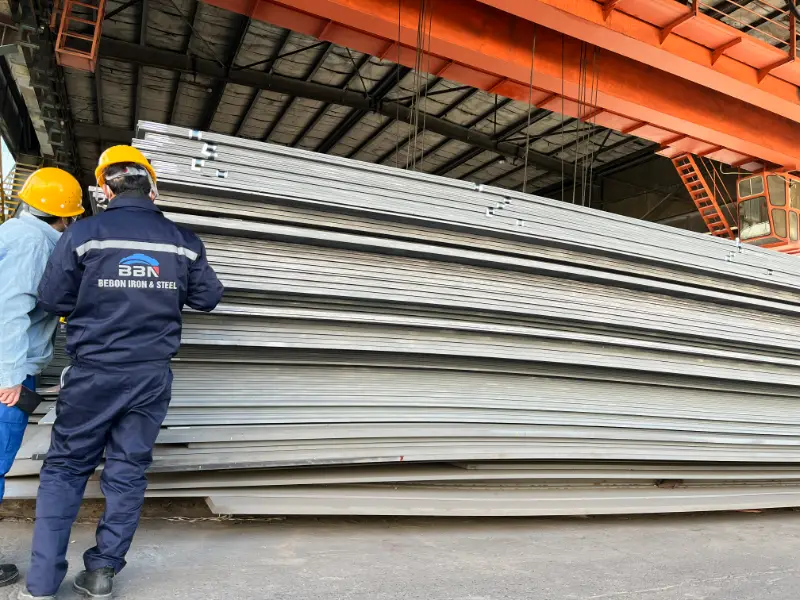
GL Grade E620 Shipbuilding Steel Plate
GL Grade E620 Shipbuilding Steel Plate: High Strength Quenched & Tempered Steel for Extreme Marine Environments
Comprehensive data for GL Grade E620 shipbuilding steel plate, including chemical composition, mechanical properties, thermal properties, equivalent grades, and application guidelines for marine and offshore engineering.
Hot rolling, quenching and tempering, welding (with preheat and PWHT), oxy-fuel/plasma/laser cutting, cold forming
- Phone : +8618037372205
- Email : [email protected]
- WhatsApp: Contact via Whtsapp
- WeChat: +8618037372205
GL Grade E620 Shipbuilding Steel Plate Introduction
GL Grade E620 is an ultra-high strength, quenched and tempered shipbuilding steel plate produced in accordance with the rules of Germanischer Lloyd (now DNV GL). With a minimum yield strength of 620 MPa, it is designed for critical structural applications in shipbuilding, offshore platforms, and heavy marine machinery that demand exceptional strength and toughness at low temperatures.
- Excellent weldability and cold forming properties when preheating and post-weld treatments are applied
- Good resistance to brittle fracture down to -40°C or lower
- Uniform mechanical properties ensured by fine grain microstructure and heat treatment
This grade is typically supplied in the quenched and tempered condition, meeting strict requirements for notch toughness and through-thickness properties.
GL Grade E620 Shipbuilding Steel Plate Chemical Composition
The chemical composition of GL Grade E620 is carefully controlled to achieve high strength and good low-temperature toughness. Micro-alloying elements such as Nb, V, Ti, and B are added for grain refinement and hardenability. Limits below are based on GL rules and common industrial practice for plates up to 50 mm thickness. Actual values are adjusted by the producer to meet mechanical property requirements.
| Element | Standard Value | Remarks |
|---|---|---|
| C | ≤ 0.20 | Lower carbon content improves weldability |
| Si | ≤ 0.50 | Deoxidizer, contributes to strength |
| Mn | ≤ 1.70 | Enhances hardenability and toughness |
| P | ≤ 0.025 | Maximum impurity level |
| S | ≤ 0.015 | Maximum impurity level |
| Cr | ≤ 1.50 | Improves hardenability and corrosion resistance |
| Ni | ≤ 2.0 | Improves low-temperature toughness |
| Mo | ≤ 0.70 | Increases strength and hardenability |
| Cu | ≤ 0.50 | Optional for atmospheric corrosion resistance |
| V | ≤ 0.12 | Grain refinement and precipitation strengthening |
| Nb | ≤ 0.06 | Grain refinement |
| Ti | ≤ 0.05 | Grain refinement and deoxidation |
| Al (total) | ≥ 0.015 | Minimum for grain refinement and deoxidation |
| B | ≤ 0.005 | Improves hardenability in thick sections |
| N | ≤ 0.015 | Controlled to prevent strain aging |
GL Grade E620 Shipbuilding Steel Plate Thermal and Electrical Physical Properties
Physical properties below are typical for quenched and tempered low-alloy steels of this strength class and are provided for engineering calculations. Actual values may slightly vary depending on the exact chemical composition and heat treatment condition. All values are measured at room temperature unless otherwise stated.
| Property | Typical Value | Unit | Test Condition / Remarks |
|---|---|---|---|
| Density (ρ) | 7.85 | g/cm³ | At 20°C |
| Modulus of Elasticity (E) | 205 – 215 | GPa | Tensile, at 20°C |
| Shear Modulus (G) | 79 – 84 | GPa | Calculated from E and ν |
| Poisson's Ratio (ν) | 0.28 – 0.30 | – | Elastic range |
| Thermal Expansion Coefficient (α) | 11.5 – 12.0 | 10⁻⁶/K | 20 – 100°C |
| Thermal Expansion Coefficient (α) | 12.5 – 13.0 | 10⁻⁶/K | 20 – 200°C |
| Thermal Expansion Coefficient (α) | 13.5 – 14.0 | 10⁻⁶/K | 20 – 300°C |
| Thermal Conductivity (λ) | 38 – 42 | W/(m·K) | At 20°C |
| Thermal Conductivity (λ) | 36 – 40 | W/(m·K) | At 100°C |
| Specific Heat Capacity (cp) | 460 – 480 | J/(kg·K) | At 20°C |
| Electrical Resistivity (ρ_e) | 0.20 – 0.25 | Ω·mm²/m | At 20°C |
GL Grade E620 Shipbuilding Steel Plate Mechanical Properties
Minimum mechanical properties as per GL rules for E620 plates. Values are valid for transverse test specimens unless otherwise specified and apply to thickness ≤ 50 mm. For thicker plates, slightly reduced strength values may be allowed. Impact testing is performed at -40°C or -60°C depending on the specific classification within the grade.
| Property | Required Value | Unit | Test Condition / Remarks |
|---|---|---|---|
| Yield Strength (ReH) | ≥ 620 | MPa | t ≤ 50 mm, transverse, 0.2% offset if no yield point |
| Yield Strength (ReH) | ≥ 580 | MPa | 50 < t ≤ 100 mm, transverse |
| Tensile Strength (Rm) | 720 – 890 | MPa | t ≤ 50 mm, transverse |
| Tensile Strength (Rm) | 700 – 870 | MPa | 50 < t ≤ 100 mm, transverse |
| Elongation (A) | ≥ 14 | % | Longitudinal, gauge length L₀ = 5.65√S₀ |
| Elongation (A) | ≥ 12 | % | Transverse, gauge length L₀ = 5.65√S₀ |
| Bend Test | d = 3t (no cracks) | – | Bending angle 180°, t = plate thickness |
| Impact Energy (KV) | ≥ 27 (longitudinal) | J | -40°C, V-notch, average of three specimens |
| Impact Energy (KV) | ≥ 27 (transverse) | J | -40°C, V-notch, average of three specimens |
| Impact Energy (KV) | ≥ 40 (longitudinal) | J | -60°C (optional requirement for 'E' grades) |
GL Grade E620 Shipbuilding Steel Plate Full Equivalent Grades According to Various Classification Societies and Standards
| Country / Region | Standard | Grade | Remarks |
|---|---|---|---|
| International (IACS) | UR W22 / UR W31 | EH620 | IACS member societies accept equivalent grades |
| Norway / Germany | DNV GL Rules | VL E620 | Combined DNV and GL designation, identical to GL E620 |
| USA | ABS Rules | EQ70 (EH620 equivalent) | Same strength class, notch toughness at -40°C |
| UK | Lloyd's Register Rules | EH620 | Toughness at -40°C or lower |
| France | Bureau Veritas Rules | E620 | Identical requirements to GL E620 |
| Italy | RINA Rules | E620 | Recognized equivalent grade |
| China | CCS Rules | E620 | Adopted in line with IACS requirements |
| Japan | NK Rules | KEH620 | Nippon Kaiji Kyokai equivalent |
GL Grade E620 Shipbuilding Steel Plate Application Introduction
GL Grade E620 steel is primarily used in marine and offshore environments where high strength-to-weight ratios are critical. Its excellent toughness at low temperatures makes it suitable for constructions operating in Arctic conditions. The quenched and tempered condition ensures uniform properties in thick plates.
- Welding requires strict control of heat input and preheating/interpass temperatures; low-hydrogen consumables and post-weld heat treatment are recommended.
- Cold forming of thin plates is possible but may require intermediate stress relieving.
- Surface protection systems (painting, cathodic protection) are typically applied due to exposure to seawater.
Product Applications: Hull envelopes and deck plates for high-speed vessels, Legs and spudcans of self-elevating offshore platforms, Boom and jib sections of heavy-duty floating cranes, Pressure hulls for submarines and submersibles, Structural nodes for offshore wind jacket foundations
Processed into products: Flanges and webs of deep girders, Cut-to-shape brackets and stiffeners, Welded box sections for crane pedestals, Milled gears and rack bars for jacking systems, Lifting eyes and padeyes, Underwater connectors and bases
Application industries: Shipbuilding (naval vessels, container ships, icebreakers), Offshore oil & gas (jack-up rigs, semi-submersibles, platforms), Marine renewable energy (offshore wind turbine foundations, wave energy devices), Heavy engineering (crane construction, lifting equipment for ports), Defence (hull armours for patrol boats)
GL Grade E620 Shipbuilding Steel Plate Similar / Semi-Equivalent Materials for Reference
| Country / Region | Standard | Grade | Remarks / Analysis |
|---|---|---|---|
| EU | EN 10025-6 | S620Q / S620QL | Quenched and tempered structural steel with minimum yield 620 MPa. Not marine-certified but often used for offshore structures when accompanied by additional testing. S620QL offers guaranteed low-temperature impact properties (-40°C or -60°C). Chemical and mechanical similarity is high; however, through-thickness properties and weldability approval must be verified per class society requirements. |
| EU | EN 10225 | S620G2+M / G2+QT | Weldable structural steels for fixed offshore structures. Yield strength 620 MPa, excellent toughness. Similar to GL E620 in chemistry and performance, but specifically formulated for offshore fixed platforms and may require supplementary testing for shipbuilding applications. |
| USA | ASTM A514 / A517 | Grade E / Grade F | High-strength quenched and tempered plate. Minimum yield strength 690 MPa, tensile 760–895 MPa. Slightly higher strength than E620; careful review of overmatching in welding is needed. Impact toughness requirements vary by grade and are not equivalent to GL rules without specifying supplementary requirements. |
| Japan | JIS G 3128 | SHY685 / SHY685N | High yield strength steel for welded structures. Minimum yield 685 MPa, similar to E620 but with higher strength. Low-temperature toughness is specified as a separate suffix. Not directly certified by GL, but can be considered with special approval. |
| Russia | GOST 27772 | C620 or similar | Equivalent structural steel for shipbuilding under Russian Maritime Register. Requires detailed comparison of chemical and mechanical properties due to differences in alloying approach. |
Notes:
Additional Information:
- GL Grade E620 may also be ordered with through-thickness (Z-direction) properties, designated as E620 Z35, Z25, or Z15 according to EN 10164.
- Ultrasonic testing per EN 10160 or equivalent is normally required for plates over 10–15 mm; acceptance class S2/E2 is common.
- Supplementary fracture toughness testing (CTOD) can be specified for critical applications.
- Delivery conditions include shot blasting and priming with shop primer suitable for temporary corrosion protection during fabrication.
- Mill test certificates (EN 10204 type 3.1 or 3.2) are mandatory.
- For thicknesses above 100 mm, property requirements and availability must be confirmed with the manufacturer as through-hardening becomes challenging.
- Share



