
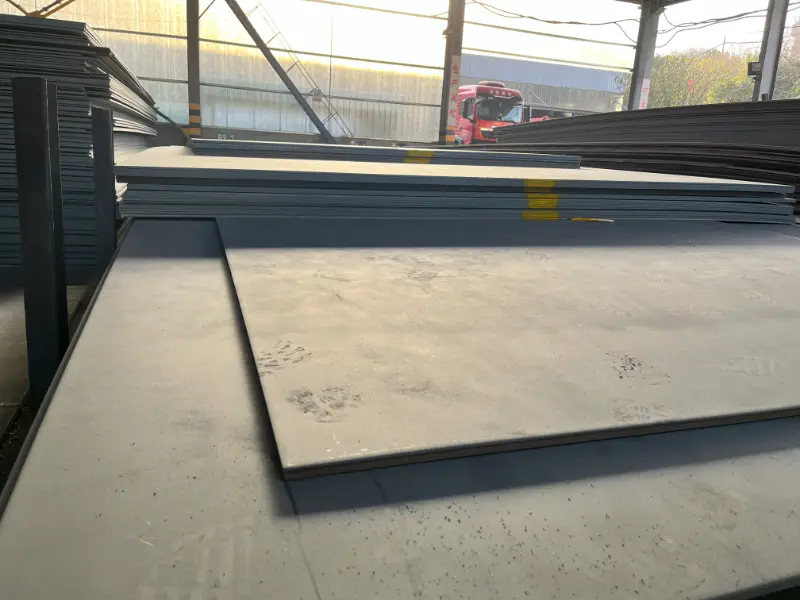
GL Grade D620 Shipbuilding Steel Plate
GL Grade D620 Shipbuilding Steel Plate: High-Strength Normalizing Rolling Marine Steel
Comprehensive material data for GL Grade D620 shipbuilding steel plate featuring high yield strength above 620 MPa, excellent low-temperature toughness, and superior weldability for marine and offshore structural applications.
Hot rolling, normalizing rolling, cold forming (limited), welding (all conventional methods), cutting (thermal and mechanical), machining
- Phone : +8618037372205
- Email : [email protected]
- WhatsApp: Contact via Whtsapp
- WeChat: +8618037372205
GL Grade D620 Shipbuilding Steel Plate Introduction
GL Grade D620 is a high-strength shipbuilding steel plate certified by Germanischer Lloyd (now DNV GL). It belongs to the normalized rolling delivery condition with a minimum yield strength of 620 MPa.
- Key Characteristics: Excellent weldability, high resistance to brittle fracture at low temperatures, and good formability for heavy plate fabrication.
- Microstructure: Fine-grained ferritic-bainitic structure achieved through controlled rolling and normalizing processes.
- Performance: Designed for critical structural components in shipbuilding and offshore engineering where high load-bearing capacity and reliability in cold environments are required.
GL Grade D620 Shipbuilding Steel Plate Chemical Composition
The chemical composition is designed to achieve high strength while maintaining excellent weldability and low-temperature toughness. Key elements include:
- Carbon (C): Controlled to low levels to ensure good weldability without preheating.
- Manganese (Mn): Provides solid-solution strengthening and improves hardenability.
- Niobium (Nb) and Vanadium (V): Microalloying elements for grain refinement and precipitation strengthening.
| Element | Standard Value (max unless range given) | Remarks |
|---|---|---|
| Carbon (C) | 0.20 | Ladle analysis; for thickness t ≤ 50 mm |
| Silicon (Si) | 0.10–0.55 | Deoxidation and strength contribution |
| Manganese (Mn) | 1.00–1.70 | Increases hardenability and strength |
| Phosphorus (P) | 0.025 | Maximum limit for toughness |
| Sulfur (S) | 0.025 | Maximum limit for ductility |
| Chromium (Cr) | 0.25 | Residual element; may be added for thickness > 50 mm |
| Nickel (Ni) | 0.80 | Improves low-temperature toughness |
| Molybdenum (Mo) | 0.08 | Optional for thick sections |
| Copper (Cu) | 0.30 | Weathering resistance; residual limit |
| Aluminum (Al) | 0.015 min (acid soluble) | Grain refinement |
| Niobium (Nb) | 0.02–0.05 | Microalloy for grain refinement |
| Vanadium (V) | 0.05–0.10 | Microalloy for precipitation strengthening |
| Titanium (Ti) | 0.02 | Grain refinement; maximum limit |
| Nitrogen (N) | 0.009 | Maximum unless bound by Al/Ti |
| Boron (B) | 0.0005 | Trace for hardenability if agreed |
GL Grade D620 Shipbuilding Steel Plate Thermal and Electrical Physical Properties
Physical properties are based on similar high-strength low-alloy steel data at room temperature and elevated temperatures. Values are representative for design purposes:
- Density: Standard for ferritic steel.
- Thermal Conductivity: Decreases slightly with increasing temperature.
| Property | Typical Value | Unit | Test Condition / Remarks |
|---|---|---|---|
| Density (ρ) | 7850 | kg/m³ | At 20°C |
| Elastic Modulus (E) | 210 | GPa | At 20°C |
| Shear Modulus (G) | 81 | GPa | Calculated from E and ν |
| Poisson's Ratio (ν) | 0.3 | – | At 20°C |
| Thermal Expansion Coefficient (α) | 12.0 | 10⁻⁶/K | 20–100°C |
| Thermal Expansion Coefficient (α) | 12.8 | 10⁻⁶/K | 20–200°C |
| Thermal Expansion Coefficient (α) | 13.5 | 10⁻⁶/K | 20–300°C |
| Thermal Conductivity (λ) | 42 | W/(m·K) | At 20°C |
| Thermal Conductivity (λ) | 40 | W/(m·K) | At 200°C |
| Thermal Conductivity (λ) | 37 | W/(m·K) | At 300°C |
| Specific Heat Capacity (cp) | 480 | J/(kg·K) | At 20°C |
| Specific Heat Capacity (cp) | 530 | J/(kg·K) | At 200°C |
| Electrical Resistivity (ρe) | 0.25 | μΩ·m | At 20°C |
GL Grade D620 Shipbuilding Steel Plate Mechanical Properties
Mechanical tests are performed on samples taken from normalized or normalizing rolled plates. Properties are verified at ambient and low temperatures:
- Tensile testing: Transverse specimens from plate surface unless otherwise specified.
- Impact testing: Charpy V-notch tests at -20°C or lower to guarantee notch toughness.
| Property | Required Value | Unit | Test Condition / Remarks |
|---|---|---|---|
| Yield Strength (ReH), min | 620 | MPa | t ≤ 50 mm; transverse test |
| Yield Strength (ReH), min | 600 | MPa | 50 < t ≤ 100 mm; transverse test |
| Tensile Strength (Rm) | 720–890 | MPa | t ≤ 50 mm |
| Tensile Strength (Rm) | 700–870 | MPa | 50 < t ≤ 100 mm |
| Elongation (A5), min | 16 | % | Gauge length 5.65√So |
| Elongation (A5), min | 15 | % | 50 < t ≤ 100 mm |
| Charpy V-Notch Impact (KV2), min | 27 (longitudinal) | J | -20°C; average of 3 tests |
| Charpy V-Notch Impact (KV2), min | 20 (transverse) | J | -20°C; average of 3 tests |
| Charpy V-Notch Impact (KV2), min | 27 (longitudinal) | J | -40°C (optional grade agreement) |
| Bend Test (D = mandrel diameter) | No cracks | – | 180° bend, D = 3a (a = thickness) for t ≤ 50 mm |
GL Grade D620 Shipbuilding Steel Plate Fully Equivalent Material Standards and Substitutable Grades
| Country/Region | Standard | Grade | Remarks |
|---|---|---|---|
| International (IACS) | UR W11 | EH620 | Identical mechanical and chemical requirements; normalized rolling |
| Germany / Norway | DNV GL Rules | N620 | Same classification society; identical specification |
| USA | ABS Rules | EH620 | American Bureau of Shipping equivalent high-strength grade |
| UK | LR Rules | EH620 | Lloyd's Register equivalent; identical yield and impact properties |
| France | BV Rules | EH620 | Bureau Veritas equivalent grade |
| China | CCS Rules | FH620 | China Classification Society; slightly tighter limits on P/S |
| Japan | NK Rules | KE620 | Nippon Kaiji Kyokai equivalent |
| Italy | RINA Rules | EH620 | Registro Italiano Navale equivalent |
| Russia | RS Rules | E620 | Russian Maritime Register; similar requirements with 620 MPa min yield |
GL Grade D620 Shipbuilding Steel Plate Application Introduction
GL D620 steel plates are specially developed for critical load-bearing components in marine and offshore environments where high strength-to-weight ratio and reliability at low service temperatures are paramount.
Processing and Fabrication:
- Welding: Readily weldable using low-hydrogen processes (SMAW, SAW, FCAW, GMAW). Preheating is generally not required for moderate thicknesses below 50 mm when using proper consumables and procedures.
- Forming: Can be cold formed with generous bend radii; hot forming should be followed by re-normalizing to restore mechanical properties.
- Corrosion Protection: Standard marine coating systems or cathodic protection recommended for seawater exposure.
Product Applications: Container ship hulls and hatch coamings, Jack-up rig legs and spudcans, Semi-submersible platform columns and decks, Icebreaker hull plating, Heavy lift crane booms and A-frames, Submarine pressure hulls, Offshore wind turbine transition pieces and monopile reinforcements
Processed into products: Main deck stringers and sheer strakes, Bilge keels and strengthening girders, Crane pedestal structures
Application industries: Shipbuilding, Offshore Oil and Gas Platforms, Heavy Lifting and Crane Manufacturing, Bridge Construction, Pressure Vessel Fabrication, Defense and Naval Vessels, Arctic and Ice-Class Ship Structures
GL Grade D620 Shipbuilding Steel Plate Similar / Alternative Materials Recommendation
| Country/Region | Standard | Grade | Remarks |
|---|---|---|---|
| Europe | EN 10025-6 | S620Q/QL/QL1 | Quenched and tempered structural steel with 620 MPa yield; higher carbon equivalent limits; suitable for non-marine heavy structures |
| Europe | EN 10025-4 | S460M/ML | Thermomechanical rolled; lower strength (460 MPa) but excellent toughness; alternative if strength requirement can be reduced |
| Germany | DIN EN 10225 | S620G2+M | Weldable structural steel for fixed offshore structures; higher Ni content for better toughness |
| USA | ASTM A514/A514M | Grade B/H | Quenched and tempered alloy steel plate with 690 MPa yield; good alternative for machinery and structural applications outside marine classification |
| Japan | JIS G 3128 | SHY 685 | High yield strength steel for welded structures; 685 MPa class; similar application fields but quenched and tempered |
| China | GB/T 712 | FH620 | Chinese shipbuilding steel with 620 MPa yield; close chemical and impact requirements at -40°C |
Notes:
Important Considerations for GL D620 Plates:
- Certification: Each plate must be stamped with the GL brand, grade, heat number, and surveyor's mark according to classification society rules.
- Ultrasonic Testing: Ultrasonic examination per ASTM A578 Level C or EN 10160 S2E2 is often required for critical structural members thicker than 20 mm.
- Supplementary Requirements: Through-thickness tensile testing (Z25/Z35 quality) may be specified where high strains in the thickness direction are expected.
- Heat Treatment After Welding: Post-weld heat treatment (PWHT) is not typically required but if applied, temperatures should not exceed 580°C to avoid affecting the normalized microstructure.
- Storage and Handling: Plates should be stored flat on skids in dry conditions and protected from prolonged exposure to marine atmospheres prior to fabrication.
- Share



