
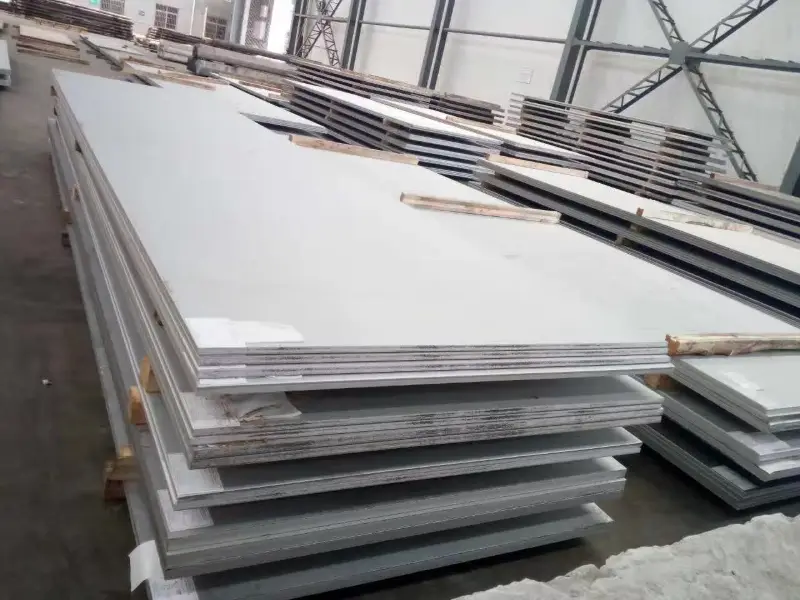
GL Grade A620 Shipbuilding Steel Plate
GL Grade A620 Shipbuilding Steel Plate: High-Strength Quenched and Tempered Steel for Marine Structures
Detailed technical data sheet for GL Grade A620 shipbuilding steel plate, covering chemical composition, mechanical and thermal properties, international equivalents, and application guidelines.
Quenching and tempering (Q&T); suitable for cold forming, bending, hot rolling, and welding with appropriate procedures
- Phone : +8618037372205
- Email : [email protected]
- WhatsApp: Contact via Whtsapp
- WeChat: +8618037372205
GL Grade A620 Shipbuilding Steel Plate Introduction
GL Grade A620 is a high-strength quenched and tempered shipbuilding steel defined by the Germanischer Lloyd (GL) classification society, now integrated into DNV GL. With a minimum yield strength of 620 MPa, this grade is intended for critical hull and offshore structural components that require an optimal combination of strength, weldability, and low-temperature toughness. Key characteristics include:
- Superior yield and tensile strength achieved through controlled quenching and tempering
- Reliable impact resistance at 0°C (grade A) for safe operation in temperate waters
- Good weldability when proper preheating and consumables are used
- Compliance with GL Rules for Classification and Construction, ensuring acceptance by major marine insurers
The steel is usually supplied in the normalized or quenched and tempered condition and is subject to strict testing for chemical composition, tensile properties, and Charpy V-notch impact values. Its balanced microalloying (Nb, V, Ti) provides grain refinement and precipitation hardening, while controlled levels of Cr, Ni, and Mo contribute to hardenability and strength without compromising ductility substantially.
GL Grade A620 Shipbuilding Steel Plate Chemical Composition
The chemical composition limits for GL Grade A620 are established to maintain consistent deep hardenability and weldability while achieving a minimum yield strength of 620 MPa. Microalloying elements (Nb, V, Ti) refine the grain size, and Cr, Ni, Mo enhance through-thickness properties. All values are maximum unless a range is given. The table below reflects the typical ladle analysis according to GL rules and supplementary DNV requirements.
| Element | Nominal Value (wt%) | Remarks |
|---|---|---|
| Carbon (C) | ≤ 0.20 | Max for weldability |
| Silicon (Si) | ≤ 0.50 | Deoxidizer and strength contributor |
| Manganese (Mn) | ≤ 1.70 | Primary solid solution strengthener |
| Phosphorus (P) | ≤ 0.025 | Max, low for toughness |
| Sulfur (S) | ≤ 0.015 | Max, low for reduced inclusions |
| Chromium (Cr) | ≤ 1.50 | Hardenability element |
| Nickel (Ni) | ≤ 2.0 | Toughness at low temperature |
| Molybdenum (Mo) | ≤ 0.70 | Prevents temper embrittlement |
| Copper (Cu) | ≤ 0.50 | Optional, minor corrosion resistance |
| Niobium (Nb) | ≤ 0.06 | Grain refiner |
| Vanadium (V) | ≤ 0.12 | Precipitation hardening |
| Titanium (Ti) | ≤ 0.05 | Grain refinement and inclusion control |
| Aluminium (Al) | ≥ 0.020 | Min, for full deoxidation |
| Nitrogen (N) | ≤ 0.015 | Max, to avoid ageing effects |
| Boron (B) | ≤ 0.005 | Optional, trace for hardenability |
GL Grade A620 Shipbuilding Steel Plate Thermal and Electrical Physical Properties
Physical properties are representative for low-alloy quenched and tempered steels of similar composition and are not explicitly mandated by GL rules. They are provided for engineering calculations such as heat transfer, thermal expansion, and stiffness modelling. Values are typical at room temperature unless noted.
| Property | Typical Value | Unit | Conditions / Notes |
|---|---|---|---|
| Density (ρ) | 7850 | kg/m³ | At 20°C |
| Modulus of Elasticity (E) | 210 | GPa | Tensile modulus at 20°C |
| Shear Modulus (G) | 81 | GPa | Calculated from E and ν |
| Poisson's Ratio (ν) | 0.30 | - | Elastic range |
| Thermal Expansion Coefficient (α) | 12.0 × 10⁻⁶ | K⁻¹ | Between 20°C and 100°C |
| Thermal Conductivity (λ) | 45 | W/(m·K) | At 20°C |
| Specific Heat Capacity (c) | 460 | J/(kg·K) | At 20°C |
| Electrical Resistivity (ρₑ) | 0.25 | µΩ·m | At 20°C, typical for low-alloy steel |
GL Grade A620 Shipbuilding Steel Plate Mechanical Properties
Mechanical properties are verified on transverse or longitudinal test pieces as specified in the GL rules. Values depend on plate thickness, usually grouping for t≤50 mm and 50≤t≤100 mm. Impact test temperature for Grade A is 0°C. The test pieces are taken from the quenched and tempered condition. Elongation is measured on a gauge length of 5.65√So (A5). All values are minimum unless a range is stated.
| Property | Typical Requirement | Unit | Test Condition / Thickness |
|---|---|---|---|
| Yield Strength (ReH) | ≥ 620 | MPa | Transverse, room temperature, t ≤ 50 mm |
| Yield Strength (ReH) | ≥ 580 | MPa | Transverse, room temperature, 50 < t ≤ 100 mm |
| Tensile Strength (Rm) | 700 - 890 | MPa | Transverse, room temperature, t ≤ 50 mm |
| Tensile Strength (Rm) | 650 - 890 | MPa | Transverse, room temperature, 50 < t ≤ 100 mm |
| Elongation (A) | ≥ 14 | % | Longitudinal, gauge length 5.65√So, t ≤ 50 mm |
| Elongation (A) | ≥ 14 | % | Longitudinal, gauge length 5.65√So, 50 < t ≤ 100 mm |
| Charpy V-notch Impact (KV) | ≥ 27 (average), ≥ 21 (single) | J | Transverse, at 0°C (Grade A) |
| Bend test (180°) | No cracks | - | Mandrel diameter 3t (t≤50mm); 4t (50 |
GL Grade A620 Shipbuilding Steel Plate Completely Equivalent Standards and Substitutable Grades
| Country / Region | Standard / Specification | Grade | Remarks |
|---|---|---|---|
| Europe (EN) | EN 10025-6 | S620Q | Hot-rolled high yield strength structural steel, quenched and tempered; identical nominal chemistry and mechanical properties; may need additional DNV/GL certification for marine use. |
| Norway / DNV | DNV Rules for Ships & Offshore Structures | NV A620 | DNV grade equivalent to GL A620 after merger; same yield class and impact designation (A→0°C). |
| International | ISO 4950-2 | S620Q | High yield strength flat steel products; chemical and mechanical requirements overlap with EN 10025-6. |
| NORSOK (Norway) | M-120 (2008) | Y62 | Offshore structural steel with minimum 620 MPa yield, certified to NORSOK requirements; often interchangeable with GL A620 for offshore components. |
GL Grade A620 Shipbuilding Steel Plate Application Introduction
GL Grade A620 steel is engineered for demanding marine and offshore environments where high static and dynamic loads are encountered. Its high strength-to-weight ratio enables thinner sections, reducing structural dead weight and improving fuel efficiency or payload capacity. Typical applications include:
- Primary hull stiffeners, girders, and decks for large container ships and bulk carriers
- Jack-up rig legs, rack chock plates, and spudcans
- Nodes for fixed offshore platforms (when filled with appropriate toughness)
- Pressure hulls for submersibles and heavy-lift crane booms
When processing, attention must be paid to preheating for welding (typically 100–150°C depending on thickness) and avoidance of hydrogen cracking. Post-weld heat treatment is generally not required for thicknesses up to 50 mm, following GL guidelines.
Product Applications: Ship hull plates and stiffened panels, Offshore platform decks and module support beams, Jack-up rig chords and rack materials, Crane rail beams and lifting frames, Pressure vessels for marine service
Processed into products: Transverse frames and longitudinal stiffeners, Bottom shell and side shell plating, Mooring winch foundations, Welded tubular joints for jacket structures, Sheave brackets and heavy-lift hooks
Application industries: Marine shipbuilding (naval and commercial vessels), Offshore oil & gas (platforms, FPSOs, mobile offshore units), Heavy engineering and construction (bridge structural supports), Renewable energy (wind turbine transition pieces and foundation jackets)
GL Grade A620 Shipbuilding Steel Plate Approximate / Similar Alternative Materials
| Country / Region | Standard / Specification | Grade | Remarks |
|---|---|---|---|
| Europe | EN 10025-6 | S690Q/QL | Higher yield strength (690 MPa) but similar alloy design and tempering response; may be used where higher strength allows weight reduction but requires re-certification. |
| USA | ASTM A514 / A709 | A514 Grade Q / HPS 690W | A514 Grade Q has minimum yield 690 MPa and is used in high-strength structural applications; closer to S690Q but can be considered with design adjustment. |
| Japan | JIS G 3128 | SHY685 / SHY620 (discontinued) | JIS SHY685 is a quenched and tempered high-strength steel for shipbuilding, but its yield is typically 685 MPa; chemical composition differs slightly, consult classification society. |
| China | GB/T 712 | Q620CF / F550Q | Chinese standard for shipbuilding high-strength steel; Q620CF has 620 MPa yield and is often used in offshore platforms; subject to CCS (China Class. Society) rules. |
| Russia | GOST R 52927 | S620Q (А620) | Russian equivalent according to GOST; classified as shipbuilding high-strength steel with similar composition and properties. |
Notes:
In addition to the standard requirements, GL may impose supplementary testing such as ultrasonic inspection (UT), lamellar tearing resistance (Z-quality: Z25 or Z35), and hardness limits in the heat-affected zone (HAZ). When ordering, it is essential to specify:
- The desired delivery condition (Q&T or normalized)
- Impact testing temperature and acceptance criteria (e.g., additional for lower temperatures)
- Z-directional properties if through-thickness loading is expected
- Any special tolerances on chemical composition (e.g., CEV ≤ 0.52 for weldability)
Welding consumables should be selected to match the strength level, typically using basic-covered electrodes or metal-core wires yielding an as-deposited tensile strength of at least 700 MPa. Strict compliance with GL welding procedure approvals is mandatory.
- Share



