
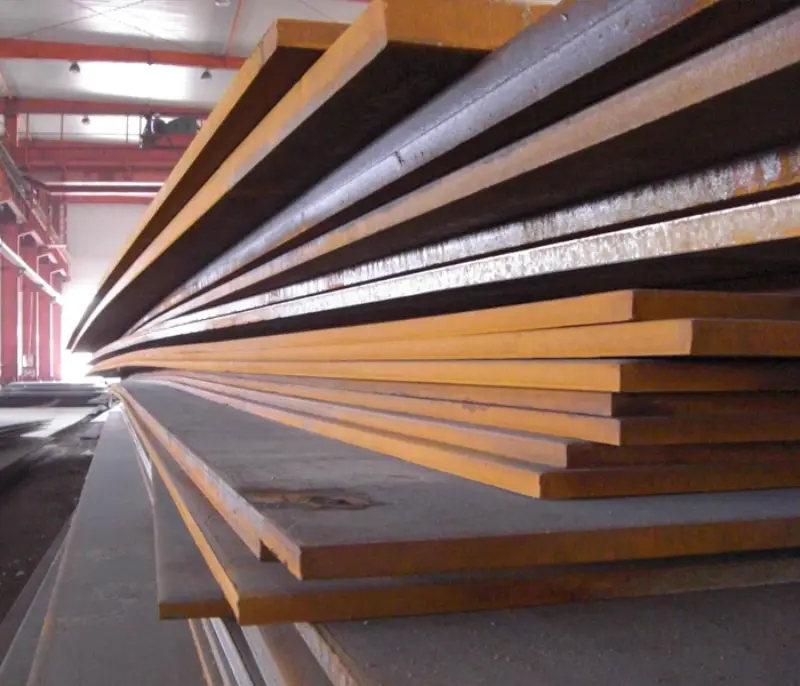
GL Grade F550 Shipbuilding Steel Plate
GL Grade F550 Shipbuilding Steel Plate - Properties, Equivalents & Applications
Detailed material data for GL Grade F550 (FH550) high strength shipbuilding steel plate according to Germanischer Lloyd rules. Covers chemical composition, mechanical and physical properties, international equivalents, and application guide.
Hot rolling, TMCP, normalizing, quenching and tempering
- Phone : +8618037372205
- Email : [email protected]
- WhatsApp: Contact via Whtsapp
- WeChat: +8618037372205
GL Grade F550 Shipbuilding Steel Plate Introduction
GL Grade F550 (designated FH550) is a high strength structural steel plate certified by Germanischer Lloyd (now DNV GL) for marine and offshore applications. It belongs to the yield strength 550 MPa class with guaranteed impact toughness at -60°C (F-grade). The steel is produced via advanced thermo-mechanical controlled processing (TMCP) or quenching and tempering (Q&T) to achieve a fine-grained microstructure with excellent strength–toughness balance.
- Minimum yield strength of 550 MPa for thicknesses up to 100 mm
- Excellent weldability with low carbon equivalent
- Good low-temperature toughness for Arctic and harsh environment service
- Meets strict requirements of IACS UR W31 and GL Rules Part 2
GL Grade F550 Shipbuilding Steel Plate Chemical Composition
Ladle analysis according to GL Rules and IACS UR W31 for FH550 grade. Microalloying elements (Nb, V, Ti) are added for grain refinement and precipitation strengthening. Ni is often enriched to improve low-temperature toughness.
- Carbon equivalent (CEV) is controlled for weldability; typically CEV ≤ 0.50–0.55%
- Total aluminum (Al) is required for fine grain practice
| Element | Standard Requirement (%) | Remarks |
|---|---|---|
| C (Carbon) | ≤ 0.18 | Ladle analysis |
| Si (Silicon) | ≤ 0.50 | Killed steel |
| Mn (Manganese) | 0.90 – 1.60 | |
| P (Phosphorus) | ≤ 0.025 | |
| S (Sulfur) | ≤ 0.025 | |
| Al (Aluminium) | ≥ 0.020 (total) | Fine grain practice |
| N (Nitrogen) | ≤ 0.012 | May be limited when Nb added |
| Nb (Niobium) | ≤ 0.05 | Grain refiner |
| V (Vanadium) | ≤ 0.10 | Precipitation strengthening |
| Ti (Titanium) | ≤ 0.02 | Grain refiner |
| Cu (Copper) | ≤ 0.35 | |
| Cr (Chromium) | ≤ 0.20 | |
| Ni (Nickel) | ≤ 0.40 | Higher values may be used for F-grade toughness |
| Mo (Molybdenum) | ≤ 0.08 |
GL Grade F550 Shipbuilding Steel Plate Thermal and Electrical Physical Properties
Representative physical properties for quenched and tempered or TMCP high strength steel with similar composition to GL F550. Actual values may vary depending on heat treatment and temperature. These data are for reference only and should be verified for specific design conditions.
- Density is practically constant for all structural steel grades
- Thermal conductivity decreases with increasing alloy content
- Resistivity is typical for low-alloy steel
| Property | Typical Value | Unit | Temperature / Condition |
|---|---|---|---|
| Density (ρ) | 7850 | kg/m³ | 20°C |
| Elastic modulus (E) | 205 | GPa | 20°C |
| Shear modulus (G) | 80 | GPa | 20°C |
| Poisson's ratio (ν) | 0.3 | - | Room temperature |
| Thermal expansion coefficient (α) | 11.7 | 10⁻⁶ /K | 20–100°C |
| Thermal expansion coefficient (α) | 12.5 | 10⁻⁶ /K | 20–200°C |
| Thermal expansion coefficient (α) | 13.2 | 10⁻⁶ /K | 20–400°C |
| Thermal conductivity (λ) | 42 | W/(m·K) | 20°C |
| Thermal conductivity (λ) | 38 | W/(m·K) | 200°C |
| Specific heat capacity | 480 | J/(kg·K) | 20–100°C |
| Specific heat capacity | 520 | J/(kg·K) | 20–400°C |
| Electrical resistivity (ρ_e) | 0.22 | µΩ·m | 20°C |
GL Grade F550 Shipbuilding Steel Plate Mechanical Properties
Tensile and impact test requirements for GL F550 (FH550) plates as per GL Rules. Transverse tensile specimens are used for thickness ≤ 50 mm; longitudinal specimens for thicker plates. Charpy V-notch impact test at -60°C ensures ductile behaviour at extremely low temperatures.
- Values are valid for thicknesses up to 100 mm unless otherwise specified; for greater thicknesses refer to specific approval
- Reduction of area and yield-to-tensile ratio are also controlled in practice
| Property | Standard Requirement | Unit | Test Condition |
|---|---|---|---|
| Yield strength (ReH) | ≥ 550 | MPa | Transverse, ambient, plate thickness t ≤ 100 mm |
| Tensile strength (Rm) | 670 – 830 | MPa | Transverse, ambient |
| Elongation (A) | ≥ 16 | % | Gauge length 5.65√So, transverse |
| Charpy impact energy (KV) | ≥ 50 | J | Longitudinal, -60°C, average of 3 specimens |
| Charpy impact energy (KV) | ≥ 34 | J | Transverse, -60°C, average of 3 specimens (optional) |
| Bend test (d = diameter of former) | 180° bend, d = 3a | - | a = specimen thickness, no cracks |
GL Grade F550 Shipbuilding Steel Plate Fully Equivalent Material Standards and Replaceable Grades
| Country / Region | Standard / Classification Society | Grade | Remarks |
|---|---|---|---|
| International | IACS UR W31 | FH550 | Unified requirement for highest toughness grade |
| Norway / Germany | DNV GL | FH550 | Same specification, formerly separate societies |
| USA | ABS (American Bureau of Shipping) | FH550 | Identical yield and toughness class |
| UK | LR (Lloyd's Register) | FH550 | Equivalent grade for marine structures |
| France | BV (Bureau Veritas) | FH550 | Equivalent grade |
| China | CCS (China Classification Society) | FH550 | Equivalent grade |
| Japan | NK (ClassNK) | KH550 | Equivalent grade (K = low-temp F-class) |
| Italy | RINA | FH550 | Equivalent grade |
| Korea | KR (Korean Register) | FH550 | Equivalent grade |
GL Grade F550 Shipbuilding Steel Plate Application Introduction
GL F550 (FH550) steel is employed in weight-critical welded structures exposed to low service temperatures and demanding fatigue loading. Due to its high strength and excellent toughness, it permits thinner sections and reduces fabrication costs. Key aspects:
- Preheating and interpass temperature control are essential for welding; typically preheat to 100–150°C depending on thickness
- Post-weld heat treatment is usually not required but may be applied for stress relief
- Compatible welding consumables: low-hydrogen electrodes with matching strength (e.g., AWS E11018M) or slightly undermatching
- Good formability suitable for cold bending with large radii; hot forming may degrade mechanical properties if not followed by re-heat treatment
Product Applications: Fracture-critical hull shell plates for ice-strengthened vessels, Deck and bottom panels requiring high tensile strength and good weldability, Longitudinal stiffeners, girders and transverse frames, Offshore platform legs and bracing members exposed to low temperature, Lifting beams and heavy-duty structural components in mining equipment
Processed into products: Hull plate sections for bow and stern regions subject to slamming loads, Shear strakes and bilge keels, Bulkhead plates of watertight compartments, Offshore module support beams, Welded tubular joints in jacket structures
Application industries: Shipbuilding (container ships, bulk carriers, tankers, ice-class vessels), Offshore oil and gas platforms, Naval vessels and military shipbuilding, Offshore wind turbine foundations (transition pieces), Heavy civil engineering (bridge girders in Arctic regions)
GL Grade F550 Shipbuilding Steel Plate Similar or Nearby Alternative Material Recommendations
| Country / Region | Standard | Grade | Remarks |
|---|---|---|---|
| International | GL Rules | EH550 | Same yield strength, impact at -40°C (less stringent low-temperature toughness) |
| International | GL Rules | DH550 | Same yield strength, impact at -20°C |
| International | GL Rules | AH550 | Same yield strength, impact at 0°C |
| International | GL Rules | FH500 | Slightly lower yield (500 MPa), same F-class toughness |
| International | GL Rules | FH620 | Higher yield strength (620 MPa), same low-temperature toughness |
| International | EN 10025-6 | S550Q / S550QL / S550QL1 | Quenched and tempered structural steel with 550 MPa yield, impact down to -60°C (optional) |
| International | API 2W | Grade 60 | Steel for offshore structures with similar strength and toughness levels |
Notes:
- For thicknesses above 50 mm, mechanical properties may be slightly reduced and require special agreement with the class society.
- Ultrasonic testing per EN 10160 (or equivalent) is typically required for plates used in highly stressed regions.
- Through-thickness properties (Z-direction) according to EN 10164 can be ordered as optional supplement for improved lamellar tearing resistance.
- Detailed welding procedures and hardness limits are part of the approval process and should follow GL guidelines and recommendations of the steel manufacturer.
- Share



