
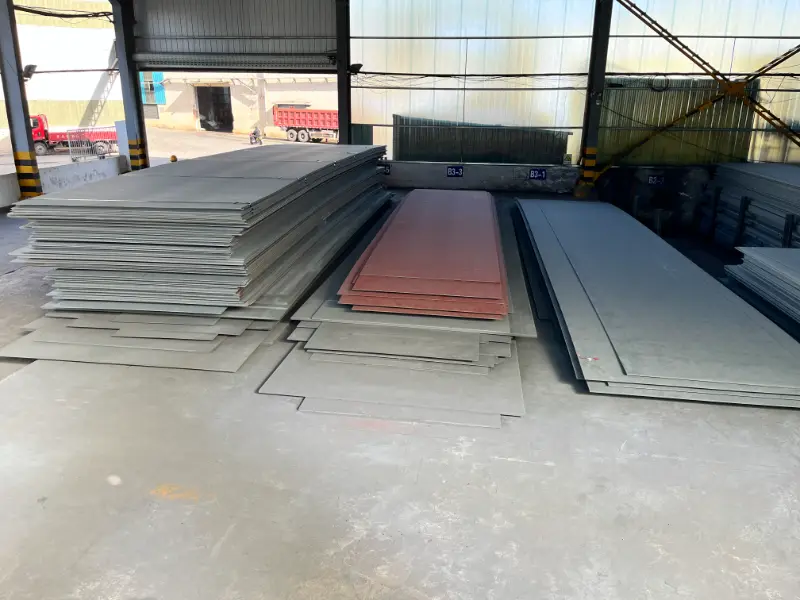
RINA Grade A32 Shipbuilding Steel
RINA Grade A32 Shipbuilding Steel: Comprehensive Properties & Global Equivalents
In-depth analysis of RINA Grade A32 shipbuilding steel plate covering chemical composition, mechanical and physical properties, international equivalents, and primary applications in ship structures.
Hot Rolling, Normalizing, Controlled Rolling (TMCP), Cutting, Bending, Welding
- Phone : +8618037372205
- Email : [email protected]
- WhatsApp: Contact via Whtsapp
- WeChat: +8618037372205
RINA Grade A32 Shipbuilding Steel Introduction
RINA Grade A32 is a normalized, high-strength structural steel plate specifically designed for shipbuilding and offshore constructions, certified by the Registro Italiano Navale. It complies with the RINA Rules for the Classification of Ships, delivering a minimum yield strength of 315 MPa. This grade provides an excellent balance of robustness, superior weldability, and enhanced toughness at low temperatures, making it indispensable for critical hull members, decks, and girders where weight reduction and structural integrity are paramount.
RINA Grade A32 Shipbuilding Steel Chemical Composition
The chemical composition of RINA A32 steel is precisely controlled to optimize strength and weldability. Elements like Carbon (C), Manganese (Mn), and Silicon (Si) define the base strength, while Aluminum (Al) is used for fine grain structure and deoxidation. Micro-alloying elements such as Niobium (Nb), Vanadium (V), and Titanium (Ti) may be added individually or in combination to refine grain size and enhance precipitation strengthening. Phosphorus (P) and Sulfur (S) are strictly limited as residual elements to ensure high toughness and resistance to lamellar tearing.
| Element | Standard Value (%) | Remarks |
|---|---|---|
| Carbon (C) | max 0.18 | Heat Analysis |
| Manganese (Mn) | 0.90 - 1.60 | Heat Analysis |
| Silicon (Si) | 0.10 - 0.50 | Heat Analysis |
| Phosphorus (P) | max 0.030 | Heat Analysis |
| Sulfur (S) | max 0.030 | Heat Analysis |
| Aluminum (Al) (acid soluble) | min 0.015 | Total Al or acid soluble Al; min 0.015% for fine grain practice |
| Niobium (Nb) | max 0.05 | Residual / Micro-alloying element |
| Vanadium (V) | max 0.10 | Residual / Micro-alloying element |
| Titanium (Ti) | max 0.02 | Residual / Micro-alloying element |
| Copper (Cu) | max 0.35 | Residual element |
| Chromium (Cr) | max 0.20 | Residual element |
| Nickel (Ni) | max 0.40 | Residual element |
| Molybdenum (Mo) | max 0.08 | Residual element |
| Nitrogen (N) | max 0.012 | Residual element; may be bound with Nb, V, Ti |
| Sum Nb + V + Ti | max 0.12 | If added in combination |
RINA Grade A32 Shipbuilding Steel Thermal, Physical & Electrical Properties
These physical properties are fundamental for engineering calculations and material behavior prediction in shipbuilding. Density (ρ) is a constant for structural steels. Elastic Modulus (E) and Shear Modulus (G) are critical for stiffness and structural deflection calculations. Thermal Expansion (α) guides the selection of fitting allowances and compensation for thermal stresses during welding. Thermal Conductivity (λ) influences heat transfer and cooling rates in structures, whereas Specific Heat Capacity (Cp) is key for heat input calculations during welding and fire safety design. Values are standard for low-carbon-manganese steels at room temperature unless specified.
| Property | Typical Value | Unit | Test Condition |
|---|---|---|---|
| Density (ρ) | 7.85 | kg/dm³ | at 20 °C |
| Elastic Modulus (E) | 210 | GPa | at 20 °C |
| Shear Modulus (G) | 81 | GPa | at 20 °C |
| Poisson's Ratio (ν) | 0.3 | - | at 20 °C |
| Thermal Expansion Coefficient (α) | 11.7 | 10⁻⁶/K | between 20 °C and 100 °C |
| Thermal Expansion Coefficient (α) | 12.1 | 10⁻⁶/K | between 20 °C and 200 °C |
| Thermal Expansion Coefficient (α) | 12.8 | 10⁻⁶/K | between 20 °C and 300 °C |
| Thermal Conductivity (λ) | 48 - 52 | W/(m·K) | at 20 °C |
| Thermal Conductivity (λ) | 46 | W/(m·K) | at 200 °C |
| Specific Heat Capacity (Cp) | 460 - 480 | J/(kg·K) | at 20 °C |
| Electrical Resistivity (ρ_e) | 0.20 - 0.25 | µΩ·m | at 20 °C |
RINA Grade A32 Shipbuilding Steel Mechanical Properties
The mechanical properties of RINA Grade A32 steel are verified via tensile and impact testing at specific temperatures. The key characteristics include Yield Strength (ReH) indicating resistance to permanent deformation, Tensile Strength (Rm) representing ultimate load capacity, and Elongation (A), a measure of ductility. Furthermore, Charpy V-notch Impact Energy (KV) at -20°C is crucial for fracture toughness in marine environments. Variations are given for different plate thickness ranges to account for microstructural changes during cooling from hot rolling.
| Property | Required Value | Unit | Test Condition / Thickness (t) |
|---|---|---|---|
| Yield Strength (ReH) | min 315 | MPa | t ≤ 50 mm |
| Yield Strength (ReH) | min 315 | MPa | 50 < t ≤ 70 mm |
| Yield Strength (ReH) | min 315 | MPa | 70 < t ≤ 100 mm |
| Tensile Strength (Rm) | 440 - 590 | MPa | t ≤ 100 mm |
| Total Elongation (A5) | min 22 | % | Longitudinal, gauge length 5.65√S₀ |
| Total Elongation (A5) | min 20 | % | Transverse, gauge length 5.65√S₀ |
| Charpy V-notch Impact Energy (KV) | min 31/22 (avg/indiv.) | J | Longitudinal, test temp. -20 °C, t ≤ 50 mm |
| Charpy V-notch Impact Energy (KV) | min 24/17 (avg/indiv.) | J | Transverse, test temp. -20 °C, t ≤ 50 mm |
| Charpy V-notch Impact Energy (KV) | min 27/20 (avg/indiv.) | J | Longitudinal, test temp. -20 °C, 50 < t ≤ 70 mm |
| Charpy V-notch Impact Energy (KV) | min 20/14 (avg/indiv.) | J | Transverse, test temp. -20 °C, 50 < t ≤ 70 mm |
| Charpy V-notch Impact Energy (KV) | min 24/17 (avg/indiv.) | J | Longitudinal, test temp. -20 °C, 70 < t ≤ 100 mm |
| Charpy V-notch Impact Energy (KV) | min 17/12 (avg/indiv.) | J | Transverse, test temp. -20 °C, 70 < t ≤ 100 mm |
RINA Grade A32 Shipbuilding Steel Globally Interchangeable & Fully Equivalent Material Grades
| Country/Region | Standard | Grade | Remarks |
|---|---|---|---|
| International | IACS | A32 | Unified Requirement W11 for Normal or TMCP rolled high strength steel. |
| USA | ABS | AH32 | American Bureau of Shipping Grade AH32. |
| France | BV | AH32 | Bureau Veritas Grade AH32. |
| China | CCS | A32 | China Classification Society Grade A32. |
| Norway/Germany | DNV | A32 | Det Norske Veritas Grade A32 (historically NV A32). |
| Germany | GL | GL-A32 | Germanischer Lloyd Grade A32 (now part of DNV). |
| South Korea | KR | AH32 | Korean Register Grade AH32. |
| UK | LR | AH32 | Lloyd's Register Grade AH32. |
| Japan | NK | AH32 | Nippon Kaiji Kyokai (ClassNK) Grade AH32. |
| Italy | RINA | A32 | Registro Italiano Navale, the base material. |
RINA Grade A32 Shipbuilding Steel Application Introduction
RINA Grade A32 steel is engineered for high-demand marine environments. Its high strength-to-weight ratio allows for lighter structural designs, increasing vessel payload capacity. The stringent toughness requirements ensure safety in cold waters and under dynamic loads. Common applications span the entire ship structure and extend to offshore engineering.
Product Applications: Hull structural sections (shell plates, bilge strakes), Deck plates and stringers, Transverse and longitudinal bulkheads, Superstructure components, Cargo hold girders and frames, Pile foundations for piers and quay walls
Processed into products: Ship side shell plates and bottom plates, Main deck, strength deck, and poop deck plates, Watertight bulkhead panels, Web frames and stiffeners, Hatch coamings and corner brackets, Engine foundation plates and girders, Offshore lift-rig legs and bracing members
Application industries: Commercial Shipbuilding (e.g., container ships, bulk carriers, tankers), Naval Defense / Warship Construction, Offshore Engineering (e.g., jackets, topside modules for oil & gas platforms), Marine Engineering (e.g., caissons, lock gates), Bridge Construction (specific applications requiring marine-grade steel)
RINA Grade A32 Shipbuilding Steel Similar or Analogous Steel Grades for Structural Replacement
| Country/Region | Standard | Grade | Analysis / Remarks |
|---|---|---|---|
| Europe | EN 10025-3 | S315N (1.0531) | Closest non-marine equivalent. Normalized structural steel with min ReH 315 MPa. Similar chemistry and weldability, but lacks mandatory marine low-temperature impact testing by classification societies. |
| China | GB/T 1591 | Q345D | High strength low alloy structural steel. Min yield 345 MPa, but with wider chemistry ranges. Impact tested at -20°C. A potential substitute for non-classified structures, requiring careful welding procedure qualification. |
| USA | ASTM A572 | Grade 50 / Type 1 | HSLA steel with a 345 MPa minimum yield. Needs normalization to approximate toughness. Not directly equivalent due to less strict P and S limits and optional fine grain practice; suitable for non-marine structural applications. |
| Japan | JIS G 3106 | SM490A | Welding structural steel with 325 MPa min yield. General use steel, not normalized by default and with broader chemistry. Similar strength level, but impact properties at 0°C only in A-grade, requiring special agreement for -20°C testing. |
Notes:
Certification and Testing: All RINA A32 plates must be stamped with the RINA mark, the grade, and heat number. Testing includes mandatory tensile and Charpy V-notch impact tests at -20 °C, all witnessed by the classification society surveyor. Welding: Pre-heating is generally not required for thicknesses below 30 mm, although post-weld heat treatment (PWHT) may be necessary for thicker or highly restrained joints to relieve residual stresses. Consumables matching the base metal strength (e.g., AWS E7018 or equivalent low-hydrogen electrodes) are recommended. Dimensional Tolerances: Delivery conditions typically follow IACS tolerances, but may be superseded by the specific project's own specifications.
- Share



