
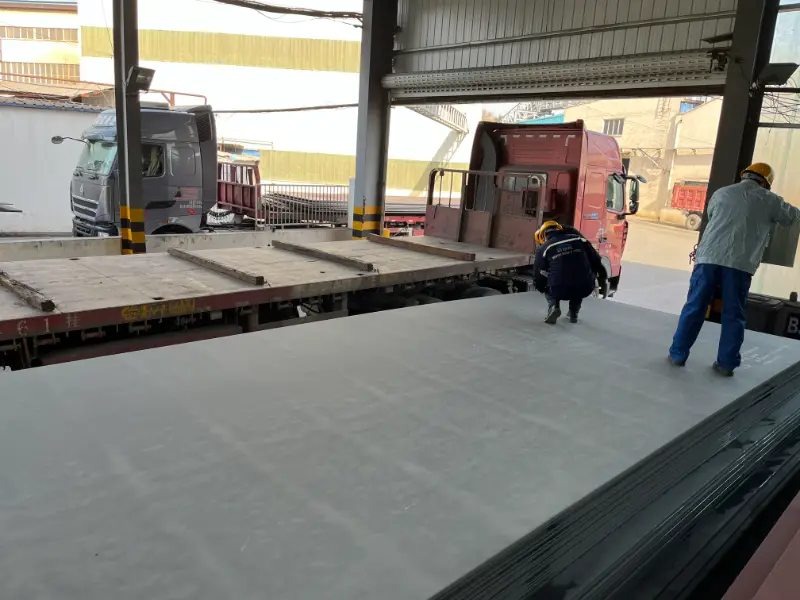
RINA Grade D32 Shipbuilding Steel Plate
RINA Grade D32 Shipbuilding Steel Plate - High Strength Hull Structural Steel
Comprehensive material data for RINA Grade D32 shipbuilding steel plate: chemical composition, mechanical properties, thermal & electrical properties, equivalent grades, similar alternatives, and application guidance for ship and offshore structures.
Welding, cutting, cold forming, bending, machining, normalized rolling (N), thermo-mechanical controlled processing (TMCP)
- Phone : +8618037372205
- Email : [email protected]
- WhatsApp: Contact via Whtsapp
- WeChat: +8618037372205
RINA Grade D32 Shipbuilding Steel Plate Introduction
RINA Grade D32 is a high-strength structural steel grade for shipbuilding certified by the Italian Classification Society (Registro Italiano Navale). It belongs to the normalized or thermo-mechanically rolled fine-grain structural steels with a minimum yield strength of 315 MPa and tensile strength in the range of 440–590 MPa. The 'D' designation indicates guaranteed impact toughness at -20 °C (minimum 31 J longitudinal). D32 is widely used in critical hull members, decks, superstructures, and offshore platforms due to its excellent combination of strength, weldability, and toughness. It complies with IACS UR W11 and RINA Rules for the Classification of Ships. Typical delivery condition is normalized (N) or thermo-mechanical controlled rolled (TMCP). It is available in plates, sheets, and wide flats, suitable for cold forming, welding, and bending processes.
RINA Grade D32 Shipbuilding Steel Plate Chemical Composition
The chemical composition of RINA Grade D32 follows IACS UR W11 for high strength hull structural steel. Limits are typical for ladle analysis. Micro-alloying elements such as Niobium (Nb), Vanadium (V), Titanium (Ti) may be added singly or in combination to achieve fine grain size and strength. Aluminum (Al) is normally added as a grain refiner. Max values unless a range is specified.
| Chemical Element | Standard Value (max, unless range) | Remarks |
|---|---|---|
| Carbon (C) | 0.18% | Ladle analysis; product analysis may vary +0.02% |
| Silicon (Si) | 0.10 – 0.50% | Typical range for deoxidation |
| Manganese (Mn) | 0.90 – 1.60% | Minimum 0.90%, maximum depending on thickness |
| Phosphorus (P) | 0.035% | Maximum |
| Sulfur (S) | 0.035% | Maximum |
| Chromium (Cr) | 0.20% | Residual element, max |
| Nickel (Ni) | 0.40% | Residual element, max |
| Molybdenum (Mo) | 0.08% | Residual element, max |
| Copper (Cu) | 0.35% | Residual element, max |
| Aluminum (Al) | 0.015% min (acid soluble) | Grain refining element |
| Niobium (Nb) | 0.02 – 0.05% | Optional micro-alloy, typical |
| Vanadium (V) | 0.05 – 0.10% | Optional micro-alloy, typical |
| Titanium (Ti) | 0.02% max | Optional micro-alloy, typical |
| Nitrogen (N) | 0.009% max (if Al added) | If other grain refiners used, limit varies |
| Ceq (IIW) | 0.38% typical max | Carbon equivalent by IIW formula, for weldability |
RINA Grade D32 Shipbuilding Steel Plate Thermal and Electrical Physical Properties
Physical properties are typical for low-carbon micro-alloyed steel at room temperature unless otherwise indicated. These values may vary slightly with actual carbon content and heat treatment. All thermal properties are given for the temperature range 0–100°C unless noted.
| Property | Typical Value | Unit | Condition / Test Details |
|---|---|---|---|
| Density (ρ) | 7.85 | g/cm³ | Room temperature |
| Elastic Modulus (E) | 200 – 210 | GPa | Room temperature |
| Shear Modulus (G) | 78 – 81 | GPa | Room temperature |
| Poisson's ratio (ν) | 0.29 – 0.30 | -- | Room temperature |
| Thermal expansion coefficient (α) | 11.5 – 12.5 | 10⁻⁶/K | Range 20 – 100°C |
| Thermal expansion coefficient (α) | 12.5 – 13.5 | 10⁻⁶/K | Range 20 – 200°C |
| Thermal conductivity (λ) | 48 – 52 | W/(m·K) | At 20°C |
| Thermal conductivity (λ) | 46 – 50 | W/(m·K) | At 100°C |
| Specific heat capacity (cp) | 450 – 480 | J/(kg·K) | Room temperature |
| Electrical resistivity (ρ_e) | 0.18 – 0.25 | µΩ·m | At 20°C |
RINA Grade D32 Shipbuilding Steel Plate Mechanical Properties
Mechanical properties for RINA D32 are specified at ambient temperature and after special treatment according to RINA Rules. Tensile testing is transverse for plates, but longitudinal values are given for hull structural members when specified. Impact test temperature is -20°C (D grade). Values apply for thicknesses up to 100 mm; for thicker plates property reduction may be defined in the rules.
| Property | Standard Required Value | Unit | Test Condition |
|---|---|---|---|
| Yield Strength (ReH) | ≥ 315 | MPa | Thickness ≤ 100 mm; transverse test |
| Tensile Strength (Rm) | 440 – 590 | MPa | Thickness ≤ 100 mm; transverse test |
| Elongation after fracture (A5) | ≥ 22 | % | Gauge length 5.65√So, longitudinal |
| Elongation after fracture (A5) | ≥ 19 | % | Gauge length 5.65√So, transverse |
| Charpy V-notch impact energy (KV) | ≥ 31 (mean of 3) | J | at -20°C; longitudinal samples |
| Charpy V-notch impact energy (KV) | ≥ 22 (individual) | J | at -20°C; longitudinal samples |
| Bend test (mandrel diameter) | 3t (t = specimen thickness) | - | 180° bending, no cracks |
RINA Grade D32 Shipbuilding Steel Plate Exact Equivalent Material Standards and Substitutable Grades
| Country / Region | Standard / Classification Society | Grade | Remarks |
|---|---|---|---|
| International (IACS) | UR W11 | HT 32 (high tensile 32) | Used by all IACS members; D toughness grade |
| Norway / Germany | DNV GL | D32 | Same strength and toughness; identical to RINA D32 |
| United Kingdom | Lloyd's Register (LR) | D32 | Identical specification |
| USA | American Bureau of Shipping (ABS) | D32 | Identical specification |
| France | Bureau Veritas (BV) | D32 | Identical specification |
| China | China Classification Society (CCS) | D32 | Identical specification |
| Japan | ClassNK (NK) | KD32 | Identical specification |
| Korea | Korean Register (KR) | RD32 | Identical specification |
| Russia | Russian Maritime Register (RS) | D32 | Identical specification |
RINA Grade D32 Shipbuilding Steel Plate Application Introduction
RINA Grade D32 is a versatile high-strength hull structural steel designed to provide superior toughness at sub-zero temperatures (-20°C). Its balanced combination of strength, formability, and weldability makes it suitable for critical components in shipbuilding and offshore engineering. The steel can be processed using conventional shipyard methods such as gas cutting, submerged arc welding, and cold forming. It is particularly recommended for large structures where weight reduction without sacrificing safety is important. All products supplied under this grade must be accompanied by a RINA inspection certificate.
Product Applications: Hull plates for tankers, bulk carriers, and container ships, Decks, superstructures, and transverse bulkheads, Longitudinal stiffeners and girders, Ice-strengthened structural parts for Arctic conditions, Offshore module support structures and flare booms, Jack-up rig legs and spudcans (as base material)
Processed into products: Main deck and bottom shell plates, Side shell plates and inner bottom panels, Web frames and stringer plates, Bow and stern plating, Bracket floors and engine room structures, Hatch covers and coamings, Foundation plates for heavy machinery
Application industries: Commercial and Naval Shipbuilding, Offshore Oil & Gas Platforms and FPSOs, Marine Engineering and Port Equipment, Dredging and Heavy-Lift Vessels, Renewable Energy (Offshore Wind Tower Foundations)
RINA Grade D32 Shipbuilding Steel Plate Similar / Alternative Materials with Close Properties
| Country / Region | Standard | Grade | Remarks |
|---|---|---|---|
| EU | EN 10025-2:2019 | S355J2+N / S355J2 | Yield 355 MPa min (higher), Tensile 470–630; similar chemistry, impact at -20°C; may be used for non-marine structural applications after agreement. |
| EU | EN 10025-3 | S355N / S355NL | Normalized fine-grain steel with comparable toughness; NL version with low-temperature impact at -50°C. |
| International | ISO 4950-2 | S355A / S355D | High yield strength plates; strength closer to D32, but Charpy temperatures differ (requires verification). |
| China | GB/T 712-2011 | D32 | Chinese shipbuilding steel grade; equivalent mechanical properties, chemical composition practically identical. |
| USA | ASTM A131 / A131M | D32 (under ASTM A131) | US standard for shipbuilding steel; matches ABS D32 and thus RINA D32. |
Notes:
- Weldability: D32 has good weldability with standard shipbuilding consumables. Preheat and interpass control may be required for thick sections (>30 mm) or low ambient temperatures.
- Corrosion Resistance: As a carbon-manganese steel, D32 is not inherently corrosion-resistant. Protective coatings or cathodic protection are necessary for marine environments.
- Thickness Limits: RINA rules typically cover D32 up to 100 mm thickness; for thicker plates, mechanical properties may need to be agreed between the purchaser and the mill.
- Testing & Certification: All plates are subject to RINA surveyor inspection and stamping. Test certificates shall comply with EN 10204 Type 3.1 or 3.2 as required by the classification society.
- Marking: Each plate bears the RINA stamp, heat number, grade (D32), and manufacturer's identification.
- Share



