
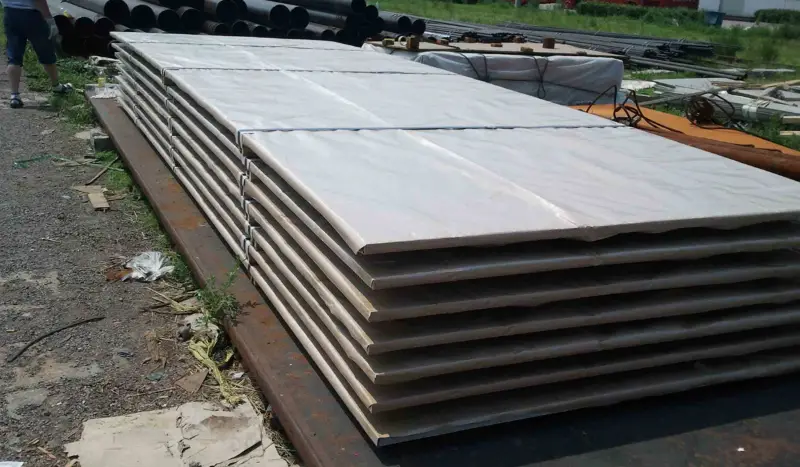
RINA Grade E32 Shipbuilding Steel Plate
RINA Grade E32 Shipbuilding Steel Plate: High-Strength, Low-Temperature Toughness for Ship Hulls and Offshore Structures
In-depth material data for RINA Grade E32 shipbuilding steel plate per RINA and IACS standards, including chemical, mechanical, thermal properties, international equivalents, and application guide.
Hot rolling, normalizing, thermomechanical rolling (TMCP), welding, flame cutting, cold forming, bending
- Phone : +8618037372205
- Email : [email protected]
- WhatsApp: Contact via Whtsapp
- WeChat: +8618037372205
RINA Grade E32 Shipbuilding Steel Plate Introduction
RINA Grade E32 is a high-strength shipbuilding steel plate certified by the Registro Italiano Navale (RINA) and conforming to IACS UR W11 requirements. It is part of the 32 kgf/mm² (315 MPa) yield strength class with notch toughness guaranteed at -40 °C, making it suitable for critical structural applications in cold environments. The steel is produced as killed and fine-grained, often supplied in normalized or thermomechanically rolled condition to ensure uniformity and consistent properties.
- Minimum yield strength of 315 MPa
- Excellent weldability and formability
- Resilient impact performance at low temperatures (≥31 J at -40 °C)
- Widely used in hull plates, decks, and major structural members of ships and offshore platforms
RINA Grade E32 Shipbuilding Steel Plate Chemical Composition
The chemical composition conforms to RINA rules and IACS UR W11 for high-strength shipbuilding steel of grade E32. Deoxidation is by aluminium and fine-grain practice is mandatory. Residual elements are controlled to ensure weldability and low-temperature toughness.
- Carbon is kept ≤0.18% to maintain good weldability
- Manganese provides strength and toughness
- Microalloying elements (Nb, V, Ti) may be added singly or in combination
| Element | Standard Value (wt%) | Remarks |
|---|---|---|
| C | ≤0.18 | Ladle analysis |
| Si | ≤0.50 | |
| Mn | 0.90–1.60 | Higher Mn up to 1.60% for increased strength |
| P | ≤0.035 | |
| S | ≤0.035 | |
| Al (acid soluble) | ≥0.015 | Fine-grain deoxidation practice |
| Nb | 0.02–0.05 | Optional; may be added alone or with V/Ti |
| V | 0.05–0.10 | Optional; may be added alone or with Nb/Ti |
| Ti | 0.007–0.05 | Optional; may be used for grain refinement |
| Cr | ≤0.25 | Residual element |
| Ni | ≤0.40 | Residual element |
| Mo | ≤0.08 | Residual element |
| Cu | ≤0.30 | Residual element |
| Cr+Ni+Mo+Cu (total) | ≤0.70 | Sum of residual elements |
| N | ≤0.009 | If free nitrogen is not bound by Al or other nitrogen-fixing elements |
RINA Grade E32 Shipbuilding Steel Plate Thermal and Electrical Physical Properties
Physical properties are typical for low-alloy structural steels and are valid at room temperature unless otherwise noted. Values are provided for engineering calculations and can vary slightly depending on exact composition and heat treatment.
- Density is standard for steel at ~7850 kg/m³
- Thermal expansion is given for 20–100 °C; for higher temperatures the coefficient increases
| Property | Typical Value | Unit | Test Condition / Remarks |
|---|---|---|---|
| Density (ρ) | 7850 | kg/m³ | At 20 °C |
| Elastic modulus (E) | 210 | GPa | At 20 °C |
| Shear modulus (G) | 80 | GPa | At 20 °C |
| Poisson's ratio (ν) | 0.3 | — | At 20 °C |
| Thermal expansion coefficient (α) | 12 | 10⁻⁶/K | 20–100 °C |
| Thermal expansion coefficient (α) | 13 | 10⁻⁶/K | 20–200 °C |
| Thermal conductivity (λ) | 50 | W/(m·K) | At 20 °C |
| Thermal conductivity (λ) | 45 | W/(m·K) | At 200 °C |
| Specific heat capacity (cp) | 460 | J/(kg·K) | At 20 °C |
| Electrical resistivity (ρe) | 0.15 | µΩ·m | At 20 °C |
RINA Grade E32 Shipbuilding Steel Plate Mechanical Properties
Mechanical properties are determined on test pieces taken from plates in the delivery condition. Yield and tensile strength depend on plate thickness; values listed cover common thickness ≤100 mm. Impact testing is performed on longitudinal V‑notch Charpy specimens at -40 °C.
- Minimum elongation based on gauge length L0=5.65√S0
- Bend test mandrel diameter: 3a (a = specimen thickness) for t ≤25 mm; larger mandrel for thicker sections
| Property | Required Value | Unit | Test Condition |
|---|---|---|---|
| Yield strength (ReH) | ≥315 | MPa | Thickness ≤100 mm |
| Tensile strength (Rm) | 440–590 | MPa | Thickness ≤100 mm |
| Elongation (A5) | ≥22 | % | Gauge length 5.65√S0; thickness range all |
| Impact energy (KV) | ≥31 (av.) / ≥22 (single) | J | Longitudinal, -40 °C; thickness ≤50 mm |
| Impact energy (KV) | ≥27 (av.) / ≥19 (single) | J | Longitudinal, -40 °C; thickness 50–70 mm |
| Impact energy (KV) | ≥24 (av.) / ≥17 (single) | J | Longitudinal, -40 °C; thickness 70–100 mm |
| Bend test | No cracks or defects | — | 180° bend; mandrel dia. 3a (t≤25 mm), 3.5a (t 25–50 mm), 4a (t>50 mm) |
RINA Grade E32 Shipbuilding Steel Plate Full Equivalent Material Standards and Substitution Grades
| Country/Region | Standard | Grade | Remarks |
|---|---|---|---|
| Italy | RINA Rules | E32 | Original designation; fully equivalent to IACS EH32 |
| International | IACS UR W11 | EH32 | International Association of Classification Societies unified requirement |
| USA | ABS Rules | EH32 | American Bureau of Shipping |
| Norway/Germany | DNV Rules | EH32 | Det Norske Veritas (now DNV GL) |
| United Kingdom | LR Rules | EH32 | Lloyd's Register |
| France | BV Rules | EH32 | Bureau Veritas |
| Japan | NK Rules | EH32 | Nippon Kaiji Kyokai (ClassNK) |
| South Korea | KR Rules | EH32 | Korean Register |
| China | CCS Rules | EH32 | China Classification Society |
| India | IRS Rules | EH32 | Indian Register of Shipping |
RINA Grade E32 Shipbuilding Steel Plate Application Introduction
RINA Grade E32 plates are primarily used in welded ship and offshore structures where high strength and guaranteed impact properties at sub-zero temperatures are required. Common applications include hull envelopes, weather decks, strength deck, bottom plating, and structural bulkheads. The material is also suitable for repair and modification of existing vessels.
Product Applications: Cargo ships (bulk carriers, container vessels), Oil tankers, LNG/LPG carriers (secondary structures), Offshore platforms (jackets, topsides), FPSO hulls, Floating docks, Heavy-lift cranes (marine)
Processed into products: Hull shell plates, Deck plates, Bottom plating, Transverse and longitudinal bulkheads, Frames and stiffeners, Webs of girders and stringers, Bracket plates, Keel plates
Application industries: Shipbuilding, Offshore engineering, Marine construction, Port and harbour equipment, Bridge building (with additional approvals)
RINA Grade E32 Shipbuilding Steel Plate Similar or Alternative Materials
| Country/Region | Standard | Grade | Remarks |
|---|---|---|---|
| Europe | EN 10025-4 | S315ML (1.8815) | Thermomechanical rolled weldable fine-grain structural steel; yield 315 MPa, impact at -50 °C; not specifically shipbuilding-approved but suitable for similar weldments |
| USA | ASTM A131/A131M | EH32 | Standard specification for structural steel for ships; directly equivalent to IACS EH32 |
| Europe | EN 10025-3 | S355NL (1.0546) | Normalized fine-grain steel with higher strength (355 MPa) and low-temperature toughness; may be considered after design review |
| Japan | JIS G 3106 | SM490B | Higher tensile strength (490 MPa class), but yield ~325 MPa; not directly a shipbuilding grade; may be used with supplementary requirements |
Notes:
Delivery condition: Plates are normally supplied in normalized (N) or thermomechanically rolled (M) condition. Chemical analysis is based on ladle sample; product analysis tolerances apply per RINA rules. Weldability is excellent with standard consumables, but low-hydrogen processes are recommended for thicknesses above 25 mm to avoid hydrogen-induced cracking. Supplementary testing such as through-thickness tensile (Z-grade) and ultrasonic examination can be specified upon order.
- Share



