
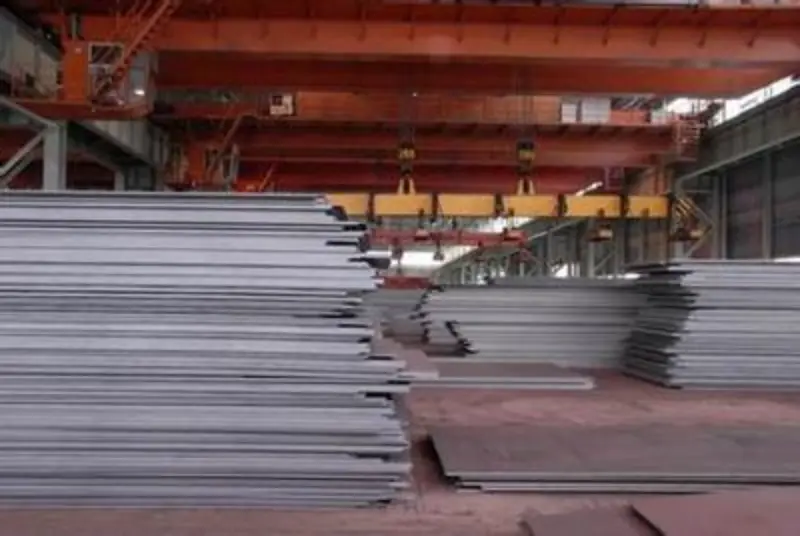
RINA Grade F32 Shipbuilding Steel Plate
RINA Grade F32 Shipbuilding Steel Plate: Properties, Equivalents & Applications
Complete material data and internationally equivalent grades for RINA Grade F32 high-strength shipbuilding steel, including chemistry, mechanical and physical properties, and recommended applications.
Normalizing (N), Thermo-Mechanical Controlled Processing (TMCP/M), or Quenching and Tempering (Q&T) as per delivery condition and thickness
- Phone : +8618037372205
- Email : [email protected]
- WhatsApp: Contact via Whtsapp
- WeChat: +8618037372205
RINA Grade F32 Shipbuilding Steel Plate Introduction
RINA Grade F32 is a high-strength, fine-grain structural steel plate governed by the rules of Registro Italiano Navale (RINA). It belongs to the F-grade category, designated for service down to -60 °C, and offers a minimum yield strength of 315 MPa. The steel is typically supplied in normalized or thermo-mechanically controlled processed (TMCP) condition, ensuring excellent toughness and weldability for demanding marine and offshore applications. Key Features:
- Excellent low-temperature impact toughness (guaranteed at -60 °C)
- High strength combined with good ductility and weldability
- Compliance with IACS UR W11 ensures consistent quality across classification societies
- Used in critical structural components of ice-going vessels and polar-class offshore structures
RINA Grade F32 Shipbuilding Steel Plate Chemical Composition
Chemical composition limits as per RINA rules for Grade F32 plates. All values are maximum unless a range is given. Grain refining elements such as Al, Nb, V, and Ti are specified to ensure fine grain practice. Carbon equivalent (CE) is controlled to guarantee good weldability.
| Element | Content (%) | Remarks |
|---|---|---|
| C | ≤ 0.16 | |
| Si | ≤ 0.50 | |
| Mn | 0.90 – 1.60 | |
| P | ≤ 0.025 | |
| S | ≤ 0.025 | |
| Al (acid soluble) | ≥ 0.015 | Minimum, for grain refinement |
| Nb | 0.02 – 0.05 | |
| V | 0.05 – 0.10 | |
| Ti | ≤ 0.02 | May be used for deoxidation |
| Cu | ≤ 0.35 | |
| Cr | ≤ 0.20 | |
| Ni | ≤ 0.40 | |
| Mo | ≤ 0.08 | |
| N | ≤ 0.009 | |
| CE (Ceq) | ≤ 0.38 | Carbon equivalent: CE = C + Mn/6 + (Cr+Mo+V)/5 + (Ni+Cu)/15 |
RINA Grade F32 Shipbuilding Steel Plate Typical Physical Properties
Physical properties for standard C-Mn high-strength steel comparable to Grade F32. These values are not directly specified in the RINA material standard but are typical for design calculations. Good thermal conductivity and moderate thermal expansion are beneficial for structural integrity under thermal cycles.
| Property | Typical Value | Unit | Test condition / Remarks |
|---|---|---|---|
| Density (ρ) | 7.85 | g/cm³ | At 20 °C |
| Modulus of elasticity (E) | 205 | GPa | At 20 °C |
| Shear modulus (G) | 80 | GPa | At 20 °C |
| Poisson's ratio (ν) | 0.3 | - | At 20 °C |
| Thermal expansion (α) | 12.0 × 10⁻⁶ | /K | 20 – 100 °C |
| Thermal conductivity (λ) | 50 | W/(m·K) | At 20 °C |
| Specific heat capacity | 460 | J/(kg·K) | At 20 – 100 °C |
| Electrical resistivity (ρₑ) | 0.20 – 0.25 | μΩ·m | At 20 °C |
RINA Grade F32 Shipbuilding Steel Plate Mechanical Properties
Tensile and Charpy V-notch impact properties for RINA Grade F32 plates (transverse direction, unless longitudinal specified). Minimum impact energy values are for longitudinal specimens; for transverse specimens the requirement is 2/3 of the longitudinal value. Properties are valid for thicknesses up to 100 mm as per IACS UR W11.
| Property | Value | Unit | Test condition / Thickness |
|---|---|---|---|
| Yield strength (ReH) | ≥ 315 | MPa | t ≤ 50 mm |
| Yield strength (ReH) | ≥ 315 | MPa | 50 < t ≤ 70 mm |
| Yield strength (ReH) | ≥ 315 | MPa | 70 < t ≤ 100 mm |
| Tensile strength (Rm) | 440 – 570 | MPa | All thicknesses up to 100 mm |
| Elongation (A) | ≥ 22 | % | t ≤ 50 mm |
| Elongation (A) | ≥ 21 | % | 50 < t ≤ 70 mm |
| Elongation (A) | ≥ 20 | % | 70 < t ≤ 100 mm |
| Charpy impact (KV, L), average | ≥ 31 | J | at -60 °C, longitudinal |
| Charpy impact (KV, L), single | ≥ 22 | J | at -60 °C, longitudinal |
| Charpy impact (KV, T), average | ≥ 21 | J | at -60 °C, transverse |
| Charpy impact (KV, T), single | ≥ 15 | J | at -60 °C, transverse |
| Bend test | No cracks | - | Bend diameter 3t (t ≤ 25 mm); 4t (t > 25 mm), 180° bending |
RINA Grade F32 Shipbuilding Steel Plate Fully Equivalent Material Standards and Substitutable Grades
| Country / Region | Standard / Classification Society | Grade | Remarks |
|---|---|---|---|
| International | IACS UR W11 | F32 | Unified requirement for F-grade, 315 MPa yield |
| USA | ABS (American Bureau of Shipping) | FH32 | Completely equivalent; F-grade, 315 MPa |
| UK | LR (Lloyd's Register) | FH32 | Equivalent F-grade high-strength steel |
| France | BV (Bureau Veritas) | FH32 | Equivalent F-grade steel for low temperature |
| China | CCS (China Classification Society) | F32 | Identical F-grade requirement |
| Norway / Germany | DNV (Det Norske Veritas) | F32 | Norsok also uses F32 |
| Japan | NK (Nippon Kaiji Kyokai / ClassNK) | F32 | Equivalent F-grade hull structural steel |
| Korea | KR (Korean Register) | FH32 | Same designation and properties |
| India | IRS (Indian Register of Shipping) | FH32 | Equivalent grade per IRS rules |
RINA Grade F32 Shipbuilding Steel Plate Application Introduction
RINA F32 steel is engineered for structural components operating in severe low-temperature environments, especially in marine and offshore constructions. Its high strength and excellent toughness at -60 °C make it the preferred material for icebreakers, polar supply vessels, and platform legs in arctic regions. Design advantages:
- Allows reduction of structural weight without compromising safety.
- Excellent weldability reduces fabrication costs and risk of cold cracking.
- Fine-grain structure ensures good resistance to brittle fracture.
- IACS certification enables global acceptance for ship classification.
Product Applications: Ice-strengthened hull plates and stiffeners, Watertight bulkheads and shell plating, Deck and bottom plates of ice-going vessels, Transition pieces and nodes for offshore wind foundations, Storage tanks for low-temperature operations
Processed into products: Ship hull structural parts (keel, frame, girder, bracket), Polar-class vessel ice belts and stem plates, Offshore platform legs and tubular chords, LNG carrier deck and containment supports, Mooring equipment foundations and deck machinery seats
Application industries: Shipbuilding (commercial, naval, ice-class), Offshore oil and gas (fixed platforms, FPSOs, jack-up rigs), Polar and heavy-duty marine engineering, Port and harbor construction (cold-climate pile driving)
RINA Grade F32 Shipbuilding Steel Plate Similar or Alternative Material Recommendations
| Country / Region | Standard | Grade | Remarks |
|---|---|---|---|
| Multiple | IACS UR W11 | EH32, DH32 | Same strength (315 MPa) but higher temperature grades: E (-40 °C) and D (-20 °C); may be used in less severe conditions. |
| Multiple | IACS UR W11 | FH36 | Higher strength (355 MPa) F-grade; suitable if higher strength is needed while retaining low-temperature capability. |
| Multiple | IACS UR W11 | FH40, FH46, FH50 | Further increased strength grades (390–480 MPa) for weight-saving designs; still F-class toughness. |
| Europe | EN 10025-4 / EN 10225 | S355NL, S460NL | Thermo-mechanical rolled steels with similar toughness at -50 °C; can be considered for offshore structures with similar design requirements. |
| USA | ASTM A131 / ASTM A945 | FH32, FH36 | ASTM marine steel grades matching F32 characteristics. |
Notes:
Plates are usually delivered with certificate 3.1 per EN 10204. Ultrasonic testing, Z-direction tensile testing, or special heat treatment may be requested as optional requirements. Welding must follow approved procedures with consideration of the carbon equivalent and preheat requirements. For thicknesses > 100 mm, mechanical properties and chemical composition should be specially agreed upon with the manufacturer.
- Share



