
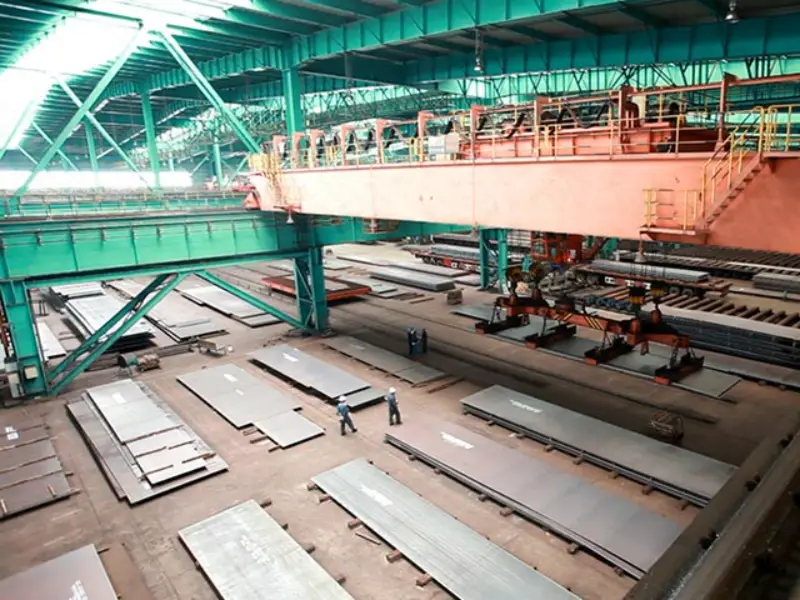
RINA Grade E Shipbuilding Steel Plate
RINA Grade E Shipbuilding Steel Plate: Chemical Composition, Mechanical & Physical Properties
Complete material data for RINA Grade E shipbuilding steel plate including chemical composition, mechanical properties, thermal and electrical physical properties, international equivalents, and application guidance.
Hot rolling, normalizing, controlled rolling, thermo-mechanical controlled processing (TMCP)
- Phone : +8618037372205
- Email : [email protected]
- WhatsApp: Contact via Whtsapp
- WeChat: +8618037372205
RINA Grade E Shipbuilding Steel Plate Introduction
RINA Grade E is a normal-strength hull structural steel plate certified by the Registro Italiano Navale (RINA). It is designed for use in shipbuilding and marine constructions requiring guaranteed toughness at sub-zero temperatures. This steel offers a minimum yield strength of 235 MPa and tensile strength between 400 and 520 MPa, with good weldability and formability. Its controlled chemistry (low carbon, fine grain practice with aluminium) ensures reliable low-temperature impact properties down to -40°C. Typical applications include shell plating, decks, bulkheads, and structural members of seagoing vessels, barges, and offshore platforms.
RINA Grade E Shipbuilding Steel Plate Chemical composition
Chemical composition limits according to RINA Rules for normal-strength hull structural steel Grade E. Fine grain practice is mandatory; elements not listed shall not be intentionally added.
- Carbon equivalent (CE) ≤ 0.40% for thickness ≤ 50 mm.
- Residual elements (Cr+Ni+Cu+Mo) ≤ 0.70%.
| Element | Standard value (max/min%) | Remarks |
|---|---|---|
| Carbon (C) | 0.18 max | heat analysis |
| Manganese (Mn) | 0.70 – 1.50 | heat analysis |
| Silicon (Si) | 0.50 max | heat analysis |
| Phosphorus (P) | 0.035 max | heat analysis |
| Sulfur (S) | 0.035 max | heat analysis |
| Aluminium (Al) | 0.015 min (acid soluble) | fine grain practice |
| Nitrogen (N) | 0.009 max | if present |
| Chromium (Cr) | 0.20 max (residual) | sum of Cr+Ni+Cu+Mo ≤ 0.70% |
| Nickel (Ni) | 0.40 max (residual) | sum of Cr+Ni+Cu+Mo ≤ 0.70% |
| Copper (Cu) | 0.35 max (residual) | sum of Cr+Ni+Cu+Mo ≤ 0.70% |
| Molybdenum (Mo) | 0.08 max (residual) | sum of Cr+Ni+Cu+Mo ≤ 0.70% |
RINA Grade E Shipbuilding Steel Plate Thermal and electrical physical properties
Typical physical properties for normal-strength structural steel at room temperature. Values may vary slightly depending on exact composition and heat treatment. These are provided as engineering references and are not mandatory requirements of RINA Rules.
| Property | Typical value | Unit | Test condition |
|---|---|---|---|
| Density (ρ) | 7.85 | g/cm³ | at 20 °C |
| Modulus of elasticity (E) | 205 | GPa | at 20 °C |
| Shear modulus (G) | 79 | GPa | at 20 °C |
| Poisson's ratio (ν) | 0.3 | — | at 20 °C |
| Thermal expansion coefficient (α) | 12.0 × 10⁻⁶ | K⁻¹ | 20 – 100 °C |
| Thermal conductivity (λ) | 50 | W/(m·K) | at 20 °C |
| Specific heat capacity (Cp) | 460 | J/(kg·K) | at 20 °C |
| Electrical resistivity (ρ_e) | 0.20 × 10⁻⁶ | Ω·m | at 20 °C |
RINA Grade E Shipbuilding Steel Plate Mechanical properties
Tensile and impact test requirements for RINA Grade E plates, sections and bars. Tests are carried out on longitudinal specimens.
- For thickness >100 mm, properties are subject to agreement.
- Bend test: 180° bending with no cracks; mandrel diameter depending on thickness.
| Property | Standard requirement | Unit | Test condition |
|---|---|---|---|
| Yield Strength (ReH) | 235 min | MPa | thickness ≤ 50 mm, longitudinal |
| Yield Strength (ReH) | 225 min | MPa | thickness >50 mm ≤ 70 mm, longitudinal |
| Yield Strength (ReH) | 215 min | MPa | thickness >70 mm ≤ 100 mm, longitudinal |
| Tensile Strength (Rm) | 400 – 520 | MPa | all thicknesses, longitudinal |
| Elongation (A) | 22 min | % | thickness ≤ 50 mm, longitudinal, gauge length 5.65√S₀ |
| Elongation (A) | 21 min | % | thickness >50 mm ≤ 70 mm, longitudinal |
| Elongation (A) | 20 min | % | thickness >70 mm ≤ 100 mm, longitudinal |
| Impact energy (KV) | 27 min | J | longitudinal, -40 °C, Charpy V-notch |
| Impact energy (KV) | 20 min | J | transverse, -40 °C, Charpy V-notch (if required) |
| Bend test | d = 2a | — | thickness ≤ 25 mm, 180° bend |
| Bend test | d = 3a | — | thickness >25 mm, 180° bend |
RINA Grade E Shipbuilding Steel Plate Full equivalent material standards and replaceable grades
| Country/Region | Standard | Grade | Remarks |
|---|---|---|---|
| International | IACS | Ordinary Strength Hull Structural Steel Grade E | Identical minimum requirements |
| United States | ABS Rules | Grade E | Full equivalent |
| France | BV Rules | Grade E | Full equivalent |
| China | CCS Rules | Grade E | Full equivalent |
| Norway/Germany | DNV Rules | Grade E | Full equivalent (consolidated DNV GL standard) |
| South Korea | KR Rules | Grade E | Full equivalent |
| United Kingdom | LR Rules | Grade E | Full equivalent |
| Japan | NK Rules | Grade E | Full equivalent |
RINA Grade E Shipbuilding Steel Plate Application Introduction
RINA Grade E steel is widely used in shipbuilding and marine engineering because of its balanced strength, good low-temperature toughness, and excellent weldability. It is typically supplied in normalized condition and conforms to classification society rules. Key application areas:
Product Applications: Ship hulls (side shells, bottom shells, bilge strakes), Decks and deckhouses, Transverse and longitudinal bulkheads, Web frames, stiffeners, girders, Hatch coamings and covers, Offshore structural modules
Processed into products: Plates cut and shaped for hull panels, Welded T-beams, angle bars, flat bars, Forged stem and stern frames, Rudder stocks and pintles (subject to approval), Brackets, gusset plates, and foundations, Pipe supports and equipment foundations
Application industries: Shipbuilding – cargo ships, tankers, passenger ferries, Offshore oil & gas – platform topsides, jackets, living quarters, Marine engineering – buoys, caissons, floating docks, Barge and pontoon construction, Naval architecture and repair
RINA Grade E Shipbuilding Steel Plate Similar alternative material recommendations
| Country/Region | Standard | Grade | Remarks |
|---|---|---|---|
| Italy (RINA) | RINA Rules | Grade D | Charpy test at -20 °C instead of -40 °C; other properties identical |
| Italy (RINA) | RINA Rules | Grade A | No impact test; for less demanding structural applications |
| Italy (RINA) | RINA Rules | AH32 | Higher yield strength (315 MPa); impact at 0 °C; for lighter structures |
| Italy (RINA) | RINA Rules | DH32 | Higher yield strength (315 MPa); impact at -20 °C |
| Italy (RINA) | RINA Rules | EH32 | Higher yield strength (315 MPa); impact at -40 °C; good toughness substitute |
| International | EN 10025-2 | S235J2+N | Structural steel with similar tensile properties; impact at -20 °C; not marine-certified by default |
Notes:
Welding: RINA Grade E has good weldability with common shipyard welding processes (SAW, FCAW, SMAW). Preheating is generally not required for thicknesses below 50 mm when using low-hydrogen consumables. Certification: Each plate must be marked with the RINA stamp, steel grade, heat number, and inspector's mark. Mill test certificates according to EN 10204 type 3.1 or 3.2 are provided. Corrosion protection: Typically delivered with shop primer (e.g., zinc silicate) to prevent atmospheric corrosion during fabrication.
- Share



