
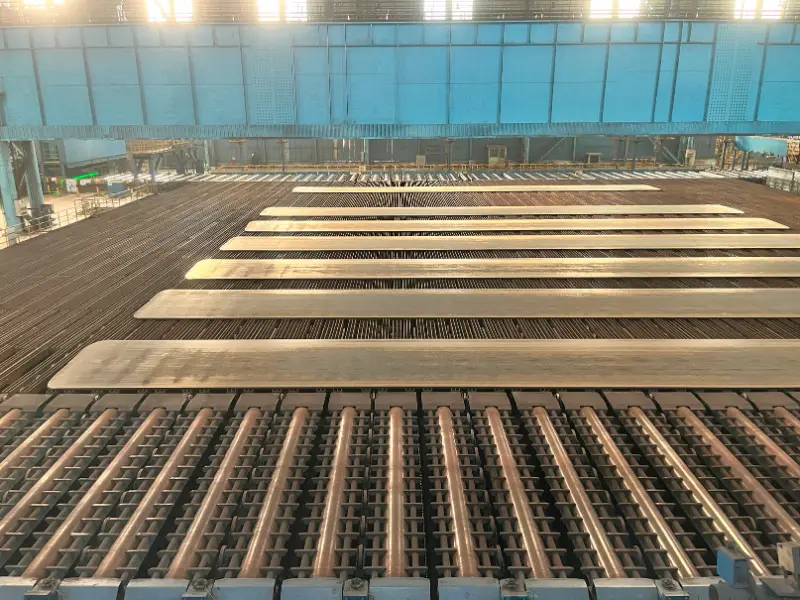
High-Strength RINA Grade A690 Shipbuilding Steel Plate
High-Strength RINA Grade A690 Shipbuilding Steel Plate: Properties & Global Equivalents
Comprehensive material data sheet for RINA Grade A690 quenched and tempered steel plate used in shipbuilding and offshore structures. Includes chemical composition, mechanical and thermal properties, international equivalents, and application guidelines.
Quenching and tempering (Q&T); hot rolled and heat treated
- Phone : +8618037372205
- Email : [email protected]
- WhatsApp: Contact via Whtsapp
- WeChat: +8618037372205
High-Strength RINA Grade A690 Shipbuilding Steel Plate Introduction
RINA Grade A690 is a high-strength quenched and tempered steel plate primarily used in shipbuilding and offshore engineering. It offers a minimum yield strength of 690 MPa in thicknesses up to 50 mm, combined with good toughness at 0 °C and excellent weldability when proper procedures are followed. The steel is manufactured to the rules of the Italian Classification Society (RINA) and is typically supplied in the normalized or quenched and tempered condition. A690 is ideal for highly loaded structural members such as crane pedestals, jack-up rig legs, and hull reinforcement where weight savings and high strength are critical. Key features:
- Minimum yield strength 690 MPa (thickness ≤50 mm)
- Charpy impact test at 0 °C (27 J min)
- Good weldability with low carbon equivalent
- Approved by RINA for marine and offshore applications
High-Strength RINA Grade A690 Shipbuilding Steel Plate Chemical Composition
The chemical composition meets the requirements of RINA for Grade A690 high strength quenched and tempered steel. Values are maximum unless a range is given. Note: Carbon equivalent (Ceq) shall not exceed 0.55% (or as agreed). Grain refining elements such as Al, Nb, V or Ti are present to ensure fine austenitic grain size.
| Element | Specified Value (max, % unless noted) | Remarks |
|---|---|---|
| Carbon (C) | 0.21 | |
| Manganese (Mn) | 1.70 | |
| Silicon (Si) | 0.10 – 0.55 | Range |
| Phosphorus (P) | 0.025 | |
| Sulfur (S) | 0.025 | |
| Chromium (Cr) | 1.50 | |
| Nickel (Ni) | 2.00 | |
| Molybdenum (Mo) | 0.70 | |
| Copper (Cu) | 0.50 | |
| Vanadium (V) | 0.10 | |
| Titanium (Ti) | 0.10 | |
| Niobium (Nb) | 0.06 | |
| Aluminium (Al total) | 0.020 min | Minimum required |
| Nitrogen (N) | 0.020 | |
| Boron (B) | 0.005 | Typically controlled |
High-Strength RINA Grade A690 Shipbuilding Steel Plate Thermal and Electrical Physical Properties
Physical properties are representative for quenched and tempered Cr-Mo-B alloy steels of this strength class. Values are measured at room temperature unless stated otherwise. These data can be used for design calculations and thermal modeling. Note: Thermal conductivity decreases with increasing temperature.
| Property | Typical Value | Unit | Remarks / Test Condition |
|---|---|---|---|
| Density (ρ) | 7850 | kg/m³ | at 20 °C |
| Modulus of elasticity (E) | 210 | GPa | at 20 °C |
| Shear modulus (G) | 81 | GPa | at 20 °C |
| Poisson's ratio (ν) | 0.30 | at 20 °C | |
| Thermal expansion coefficient (α) | 11.5 × 10⁻⁶ | K⁻¹ | 20–100 °C |
| Thermal expansion coefficient (α) | 12.3 × 10⁻⁶ | K⁻¹ | 20–200 °C |
| Thermal expansion coefficient (α) | 13.0 × 10⁻⁶ | K⁻¹ | 20–300 °C |
| Thermal conductivity (λ) | 35 | W/(m·K) | at 20 °C |
| Specific heat capacity | 470 | J/(kg·K) | at 20 °C |
| Electrical resistivity (ρ_e) | 0.25 × 10⁻⁶ | Ω·m | at 20 °C |
High-Strength RINA Grade A690 Shipbuilding Steel Plate Mechanical Properties
Mechanical properties are determined on test specimens taken in accordance with RINA rules. Tensile test is performed transversely unless otherwise agreed. Impact test temperature: 0 °C (Grade A). Values below are for plate thickness up to 50 mm; for thicker plates (50–100 mm and >100–150 mm) slightly reduced yield strength applies as per the standard. Bend test: no cracks after 180° bending with specified mandrel diameter.
| Property | Specified Value | Unit | Test Condition / Remarks |
|---|---|---|---|
| Yield strength (ReH) | 690 min | MPa | thickness ≤ 50 mm |
| Yield strength (ReH) | 670 min | MPa | thickness 50–100 mm |
| Yield strength (ReH) | 650 min | MPa | thickness 100–150 mm |
| Tensile strength (Rm) | 770 – 930 | MPa | thickness ≤ 150 mm |
| Elongation after fracture (A) | 14 min | % | Gauge length 5.65√So, transverse |
| Bend test (mandrel diameter) | 3a | 180° bend, a = plate thickness | |
| Charpy impact energy (KV2) | 27 min | J | Longitudinal, 0 °C |
| Charpy impact energy (KV2) | 20 min | J | Transverse, 0 °C (if agreed) |
High-Strength RINA Grade A690 Shipbuilding Steel Plate Completely Equivalent Material Standards and Substitutable Grades
| Country / Region | Standard / Classification Society | Equivalent Grade | Remarks |
|---|---|---|---|
| International | RINA Rules | RINA A690 | Original specification |
| USA | ASTM A514 / A517 | A514 Grade A | Similar QT steel, YS 690 MPa |
| EU | EN 10025-6 | S690Q / S690QL | Technical delivery conditions for QT steels |
| USA / ABS | ABS Rules | ABS AQ69 | ABS Grade with YS 690 MPa |
| Norway / DNV | DNV Rules | DNV NV E690 | DNV extra high strength, T=–40 °C possible |
| UK / LR | LR Rules | LR A690 | Lloyd's Register equivalent |
| France / BV | BV Rules | BV E690 | Bureau Veritas extra high strength |
| Japan / NK | NK Rules | NK K690 | Nippon Kaiji Kyokai equivalent |
High-Strength RINA Grade A690 Shipbuilding Steel Plate Application Introduction
RINA Grade A690 steel plate is designed for critical structural applications where high strength and weight reduction are essential. It is widely used in marine and offshore engineering fields. The steel must be welded using low-hydrogen procedures and preheating as per the plate thickness and carbon equivalent to avoid cold cracking. Post-weld heat treatment is generally not required for thicknesses below 50 mm, but stress relieving may be applied if mandated by the design code. Typical applications include:
Product Applications: Jack-up rig legs and rack plates, Ship crane pedestals and slewing rings, Heavy-lift crane lattice booms, High-strength structural members in FPSO modules, Armor plates for specialized vessels
Processed into products: Tooth segments for rack and pinion lifting systems, Welded I-beams and box girders for offshore cranes, Bolted and welded connections in dynamic structures, Wear plates and abrasion-resistant linings (when additional hardness is required), Base plates and swivel flanges for heavy machinery
Application industries: Shipbuilding: hull reinforcement, deck structures, hatch covers, Offshore oil & gas: jack-up rig legs, rack & pinion systems, flare booms, Heavy lifting: mobile crane booms, pedestal cranes, heavy transport equipment, Mining: dump truck bodies, excavator buckets and arms, Pressure vessels and penstocks (with supplementary certification)
High-Strength RINA Grade A690 Shipbuilding Steel Plate Similar / Near-Equivalent Substitute Materials Recommendation
| Country / Region | Standard / Classification Society | Near-Equivalent Grade | Remarks and Analysis |
|---|---|---|---|
| USA | ASTM A514 | A514 Grade B, E, F, H, Q | Different alloy optimizations; same minimum YS 690 MPa, may need requalification for marine use. |
| EU | EN 10025-6 | S690QL1 | Improved low-temperature toughness (–60 °C), otherwise similar composition and strength. |
| China | GB/T 16270 | Q690D / Q690E | High strength structural steel plates; verify charpy requirements and RINA acceptance. |
| Japan | JIS G 3128 | SHY685 / SHY685N | Yield strength 685 MPa class; close in performance, slight difference in specification. |
| Australia | AS 3597 | Grade 700 | Quenched and tempered plate with YS 700 MPa; additional testing required for marine application. |
Notes:
Welding: Use low-hydrogen consumables matching the strength level (e.g., E11018M electrode). Preheat temperature typically 100–200 °C depending on thickness and carbon equivalent. Interpass temperature should not exceed 250 °C. Forming: Hot forming above 650 °C may require re-heat treatment to restore mechanical properties. Cold forming with large deformation should be followed by stress relieving. Corrosion: Not inherently corrosion resistant; protective coatings are recommended for marine environments. Ultrasonic testing: Plates are often ordered with UT according to EN 10160 or ASTM A578 to ensure internal soundness.
- Share



