
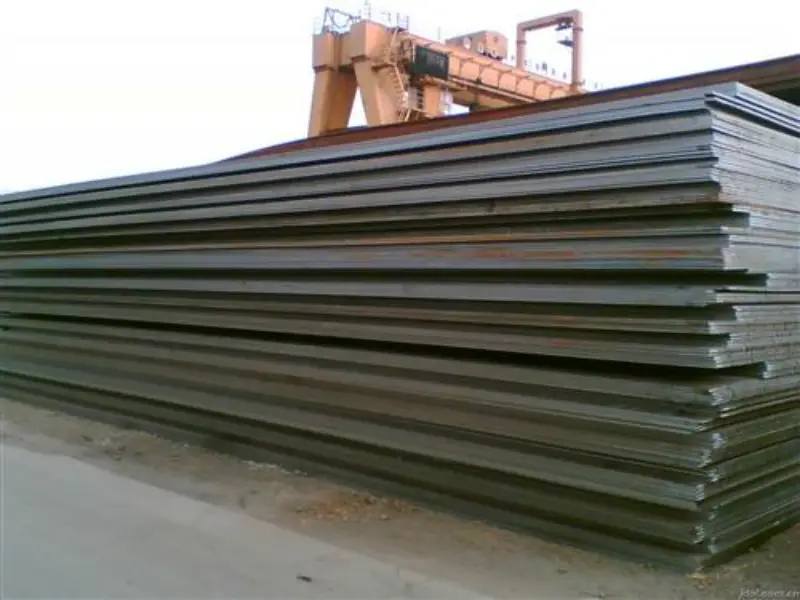
RINA Grade F620 Shipbuilding Steel Plate
RINA Grade F620 Shipbuilding Steel Plate - High Strength Quenched & Tempered 620 MPa Yield
RINA Grade F620 is a premium quenched and tempered high-strength shipbuilding steel with a minimum yield strength of 620 MPa, designed for critical offshore and marine structures requiring exceptional toughness at low temperatures.
Hot rolling, controlled rolling, quenching and tempering (Q&T), normalizing, cold forming, welding, machining
- Phone : +8618037372205
- Email : [email protected]
- WhatsApp: Contact via Whtsapp
- WeChat: +8618037372205
RINA Grade F620 Shipbuilding Steel Plate Introduction
RINA Grade F620 is a high-strength, quenched and tempered structural steel plate certified by the Italian classification society RINA (Registro Italiano Navale). It belongs to the F-grade categories with specified minimum yield strength of 620 MPa. This steel grade exhibits an excellent combination of high strength, superior weldability, and outstanding notch toughness down to –60°C, making it ideal for demanding marine and offshore applications. The fine-grained microstructure achieved through controlled rolling and heat treatment ensures reliable performance under dynamic loads and severe environmental conditions. Typical applications include hull structures, jack-up rigs, and heavy-lift crane bases.
- Nominal yield strength: 620 MPa
- Excellent low-temperature impact toughness (F-grade: –60°C)
- Quenched and tempered for optimum strength/ductility balance
- Compliant with RINA Rules Part D, Chapter 3
RINA Grade F620 Shipbuilding Steel Plate Chemical Composition
The chemical composition of RINA Grade F620 is controlled to achieve high strength and excellent low-temperature toughness. The alloy design includes micro-alloying elements such as niobium, vanadium, and titanium for grain refinement, and nickel and chromium for enhanced hardenability. The phosphorus and sulfur contents are strictly limited to ensure cleanliness and improve impact properties.
- Low carbon content (≤0.18%) ensures good weldability
- Addition of aluminum as a grain refiner and deoxidizer
- Strict impurity control (S, P) for superior impact toughness
| Element | Value (%) | Remarks |
|---|---|---|
| Carbon (C) | ≤ 0.18 | Ladle analysis |
| Silicon (Si) | ≤ 0.50 | Deoxidizer and strength contributor |
| Manganese (Mn) | ≤ 1.60 | Controls hardenability and strength |
| Phosphorus (P) | ≤ 0.020 | Kept low for toughness |
| Sulfur (S) | ≤ 0.010 | Minimized for cleanliness and impact properties |
| Chromium (Cr) | ≤ 0.90 | Hardenability and corrosion resistance |
| Nickel (Ni) | ≤ 1.50 | Enhances toughness, especially at low temperatures |
| Molybdenum (Mo) | ≤ 0.50 | Increases hardenability and high-temperature strength |
| Copper (Cu) | ≤ 0.50 | Weathering resistance; controlled to avoid hot shortness |
| Vanadium (V) | ≤ 0.10 | Micro-alloy for grain refinement and precipitation strengthening |
| Titanium (Ti) | ≤ 0.02 | Grain refiner; forms stable carbides/nitrides |
| Aluminum (Al) | ≥ 0.020 | Total aluminum; ensures fine grain structure |
| Niobium (Nb) | ≤ 0.05 | Micro-alloy for grain refinement and strengthening |
| Nitrogen (N) | ≤ 0.012 | Controlled to avoid aging and brittleness |
| Boron (B) | ≤ 0.0005 | Optional; used for enhanced hardenability in some thicknesses |
RINA Grade F620 Shipbuilding Steel Plate Physical Properties
Physical properties are representative of quenched and tempered high-strength low-alloy steel. Slight variations may occur depending on exact chemical composition and heat treatment. These values are important for design calculations involving thermal loading, electrical conductivity, and structural dynamics.
- Thermal expansion coefficient is nearly constant in the range 20–600°C
- Thermal conductivity decreases with increasing temperature
| Property | Typical Value | Unit | Condition / Remarks |
|---|---|---|---|
| Density (ρ) | 7850 | kg/m³ | At 20°C |
| Modulus of Elasticity (E) | 210 | GPa | At 20°C, static/dynamic properties |
| Shear Modulus (G) | 80 | GPa | Calculated from E and Poisson ratio |
| Poisson's Ratio (ν) | 0.3 | — | Elastic range |
| Thermal Expansion Coefficient (α) | 12.0 | 10⁻⁶ /°C | Temperature range 20–100°C |
| Thermal Expansion Coefficient (α) | 13.0 | 10⁻⁶ /°C | Temperature range 20–200°C |
| Thermal Conductivity (λ) | 46 | W/(m·°C) | At 20°C |
| Thermal Conductivity (λ) | 42 | W/(m·°C) | At 200°C |
| Specific Heat Capacity (cp) | 460 | J/(kg·°C) | At 20°C |
| Electrical Resistivity (ρe) | 0.22 | 10⁻⁶ Ω·m | At 20°C, typical for low-alloy steel |
RINA Grade F620 Shipbuilding Steel Plate Mechanical Properties
Mechanical properties are determined in accordance with RINA testing requirements. The steel must exhibit minimum yield and tensile strengths with adequate elongation and notch toughness. Impact tests are performed at –60°C for F-grade designation. Bend tests should show no cracking when bent 180° around a mandrel of diameter equal to 3 times the specimen thickness.
- Yield strength and tensile strength are generally valid for thickness ≤50 mm; for greater thicknesses slight reductions may apply (consult manufacturer)
- Charpy V-notch energy values are minimum averages for three specimens; single values must not fall below 70% of the average requirement
- Testing direction typically longitudinal (L) and transverse (T)
| Property | Requirement | Unit | Test Condition |
|---|---|---|---|
| Yield Strength (ReH) | ≥ 620 | MPa | Thickness ≤ 50 mm; tensile test transverse |
| Tensile Strength (Rm) | 720 – 890 | MPa | Thickness ≤ 50 mm; tensile test transverse |
| Elongation (A5) | ≥ 15 | % | Gauge length L0 = 5.65√S0, transverse specimen |
| Bend Test (180°) | No cracks | — | Mandrel diameter d = 3a (a = specimen thickness) |
| Charpy Impact Energy (KV) – Longitudinal | ≥ 41 | J | Temperature: –60°C; average of three specimens |
| Charpy Impact Energy (KV) – Longitudinal | ≥ 28 | J | Temperature: –60°C; individual minimum value |
| Charpy Impact Energy (KV) – Transverse | ≥ 27 | J | Temperature: –60°C; average of three specimens |
| Charpy Impact Energy (KV) – Transverse | ≥ 19 | J | Temperature: –60°C; individual minimum value |
RINA Grade F620 Shipbuilding Steel Plate Exact Equivalent Material Standards and Replaceable Grades
| Country / Region | Standard | Grade | Remarks |
|---|---|---|---|
| International (IACS) | DNV Rules | NV F620 | DNV GL direct equivalent for offshore/marine |
| International (IACS) | ABS Rules | ABS F620 | American Bureau of Shipping equivalent |
| International (IACS) | LR Rules | LR F620 | Lloyd's Register equivalent |
| International (IACS) | BV Rules | BV F620 | Bureau Veritas equivalent |
| International (IACS) | CCS Rules | CCS F620 | China Classification Society equivalent |
| International (IACS) | NK Rules | NK F620 | ClassNK equivalent |
| International (IACS) | KR Rules | KR F620 | Korean Register equivalent |
RINA Grade F620 Shipbuilding Steel Plate Application Introduction
RINA Grade F620 is specifically designed for critical structural components where high strength, low-temperature toughness, and weldability are essential. Its superior properties make it the material of choice for heavy-duty marine and offshore constructions. Fabrication requires controlled heat input during welding and possible post-weld heat treatment depending on thickness and service conditions.
- Preheating and interpass temperature control are essential to avoid hydrogen cracking
- Typically used in thicknesses up to 100 mm; consult rolling mill for larger dimensions
- Can be cut, formed, and machined using standard practices for Q&T steels
Product Applications: Hull structures for ice-class vessels and Arctic service ships, Jack-up rig spud cans and chords, Offshore platform deck plating and major support beams, Heavy-lift crane pedestals and slewing rings, Pressure vessel shells requiring moderate temperature service, Structural components for blast-resistant buildings
Processed into products: Welded T-joints and cruciform joints, Chord and brace members in tubular trusses, Flanges and webs for built-up girders, Stiffened panel fabrications, Node castings or forgings (when equivalent grade is used), Pipe fittings and flanges subjected to high internal pressure
Application industries: Shipbuilding and repair, Offshore oil & gas (platforms, FPSOs, jack-up legs), Marine engineering (docks, buoys, heavy lifting systems), Renewable energy (offshore wind turbine foundations, transition pieces), Pressure vessel and boiler fabrication (subject to code approval), Heavy machinery and transport (crane booms, mining equipment)
RINA Grade F620 Shipbuilding Steel Plate Materials with Similar Properties and Cross-Reference
| Country / Region | Standard | Grade | Analysis / Remarks |
|---|---|---|---|
| Europe | EN 10025-6 | S620Q | Quenched and tempered structural steel; minimum yield 620 MPa; similar weldability and toughness; may require additional qualification for marine use. |
| Europe | EN 10025-6 | S620QL | Low temperature variant with guaranteed impact properties down to –40°C or –50°C; close to F620 but verify –60°C requirement. |
| Europe | EN 10225 | S620Q | Weldable structural steels for fixed offshore structures; directly aligned with F620 for offshore applications. |
| USA | ASTM A514 / A517 | Grade E | Yield strength 690 MPa, higher strength; similar chemistry and processing; often used as an upgrade where higher strength is acceptable. |
| Japan | JIS G 3128 | SHY 685 | High yield strength steel for welded structures; minimum yield 685 MPa; excellent toughness; suitable alternative for heavy construction. |
Notes:
All data provided are typical values based on RINA Rules for the Classification of Ships, Part D, Chapter 3, and should be confirmed with the material certificate from the steelmaker. For exact requirements (e.g., on thickness dependency of yield strength or alternative test temperatures), the latest issue of the classification rules and the specific purchase specification apply. Welding consumables must be selected to match the strength level; low-hydrogen practices are strongly recommended. This grade may be supplied with normalizing rolling (N) or thermo-mechanical control process (TMCP) as an alternative to quenching and tempering upon agreement. Full traceability and positive material identification (PMI) are normally required in offshore projects.
- Share



