
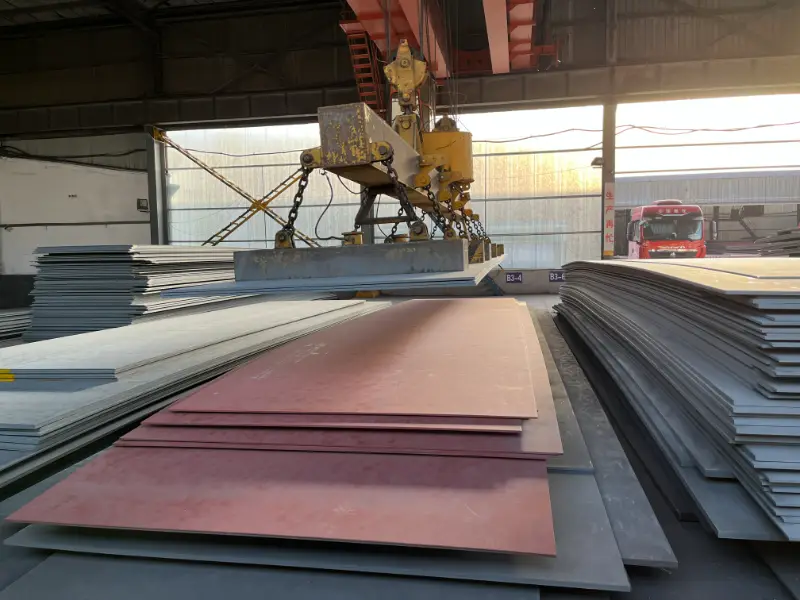
RINA Grade E620 Shipbuilding Steel Plate
RINA Grade E620 Shipbuilding Steel Plate - 620 MPa Yield, Quenched & Tempered
Comprehensive data for RINA Grade E620: chemical composition, mechanical and thermal properties, international equivalent grades, and application guidance for this high-strength quenched and tempered ship plate.
Cutting, welding (SMAW, SAW, GMAW), cold forming (minimum bend radius recommendations apply), hot forming with subsequent heat treatment
- Phone : +8618037372205
- Email : [email protected]
- WhatsApp: Contact via Whtsapp
- WeChat: +8618037372205
RINA Grade E620 Shipbuilding Steel Plate Introduction
RINA Grade E620 is a high-strength quenched and tempered shipbuilding steel with a specified minimum yield strength of 620 MPa, certified by the Italian classification society RINA. Designed for critical structural components in ships and offshore platforms, E620 offers excellent strength, toughness, and weldability in low-temperature marine environments. The steel is typically supplied in plate form, normalized or thermo-mechanically rolled before quenching and tempering. Its fine-grain microstructure and controlled chemistry (low carbon equivalent) ensure good crack arrest properties and resistance to brittle fracture, even at -40°C. Stringent limits on phosphorus and sulfur enhance surface quality and fatigue resistance.
- High yield/tensile ratio for weight-optimized structures
- Excellent notch toughness at sub-zero temperatures
- Compliant with IACS unified requirements for ship steels
This grade is widely adopted in regions following RINA rules or accepting class equivalents.
RINA Grade E620 Shipbuilding Steel Plate Chemical Composition
Chemical composition as per RINA Rules for E620 grade. Limits ensure good weldability and mechanical properties. Carbon equivalent (CEV) is controlled to avoid cold cracking. Fine-grain elements (Nb, V, Ti, Al) are added to refine the microstructure.
- Carbon: up to 0.20%
- Mn: contributes to strength and hardenability
- Ni and Cr: improve toughness and resistance to temper embrittlement
Actual values may be tighter depending on plate thickness; the table reflects maximum permissible values unless a range is given.
| Element | Standard Value (%) | Remarks |
|---|---|---|
| Carbon (C) | ≤ 0.20 | Ladle analysis |
| Silicon (Si) | ≤ 0.55 | Deoxidation and strength |
| Manganese (Mn) | ≤ 1.70 | Increases hardenability |
| Phosphorus (P) | ≤ 0.025 | Low P for ductility |
| Sulfur (S) | ≤ 0.025 | Low S for lamellar tearing resistance |
| Aluminum (Alt) | ≥ 0.015 | Minimum total Al for grain refinement |
| Nitrogen (N) | ≤ 0.012 | Control of precipitate size |
| Niobium (Nb) | ≤ 0.05 | Microalloying element |
| Vanadium (V) | ≤ 0.10 | Precipitation hardening |
| Titanium (Ti) | ≤ 0.05 | Grain refinement and toughness |
| Chromium (Cr) | ≤ 0.80 | Optional alloying for thick plates |
| Nickel (Ni) | ≤ 2.00 | Improves low-temperature toughness |
| Molybdenum (Mo) | ≤ 0.50 | Enhances hardenability in thick sections |
| Copper (Cu) | ≤ 0.50 | Atmospheric corrosion resistance, limited to avoid hot shortness |
| Boron (B) | ≤ 0.004 | Used in some heats to boost hardenability |
| Carbon Equivalent (CEV) | ≤ 0.52 (typically) | Based on product thickness; formula: C+Mn/6+(Cr+Mo+V)/5+(Ni+Cu)/15 |
RINA Grade E620 Shipbuilding Steel Plate Thermal and Electrical Physical Properties
Physical properties are typical for quenched and tempered low-carbon alloy steel. These values are applicable for preliminary design and finite element analysis. Actual properties may vary slightly with chemical composition and heat treatment.
- Density: ~7850 kg/m³
- Thermal expansion: linear coefficient ~12 × 10⁻⁶ /K up to 100°C
- Thermal conductivity decreases with increasing temperature
Electrical resistivity is given for direct current applications.
| Property | Typical Value | Unit | Test Condition / Remarks |
|---|---|---|---|
| Density (ρ) | 7850 | kg/m³ | Room temperature |
| Elastic modulus (E) | 210 | GPa | Tension, ambient temperature |
| Shear modulus (G) | ~80 | GPa | Calculated from E and ν |
| Poisson's ratio (ν) | 0.3 | – | Typical for steel |
| Coefficient of thermal expansion (α) | 12.0 × 10⁻⁶ | K⁻¹ | 20–100 °C range |
| Thermal conductivity (λ) | 45 | W/(m·K) | At 20 °C |
| Specific heat capacity (cp) | 460 | J/(kg·K) | Ambient to moderate temperature |
| Electrical resistivity (ρe) | 0.20 × 10⁻⁶ | Ω·m | At 20 °C, typical for carbon steel |
RINA Grade E620 Shipbuilding Steel Plate Mechanical Properties
Mechanical properties are verified on transverse test pieces unless otherwise specified. Minimum requirements apply for plate thicknesses up to 100 mm; for thicker plates, values may be slightly reduced per RINA rules. Impact tests at -40°C ensure suitability for polar and harsh environments.
- Yield and tensile specimens taken from base material
- Charpy V-notch impact test: minimum average value 50 J, single value 35 J
- Bend test: 180° over former diameter 3t (t = plate thickness), no cracks allowed
| Property | Standard Requirement Value | Unit | Test Condition |
|---|---|---|---|
| Yield strength (ReH) | ≥ 620 | MPa | Ambient temperature, transverse |
| Tensile strength (Rm) | 720 – 890 | MPa | Ambient temperature, transverse |
| Elongation (A5) | ≥ 14 | % | Gauge length 5.65√So |
| Charpy V-notch impact (KV) | ≥ 50 (average) / ≥ 35 (single) | J | Transverse, -40 °C |
| Bend test (180°) | No cracks or defects | – | Former diameter = 3 × plate thickness (t) |
RINA Grade E620 Shipbuilding Steel Plate Full Equivalent Grades – Identical Yield Strength and Impact Class
| Country / Region | Standard | Grade Designation | Remarks |
|---|---|---|---|
| Italy | RINA Rules | E620 | Original classification; -40°C impact |
| USA / International | ABS Rules | EQ70 | ABS equivalent; 620 MPa minimum yield, -40°C |
| Norway / Germany | DNV Rules | E690 | DNV equivalent; identical strength and impact class |
| UK | Lloyd's Register Rules | EH620 | LR designation; also classed as EH620 |
| France | Bureau Veritas Rules | E620 | BV adopts same grade name |
| China | CCS Rules | E620 | China Classification Society equivalent |
| Japan | ClassNK Rules | KE620 | Nippon Kaiji Kyokai equivalent |
| Korea | KR Rules | RE620 | Korean Register equivalent |
RINA Grade E620 Shipbuilding Steel Plate Application Introduction
RINA Grade E620 steel is engineered for demanding marine and offshore applications where high specific strength and excellent low-temperature toughness are critical. Ideal for weight-sensitive, dynamically loaded structures.
- Suitable for fatigue-critical joints when correctly designed and welded.
- Can be processed by all common cutting and welding methods; preheating may be required for thick sections (consult manufacturer's recommendations).
- Corrosion protection is typically achieved via coating systems, as the steel has limited atmospheric corrosion resistance.
When substituting an equivalent grade, ensure the certification scope matches the required class society and product thickness range.
Product Applications: Hull plates and stiffeners for large container ships, bulk carriers, and LNG carriers, Deck and bottom plates for offshore drilling units, Reinforced panels for blast walls, Leg sections of self-elevating platforms (jack-up legs), Girder webs and flanges in crane structures
Processed into products: Longitudinal and transverse hull frames, Main and weather deck plates, Hatch coamings and bulwark plating, Load-bearing brackets and stiffeners, Shear plates and cruciform joints in high-stress zones, Lifting lugs and pad-eyes (when approved by design), Transition pieces in topside-to-jacket connections
Application industries: Shipbuilding and ship repair (merchant vessels, naval ships, icebreakers), Offshore oil and gas (jack-up rigs, floating production units, platform decks), Renewable energy (offshore wind turbine foundations, substation topsides), Heavy lifting and transport (crane booms, heavy-lift vessel frames), Mining and earthmoving equipment (machinery cabins, booms)
RINA Grade E620 Shipbuilding Steel Plate Similar/Neighboring Grades – Close Performance Alternatives
| Country / Region | Standard | Grade Designation | Remarks |
|---|---|---|---|
| Multiple | EN 10025-6 | S620Q / S620QL / S620QL1 | Structural quenched & tempered steel, min 620 MPa yield (t≤50 mm), different toughness classes (QL: -40°C, QL1: -60°C) |
| Multiple | ASTM A514/A514M | ASTM A514 Grade B/H/F/Q | Quenched & tempered alloy steel plates with yield 690 MPa; similar applications, but higher strength and CEV may require careful welding |
| Italy | RINA | E690 | Higher strength variant (≥690 MPa); same toughness at -40°C; suitable where weight savings justify increased cost |
| Italy | RINA | E550 | Lower yield strength (≥550 MPa); often used where higher ductility or forming is needed |
| Norway/Germany | DNV | E690 | DNV grade with 690 MPa yield; direct substitute if design allows slight over-strength |
| UK | LR | EH690 | EH690 directly replaces E620 when approved by classification; check welding procedures |
Notes:
Welding considerations: Consumables should match or slightly overmatch the base metal strength (e.g., AWS E11018-M or equivalent). Preheating to 100–150°C is recommended for plates thicker than 30 mm. Post-weld heat treatment is generally not needed unless specified by the construction code. Forming: Hot forming should be followed by re-heat treatment to restore properties. Certification: Each plate is stamped with the RINA mark, steel grade, heat number, and thickness. Third-party inspection is mandatory for class-approved structures. For further details, refer to the latest edition of the RINA Rules for Materials and Welding.
- Share



