
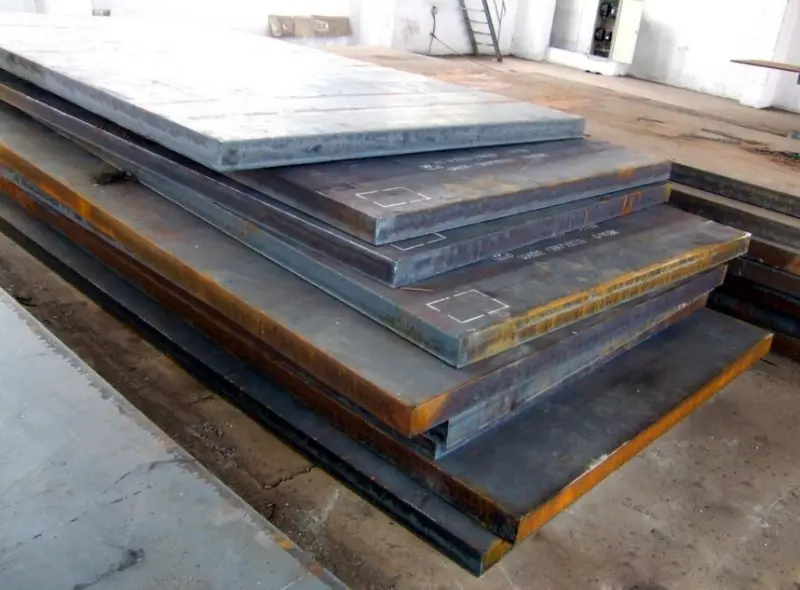
RINA Grade D620 Shipbuilding Steel Plate
RINA Grade D620 Shipbuilding Steel Plate: High-Strength Quenched & Tempered Steel for Marine Structures
In-depth material data for RINA Grade D620 marine steel plate: chemical composition, mechanical properties at various thicknesses, thermal and electrical physical properties, full international equivalents, and application guidance for shipbuilding and offshore engineering.
Hot rolling, thermomechanical rolling, quenching and tempering, normalizing; suitable for cold forming, hot forming, welding, cutting, and machining.
- Phone : +8618037372205
- Email : [email protected]
- WhatsApp: Contact via Whtsapp
- WeChat: +8618037372205
RINA Grade D620 Shipbuilding Steel Plate Introduction
RINA Grade D620 is a high-strength, quenched and tempered shipbuilding steel plate certified by the Italian Classification Society (Registro Italiano Navale). It belongs to the D-series of extra-high-strength structural steels with a specified minimum yield strength of 620 MPa at thicknesses up to 50 mm. Key features:
- Excellent combination of strength, toughness, and weldability due to refined grain and low carbon equivalent.
- Designed for critical marine and offshore applications requiring weight reduction and high load-bearing capacity.
- Charpy V-notch impact test at -20 °C (D-grade) ensures reliable brittle fracture resistance in cold environments.
- Supplied in thermomechanical rolled, normalized, or quenched & tempered condition depending on thickness and requirements.
This steel is widely used in hull structures, deck plating, heavy lift crane booms, and offshore platform constructions.
RINA Grade D620 Shipbuilding Steel Plate Chemical Composition
The chemical composition conforms to RINA Rules Part D, Chapter 3, Table 7 for grade D620. Values are maximum unless a range is indicated. The steel is microalloyed with Nb, V, Ti for grain refinement and precipitation strengthening. Carbon equivalent (CEV) is controlled typically ≤0.52-0.54% to ensure good weldability.
| Element | Specified Value (max, %) | Remarks |
|---|---|---|
| Carbon (C) | 0.20 | Ladle analysis |
| Silicon (Si) | 0.10 – 0.55 | Range allowed |
| Manganese (Mn) | 1.70 | For product thickness ≤ 150 mm |
| Phosphorus (P) | 0.025 | |
| Sulfur (S) | 0.015 | Low S for improved toughness |
| Chromium (Cr) | 1.50 | |
| Nickel (Ni) | 2.00 | |
| Molybdenum (Mo) | 0.70 | |
| Copper (Cu) | 0.50 | |
| Niobium (Nb) | 0.06 | May be part of Nb+V+Ti sum |
| Vanadium (V) | 0.12 | May be part of Nb+V+Ti sum |
| Titanium (Ti) | 0.05 | May be part of Nb+V+Ti sum |
| Aluminium (Al) total | 0.015 min | Usually 0.020-0.060; fine grain practice |
| Nitrogen (N) | 0.015 | Usually bound by Al or other elements |
| Boron (B) | 0.005 | Optional; used to increase hardenability |
RINA Grade D620 Shipbuilding Steel Plate Thermal and Electrical Physical Properties
The physical properties are representative for low-alloy quenched and tempered steels with similar chemical composition. Actual values vary slightly with exact tempering conditions and temperature. These data are not part of the mandatory specification but are commonly used in design calculations.
| Property | Typical Value | Unit | Test Condition / Remarks |
|---|---|---|---|
| Density (ρ) | ~ 7850 | kg/m³ | At 20 °C |
| Modulus of Elasticity (E) | 205 – 210 | GPa | At 20 °C; decreases with temperature |
| Shear Modulus (G) | ~ 80 | GPa | Calculated from E and Poisson ratio |
| Poisson's Ratio (ν) | ~ 0.3 | In elastic range | |
| Thermal Expansion Coefficient (α) | 12.0 × 10⁻⁶ | K⁻¹ | Between 20 °C and 100 °C |
| Thermal Expansion Coefficient (α) | 13.5 × 10⁻⁶ | K⁻¹ | Between 20 °C and 200 °C |
| Thermal Expansion Coefficient (α) | 14.0 × 10⁻⁶ | K⁻¹ | Between 20 °C and 300 °C |
| Thermal Conductivity (λ) | 40 – 45 | W/(m·K) | At 20 °C, typical for QT steel |
| Specific Heat Capacity (cp) | 460 – 480 | J/(kg·K) | At 20 °C |
| Electrical Resistivity (ρe) | 0.22 – 0.28 × 10⁻⁶ | Ω·m | At 20 °C, medium alloy content |
RINA Grade D620 Shipbuilding Steel Plate Mechanical Properties
Mechanical properties are determined on transverse test pieces in accordance with RINA Rules. Tensile and impact tests are performed after final heat treatment. Yield strength decreases with increasing thickness, as shown. Charpy V-notch impact energy is specified at -20 °C (D grade) with a minimum average of 27 J per full-size specimen; individual minimum 70% of average is allowed. Bending tests require 180° bend without cracking.
| Property | Specified Value | Unit | Test Condition / Thickness Range |
|---|---|---|---|
| Yield Strength (ReH) | 620 min | MPa | t ≤ 50 mm |
| Yield Strength (ReH) | 590 min | MPa | 50 < t ≤ 100 mm |
| Yield Strength (ReH) | 560 min | MPa | 100 < t ≤ 150 mm |
| Tensile Strength (Rm) | 720 – 890 | MPa | All thicknesses |
| Elongation after fracture (A5) | 15 min | % | t ≤ 50 mm, gauge length L0 = 5.65√S0 |
| Elongation after fracture (A5) | 14 min | % | 50 < t ≤ 100 mm |
| Elongation after fracture (A5) | 14 min | % | 100 < t ≤ 150 mm |
| Charpy Impact Energy (KV2) | 27 min (average) | J | -20 °C, transverse, full-size 10x10 mm |
| Bend Test (180°) | d = 3a | d = bend mandrel diameter, a = specimen thickness; no cracks |
RINA Grade D620 Shipbuilding Steel Plate Completely Equivalent Material Standards & Replaceable Grades
| Country / Region | Standard / Specification | Grade | Remarks |
|---|---|---|---|
| Europe | EN 10025-6 | S620Q (1.8914) | Quenched and tempered; CEV max 0.54; similar tensile and Charpy at -20°C (for QL1) or -20°C QL2 (on agreement). Additional RINA certification available. |
| International (IACS) | UR W11 / W28 | AH/DH/EH/FH 620 | Unified Requirements for High Strength Quenched & Tempered Steels for Marine Use. All major classification societies recognize this scheme. |
| USA | ASTM A514/A514M | Grade Q (or similar) | Minimum YS 690 MPa (100 ksi), but some grades with adjusted tempering may match 620 MPa. Not identical; additional testing required for RINA equivalence. |
| Germany | DIN EN 10025-6 | S620Q | Identical to EN standard, often delivered with RINA dual certification. |
| France | NF EN 10025-6 | S620Q | French national adoption of EN standard. |
| UK | BS EN 10025-6 | S620Q | British standard adoption; commonly available with RINA stamp. |
| Japan | JIS G 3128 | SHY 685 (similar strength) | High yield strength steel for welded structures; YS min 685 MPa. Requires careful comparison of chemical and impact requirements. |
RINA Grade D620 Shipbuilding Steel Plate Application Introduction
RINA Grade D620 is intended for heavily loaded, safety-critical welded structures exposed to dynamic loads and low ambient temperatures. Key application considerations:
- Excellent base material for weight-optimized designs due to its high strength-to-weight ratio.
- Requires strict adherence to welding consumables and preheat/interpass temperature controls (typical preheat ~100-150°C depending on thickness).
- Suitable for cold bending with minimum bending radius typically ≥ 3t (t = plate thickness) to avoid strain-age embrittlement.
- Post-weld heat treatment (PWHT) must be carefully simulated as it may reduce mechanical properties.
Product Applications: Hull shell plates, stringer plates, and sheer strakes, Deck plates and hatch coamings, Legs of jack-up rigs, spudcans, and rack chords, Crane booms and heavy-duty jibs, Offshore module support frames and nodes, Penstocks and spiral casings in hydropower plants, Military and ice-class vessel reinforcement
Processed into products: Welded box girders and built-up I-beams, Heavy flanges and stiffeners, Brackets and connection plates in truss structures, Tubular joints (K, T, Y nodes) for offshore jackets, Cut-outs and reinforcement pads, Piles and pile sleeves for offshore foundations, Gear rings and slewing rims for heavy rotating equipment
Application industries: Shipbuilding and marine construction, Offshore oil & gas platforms (jackets, deck modules), Heavy lifting equipment and crane manufacturing, Bridge engineering (especially long-span steel bridges), Wind energy (tower sections, transition pieces, foundations), Pressure vessel and boiler fabrication, Mining and earthmoving machinery
RINA Grade D620 Shipbuilding Steel Plate Similar / Substitute Materials with Comparable Performance
| Country / Region | Standard / Specification | Grade | Remarks |
|---|---|---|---|
| Europe | EN 10025-6 | S690Q | Higher YS min 690 MPa. Often used as an upgrade when strength-to-weight ratio is critical. Requires reassessment of forming and welding procedures. |
| USA | ASTM A514/A514M | Grade H, Grade F | YS min 690 MPa. Similar QT condition; good toughness. May be considered with thickness limitations and Charpy requirements adjustment. |
| Germany | DIN EN 10210-1 / 10219-1 | S620QH / S620QLH | Hollow sections of same strength grade; applicable for structural tubes instead of plates. |
| China | GB/T 16270 | Q620D | High strength structural steel with YS 620 MPa; D indicates -20°C impact. Very close in performance; often used in domestic offshore projects. |
| Italy | RINA | E620 | Same strength but E-grade impact at -40°C; better low-temperature toughness. |
| International | ISO 4950-2 | S620QL | International standard for high yield strength flat products; similar composition and properties. |
Notes:
- All data based on RINA Rules for the Classification of Ships, Edition 2023 (Part D, Chapter 3), and verified against EN 10025-6:2019. Users must request the latest revision of the rules for the exact project.
- For thicknesses above 150 mm, mechanical properties and chemical composition may need additional agreement between the manufacturer and RINA.
- Ultrasonic testing according to EN 10160 Class S1 or higher is commonly required for safety-critical applications.
- The steel is sensitive to cooling rate during welding; avoid excessive heat input (typically max 3.0 kJ/mm) to prevent coarse grain HAZ.
- This grade is not intended for continuous service temperatures above 400°C due to temper embrittlement risk.
- Share



