
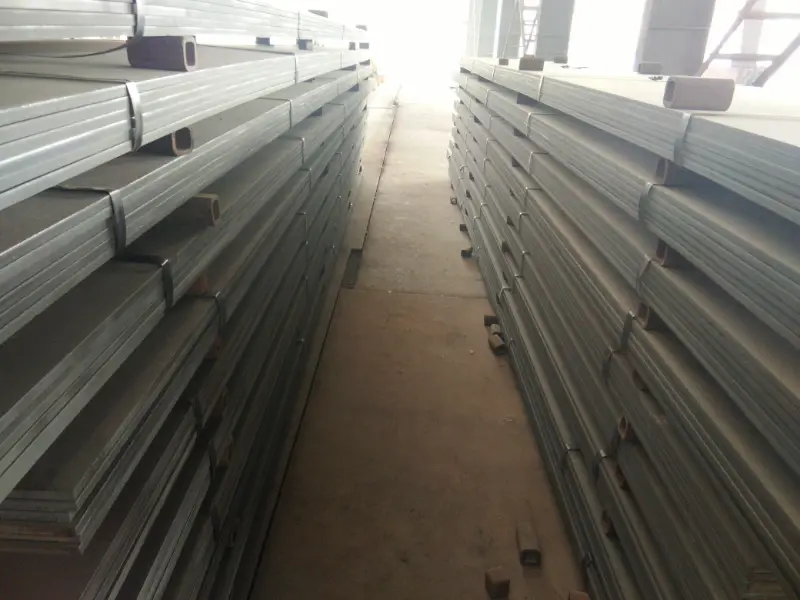
RINA Grade A620 Shipbuilding Steel Plate
RINA Grade A620 Shipbuilding Steel Plate - High Strength Quenched & Tempered Offshore Steel
Comprehensive material data for RINA Grade A620 shipbuilding steel plate: chemical composition, mechanical & thermal properties, international equivalents, and application guide.
Quenched & Tempered (Q+T); Weldable, Machinable, Gas Cuttable
- Phone : +8618037372205
- Email : [email protected]
- WhatsApp: Contact via Whtsapp
- WeChat: +8618037372205
RINA Grade A620 Shipbuilding Steel Plate Introduction
RINA Grade A620 is a high-strength quenched and tempered steel plate primarily used in shipbuilding and offshore structures. It is certified by the Italian Classification Society (RINA) and offers a minimum yield strength of 620 MPa. The steel exhibits excellent toughness, good weldability, and resistance to brittle fracture at low temperatures, making it suitable for critical structural components in demanding marine environments. The material is supplied in quenched and tempered condition with precise control over chemical composition to ensure consistent mechanical properties. Typical applications include heavy-lift crane pedestals, jack-up rig legs, and other high-stress members where weight reduction without compromising strength is essential.
RINA Grade A620 Shipbuilding Steel Plate Chemical Composition
The chemical composition is controlled to achieve a balance between high strength and good weldability. Microalloying elements such as niobium, vanadium, and titanium are used for grain refinement and precipitation strengthening. Maximum limits are according to RINA Rules for A620, typical values are shown when not mandated.
| Element | Specified Value (max %) | Remarks |
|---|---|---|
| Carbon (C) | 0.20 | Maximum |
| Silicon (Si) | 0.10 - 0.55 | Range |
| Manganese (Mn) | 0.90 - 1.60 | Range |
| Phosphorus (P) | 0.025 | Maximum |
| Sulfur (S) | 0.025 | Maximum |
| Chromium (Cr) | 0.80 | Typical max. – not explicitly limited |
| Nickel (Ni) | 1.00 | Typical max. – may be higher by agreement |
| Molybdenum (Mo) | 0.50 | Typical max. – added for hardenability |
| Copper (Cu) | 0.50 | Typical max. |
| Nitrogen (N) | 0.015 | Maximum |
| Aluminium (Al, total) | 0.020 min | Fine grain practice |
| Niobium (Nb) | 0.06 | Typical max. |
| Vanadium (V) | 0.10 | Typical max. |
| Titanium (Ti) | 0.05 | Typical max. |
| Boron (B) | 0.005 | May be present for hardenability |
RINA Grade A620 Shipbuilding Steel Plate Thermal and Electrical Physical Properties
These physical properties are typical for quenched and tempered high-strength steel plates at room temperature unless otherwise stated. They are not compulsory certification items but are useful for design and heat transfer calculations. Values may vary slightly depending on exact chemical composition and heat treatment.
| Property | Typical Value | Unit | Test Condition |
|---|---|---|---|
| Density (ρ) | 7850 | kg/m³ | 20°C |
| Modulus of Elasticity (E) | 205 | GPa | 20°C |
| Shear Modulus (G) | 80 | GPa | 20°C |
| Poisson's Ratio (ν) | 0.3 | - | 20°C |
| Thermal Expansion Coefficient (α) | 12.5 | 10⁻⁶/K | 20 - 100°C |
| Thermal Expansion Coefficient (α) | 13.0 | 10⁻⁶/K | 20 - 200°C |
| Thermal Conductivity (λ) | 42 | W/(m·K) | 20°C |
| Thermal Conductivity (λ) | 40 | W/(m·K) | 100°C |
| Specific Heat Capacity (c) | 460 | J/(kg·K) | 20 - 100°C |
| Electrical Resistivity (ρ_e) | 0.25 | µΩ·m | 20°C |
RINA Grade A620 Shipbuilding Steel Plate Mechanical Properties
Mechanical properties are determined in accordance with RINA testing procedures. Values depend on plate thickness; the range covers typical thicknesses up to 50 mm. Impact test temperature is generally -20°C or as agreed (-40°C or -60°C optional). Tensile tests are performed on transverse specimens.
| Property | Required Value | Unit | Test Condition / Remarks |
|---|---|---|---|
| Yield Strength (ReH) | ≥620 | MPa | Thickness ≤50 mm |
| Yield Strength (ReH) | ≥580 | MPa | Thickness >50 mm ≤80 mm |
| Tensile Strength (Rm) | 720 - 890 | MPa | All thicknesses |
| Elongation (A5) | ≥14 | % | Gauge length 5.65√So |
| Elongation (A50) | ≥12 | % | Gauge length 50 mm |
| Charpy Impact Energy (KV) | ≥27 @ -20°C (longitudinal) | J | Standard test temperature; higher grades available |
| Charpy Impact Energy (KV) | ≥27 @ -40°C | J | Optional specification |
| Bend Test (D = mandrel diameter, a = thickness) | 180° bend, D=4a | - | No cracks allowed |
RINA Grade A620 Shipbuilding Steel Plate Fully Equivalent Material Standards and Replaceable Grades
| Country / Region | Standard | Grade | Remarks |
|---|---|---|---|
| Italy / International | RINA Rules | A620 | Original certification |
| Europe | EN 10025-6 | S690Q/QL | Identical strength class; chemistry and delivery condition match when ordered as shipbuilding quality |
| USA | ASTM A514/A517 | Grade E or Q (modified) | Comparable strength; additional toughness and S-content requirements must be agreed |
| Norway / International | DNV GL Rules | S620 | Recognised equivalent in DNV classification |
| UK / International | Lloyd's Register Rules | R620 | Direct equivalent in LR certified ships |
| USA / International | ABS Rules | A620 | ABS grade for identical application |
| France / International | Bureau Veritas Rules | A620 | BV equivalent |
| South Korea / International | Korean Register Rules | R620 | KR equivalent |
RINA Grade A620 Shipbuilding Steel Plate Application Introduction
RINA A620 is designed for heavy‑duty marine and offshore structural applications where high strength‑to‑weight ratio and excellent weldability are essential. It is typically delivered in quenched and tempered condition, and fabrication should follow established welding procedures with low‑hydrogen processes. Preheating and interpass temperature control are critical to avoid hydrogen cracking. The steel can be cold formed with limitations due to high strength; hot forming must not exceed the tempering temperature. Shot blasting and protective coating are recommended for long‑term corrosion resistance. Key applications:
- Leg structures of self‑elevating jack‑up platforms
- Extra‑heavy crane pedestals and booms on floating cranes
- Hull inserts and stress concentration regions in high‑speed vessels
- Pressure hulls for deep‑diving submersibles
- Structural nodes and heavy‑lift attachment points
Product Applications: Jack‑up rig legs and spudcans, Floating crane vessels and derrick barges, Arctic‑class ship hulls and icebreakers, Offshore platform topsides and jackets, Subsea lifting and deployment frames
Processed into products: Flange plates in built‑up girders, Bracket and stiffener plates, Welded tubular joints (nodes), Load‑bearing shoes and pads, Ring frames in cylindrical structures, Foundation plates for heavy machinery
Application industries: Shipbuilding and Ship Repair, Offshore Oil & Gas Platforms, Heavy Marine Lifting Equipment, Naval Architecture and Defence, Renewable Energy Offshore Structures (e.g. wind turbine foundations)
RINA Grade A620 Shipbuilding Steel Plate Similar Alternative Materials
| Country / Region | Standard | Grade | Remarks |
|---|---|---|---|
| Europe | EN 10025-6 | S690QL1 | Higher low‑temperature toughness; –40°C guaranteed; suitable as advanced alternative to A620 when toughness is critical |
| USA | ASTM A514 | Grade F or H | Lower S content required for structural welding; comparable strength but different alloy design |
| Japan | JIS G 3128 | SHY 685 | High yield strength steel for welded structures; used in heavy machinery; not always ship‑certified |
| China | GB/T 16270 | Q690E | Quenched and tempered steel; similar strength; limited ship‑class acceptance unless witnessed by RINA |
| Russia | GOST 5520 | 09G2FB or modifications | High strength shipbuilding steel; may require re‑qualification for RINA equivalence |
Notes:
Welding: Use low‑hydrogen electrodes (e.g. AWS E11018‑M) or submerged‑arc welding with matching filler metals. Preheating (typically 100–200°C depending on thickness) and post‑weld hydrogen release may be required. NDT: Ultrasonic testing per EN 10160 class S1 or equivalent is common. Third‑party inspection: RINA surveyors witness mechanical testing during certification. Handling: Due to high hardness, plates should be handled carefully to avoid edge cracks; grinding of cut edges is recommended before welding. No further heat treatment is normally applied after fabrication unless specified by design codes.
- Share



